


like the Vmax, the Diversion is a ghost from the 80s, brought back to life by Yamaha in 2009. After years of the FZ6's monopoly as the entry-level model among Yam' 4-cylinders, the XJ is making a comeback! Its aim is to be an easy-to-ride machine, with less power but more low-end torque than the FZ6, and above all, more affordable.
after Honda proved with the CBF600 that there was a market for entry-level medium-displacement enthusiasts, Yamaha decided to step into the breach with the new XJ6 series. The concept is quite similar to the Diversion of the '80s and '90s, but has been completely revised. The XJ6 and XJ6 Diversion have been designed as entry-level models. To achieve this, Yamaha had to be more restrained than with the R6 and the derivative FZ6.
the XJ6 stands out on many levels, with its "calmed" in-line 4-cylinder derived from the 600cc FZ6, its new, simple chassis and its different ergonomics. Every effort has been made to make the XJ6 as accessible as possible.
the result is clear. From the moment the ignition is switched on, the engine hums gently and the XJ6 glides obediently away from the lights of downtown Sidney. Engine specification is broadly similar to that of the CBF600: 78 hp (at 10,000 rpm) and almost 60 Nm at just 8,500 rpm. Mainly due to the nature of the small 600cc in-line engine, maximum torque is obtained at an engine speed 1,500 rpm lower than that of the FZ6. As a result, the XJ6 is easier to launch, enabling efficient, low-rev navigation in city traffic. In the first gears, the Diversion feels more powerful than the Honda. It's true that I last rode a CBF 600 a little while ago, but I remember a softer, more "pushy" feel. Incidentally, the figures confirm that the XJ6 is 8 kilos lighter.
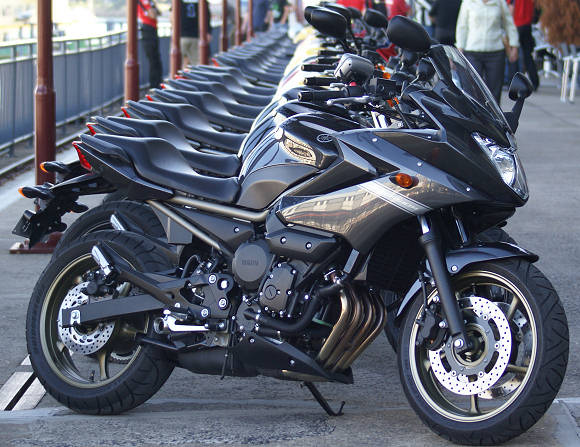
it took me about a minute to familiarize myself with the XJ6's ergonomics, and all I had to do was enjoy the view of Australia's famous city and its surroundings. Everything, from the clutch to the gearbox, responds smoothly. And there's nothing intimidating about the XJ6, apart from the headlight's aggressively dynamic design. This is essential for anyone new to motorcycling, or for experienced riders looking for a more subtle ride.
the level of finish and design is good for an entry-level motorcycle. And who knows, with the financial crisis wreaking havoc around the world, maybe one day we'll have to fall back on bikes in this segment.
I didn't have to try out the XJ6 to know that it offers very good value for money. But the test ride did let me know that the XJ6 isn't the most comfortable on long trips.
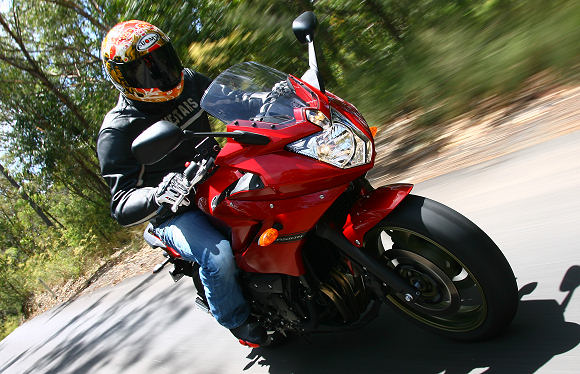
it took me a while to get out of town on some nice bush roads, before finally turning off onto the Pacific Higway and heading back to Sydney. On very hard surfaces, the suspension and the 205 kilos of the XJ6 are not ideal and wobble a little. The tubular steel frame carries the bike perfectly, but is not as light and agile as the FZ6's aluminum frame. Experienced riders won't find the precise feedback they may be looking for, but others will be very happy with the return. Why pay more if you don't need it?
The XJ6 and XJ6 Diversion have everything it takes to be sufficiently fun on open roads, but little more. In this respect, Yamaha is fully compliant with its specifications.
When it comes to tires, Yamaha has equipped its machine with a very agile "160". This rear tire makes it easy to tip the XJ6 around corners, facilitating quick maneuvers in town.
the XJ6 Diversion is distinguished from the XJ6 by its semi fairing. This well-designed fairing is an interesting option for those who want to get out of town. Or for those who mistakenly think that a motorcycle with a fairing "imposes" a little more... In reality, the major difference between the two versions is the additional wind protection and better integration of the mirrors. This improves comfort and aerodynamics on long trips, even if visibility through the mirrors is better on the naked version. Nevertheless, there are still a few high-frequency vibrations in the wrists and ankles, which become annoying after many kilometers. Nothing unbearable though.
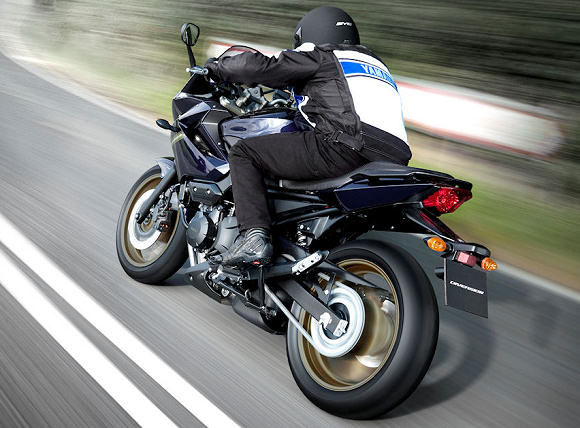
what bothered me most after a few kilometers was the insufficiently padded saddle. After too few kilometers, my lower back started to tickle, and the low seat height made me feel a bit too tall on the bike. This inconvenience makes the XJ6 a good starting point for manufacturers of "gel" saddles...
on our way back to Sydney, we joined a road in front of the famous Harbour Bridge (the widest bridge in the world) for a photo shoot. Whelling authorized and easy to do, it would have been rude not to listen to the instructions!
The XJ6 is an excellent city and commuter car that combines a tight budget with style.
the dashboard is easy to read and identical on both versions. Speed is displayed on a digital speedometer on the left, while revs are indicated by an analog tachometer on the left. The XJ6 and XJ6 diversion are available with ABS for an additional 400 euros.
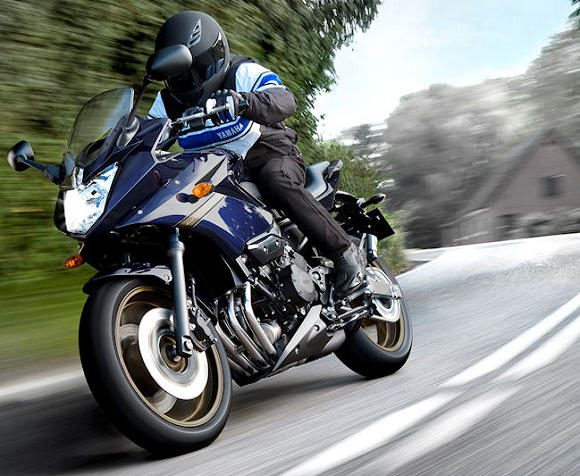
yamaha has filled a gap in its range, and in general, I think the XJ6 naked and Diversion are very good value for money. The high level of finish and "standing" it brings will stand up well to the market. If, after a year or two, you're looking for a new machine, the XJ6 is sure to make a name for itself in the aftermarket.
the Diversion is back and effectively completes the Yam' medium-displacement range.
By Tor Sagen - Tradaptation : Sebastien de Malfin
Photo credits : Dentsu Live and Manufacturer
 helmet
 Gloves
 jacket
 braking
 Chain kit
 Oils
Oils Find an intercom
 Parts
Parts Luggage
 Tires
Tires
 France
Bikers' reviews Leave a review - 16 reviews
There's the Yamaha XJ6, which is pretty, low-slung, easy to handle, a delight in town and when maneuvering on foot, and the engine can idle at over 12,000 rpm
It's great
Where it doesn't go at all well is
1) the sausage chassis: you can see the swingarm move when you accelerate a bit, and it's very annoying when you accelerate, as you get the impression that the bike wants to go sideways
2) the very unpleasant gearbox, which slams and/or refuses to shift gears at low and medium revs, as only Yamaha can do. Above 6000/7000 revs it's fine, but I'm rarely at these revs for city riding or touring
3) injection management is simple and crude, with unpleasant jerks at low revs.
4) the short range of 200/250km, due to a consumption of 5 to 6L per 100 without forcing, with a 17l fuel tank
The rest is tolerable for the price: average brakes, average forks
A good point for reliability
It's a cute little low-end roadster that pulls short and is a lot of fun to ride, without expecting more
In comparison, the 2000 600 Fazer was far superior in versatility. Rating : 4/5 Respond to Pierre71
Fitted with PR2 for the time being, it's no surprise that the center of gravity seems slightly higher and therefore a little more technical on the angle than the CB500F. We'll have to wait and see, once we've fitted the new Roadtec01.
Superb motorization, effective fairing protection, its weight isn't that disturbing. It's easy to handle and accessible from the height of my metre 69.
Pleasant to ride as a duo, both in terms of the absence of jerks and the seating position.
A versatile bike. A must for everyone. Rating : 5/5 Respond to InnaDiJam
It's got a real kick from 6500rpm upwards, it's great fun, it's got a good feel and a good geule!
A great bike for beginners!
On the downside, there's a problem with the gears at standstill, and it's hard to shift into neutral in second gear... Rating : 3/5 Respond to Toto-riina9292
thank you Rating : 3/5 Respond to louloutte
Powerful enough for me. A sound that's not too flashy. I think I'll keep it for a long time :-) Rating : 5/5 Respond to Yetie
HIGHLIGHTS: easy to handle, easy to ride, Yamaha service
THE MINUSES: for the passenger, a hellishly awkward seat and quickly painful leg position (mad not big)
very, very average protection Rating : 3/5 Respond to F5AGK
In comparison, it's the Fazer that's made for riding! Rating : 1/5 Respond to pechou
http://www.yamaha-motor.com/sport/products/modelspecs/619/0/specs.aspx :p Rating : 5/5 Respond to kodaken