

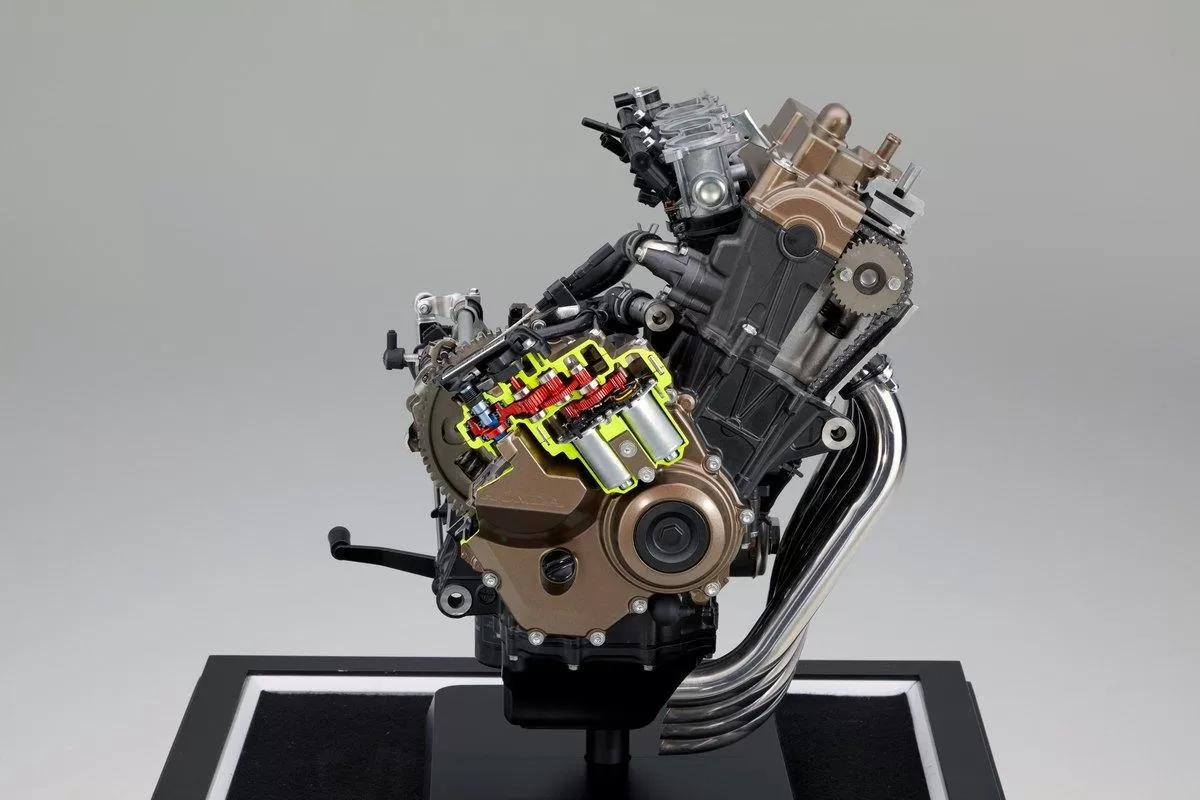
At the Milan 2023 Motor Show, Honda presented a brand-new automatic clutch system; a different evolution from the DCT gearbox or the shifter that acts as a double clutch. Theidea, which we presented to you last October
The Honda story
Before telling you more about this technology, and giving you our feelings after the test drive, let's go back in time to understand where Honda is coming from
As early as 1958, Honda brought out the super cub, with its centrifugal clutch. A few years later, in 1962, the Juno rolled off the production line: a scooter with an automatic transmission. In 1977, the Hondamatic motorcycle was equipped with a torque converter. Then, more recently, came the futuristic DN-01 with its Human Friendly transmission (HFT), and finally, the VFR 1200 F equipped with the double-clutch transmission (DCT). Honda engineers are constantly seeking to revolutionize two-wheeled motorcycles by making them easier to use and more fun to ride: the constant innovation of motorized two-wheeled transmissions
What is the E-clutch?
The E-clutch is a motor control unit (MCU) that operates the clutch for you. It doesn't just pull the lever - far from it - it takes many factors into account:
- The countershaft speed sensor
- The rotation angle sensor, which 'reads' the rate of opening of the clutch plates
- The ECU, which receives the following information
- Shift force
- Gear engaged
- Throttle position
- Engine speed
- Wheel speed
- Two mini-motors are engaged to pull the clutch lever with unfailing finesse.
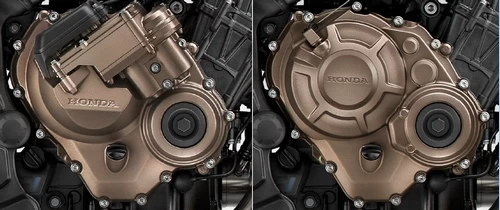
For those who don't understand, don't worry, we'll keep it simple: when you start the bike, the system automatically activates the e-clutch and the clutch, so all you have to do is remove the kickstand and engage the first gear, without touching anything with your left hand.
Junya Ono, one of the three engineers behind the e-clutchRatherthan relying on a fully automatic transmission, the rider can freely choose how to use his transmission, depending on the driving scenarios he encounters. He may prefer more comfort in some circumstances and more sportiness in others.
Does it really work?
We tested two models equipped with this technology: the CB 650 R, the mid-range roadster, and the CBR 650, the sports bike derived from the roadster
It's a very special feeling, and quite magical the first time; not touching the clutch is almost unnatural, as it's the first thing we learned when we took our driving test. With the bike on, you shift into first gear, and all you have to do is turn the throttle with the same fillet as you would have done using the clutch; the bike goes instantly. It's disturbing, but also exhilarating, the feeling that the bike is doing the work for you. Once you're underway, you don't have to change a thing, every time you shift up or down, all you have to do is push down on the gear pedal with your foot, and the bike does the rest.
When you shift up, theclutch is already half-engaged by the MCU to reduce transmission jerking, which is quite similar to a quickshifter in operation. To downshift, the MCU disengages the clutch to release the gear, and just as when upshifting, the clutch is already half-engaged.
This technology smoothes gear shifts and reduces slippage that could damage the gearbox or clutch. As always with Honda, the aim is twofold: to prolong the life of the bike, but also to make everyday life easier for you.
Is it still possible to stall?
If you let the E-clutch do its job, it's not possible to stall, as each shift is managed by the MCU. On the other hand, if you touch the clutch lever, this temporarily deactivates the E-clutch, giving you back control of the gearshift. That's when you can stall. Honda engineers have calibrated the system so that at slow speeds, if you touch the clutch lever, the e-clutch reactivates after 5s, and only 1s at higher speeds. However, if you shift back into first gear by reflexively actuating the clutch, the system cuts out, and if you immediately think of the assistance offered, release the lever, without delicately managing the clutch and acceleration, you'll find yourself in the crosshairs of a young biker on the driving-licence plate.
With the e-clutch, riding becomes no less fun: you continue to enjoy the ride, but with one less action. This may be of interest to those who do a lot of city riding, since faced with regular gear changes, you'll no longer have the sensation of tightness in your left arm. People who've fallen back on scooters in the city will be happy to get back on a real motorcycle, with the big wheels and the shifting.
It's also conceivable that people with reduced mobility in their left arm could easily move the controls to the right handlebar, and get back on the bike.
On the other hand, if you want to do wheelies, traverses when approaching a bend or anything else, you'll have to use the clutch lever and resume normal operation. As the clutch is already half engaged by the MCU, you'll find that the lever is much softer than usual.
Does this system have any shortcomings?
During our test, we found the same shortcomings as with a conventional gearbox: if you don't shift correctly, you may occasionally find yourself in a false neutral. This is where the e-clutch setting can be a lifesaver: by switching to the hard setting, you'll need to increase the force on the gear pedal, and thus reduce this little inconvenience, which also exists on any other conventional motorcycle.
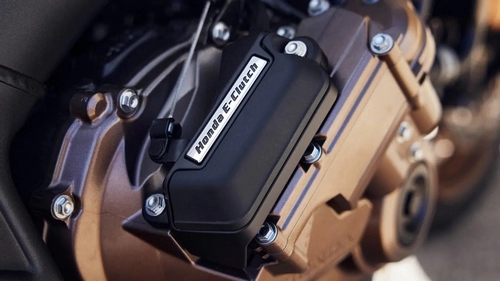
Another small remark, but not a real fault, is that when you put your foot down when stationary, you may feel the box on your right calf. Luckily, this is the electronic part that doesn't heat up.
Honda-style seduction
In conclusion, it's an amazing technology that changes the daily life of motorcyclists. It's easy to get used to, and switching back to the classic clutch can be disconcerting, but those who want to push the envelope even further will prefer Honda's DCT, where gears are shifted automatically. But as DCT is not offered on the roadsters in the range, e-clutch is the less expensive solution. The technology costs around €400, whereas DCT is over €1,000 more expensive than the basic models.
You can find out more about e-clutch on the CB 650 R and CBR 650 R at the official Honda presentation north of Marseille.
Photo credit: Honda

 Share
Share
 helmet
 Gloves
 jacket
 braking
 Chain kit
 Oils
Oils Find an intercom
 Parts
Parts Luggage
 Tires
Tires

Bikers' reviews
Frein arrière au guidon ?
Bonne explication