


9:56pm Houston, Sunday July 20, 1969.
Neil Armstrong descended the 9 steps of his LEM, placed his left foot on the lunar sand and became the first man to set foot on another celestial body after crossing space. He then uttered a phrase that has become such a cult that it's hardly worth repeating.
What's that got to do with motorcycles? NOTHING. None.... other than the megalomaniacal reflection of an emotion experienced at the handlebars of a machine with a mythical lineage on an equally mythical track.
But let's get back down to earth, because it's on two wheels that the adventure takes place.
9h00. Monday on the Paul Ricard circuit in Le Castellet.
Home to the Bol d'Or of yesterday...and today!
I leave the pits in1st gear and take to the track, with the feeling that I too am experiencing a moment of grace.
Imagine: 'There you are. On the other side of the fence! Riding on a circuit whose very name awakens memories filled with huge doses of watts, suffering, feats and monumental binges... And above all, you're riding a machine whose lineage is just as mythical as this track on which it has distinguished itself so many times. '
The 2017 GSX-R 1000. R' version please!
4 letters that revolutionized the world of sports bikes in 1985 with the launch of the 750 missile.
Since then, this brand has crossed time and space and, like any self-respecting legend, has a history, a soul. But also its hours of glory and its hours of doubt. The result is an unrivalled record of achievements: 15 Endurance World Championship titles, 15 Bol d'Or victories, 7 24 Hours of Motorcycling victories... The Gex 1000 is the undisputed queen of endurance racing.
So here I am, at the helm of the bike that's set to regain its status as the best hypersport on the market, having kicked ass for so long before losing its superb looks.
16 years after the K1 (for 2001), here comes the 6th generation GSX-R 1000, with the tough task of rekindling the flame for years to come.
Rekindle, yes. For lack of real development over the last ten years or so, Suzuki's superbike has found itself relegated to the second row in terms of pure performance; stifled by an armada of more modern, wilder and sharper rivals:
The Yamaha R1 has unleashed its exuberant crossplane engine, the ZX-10R is dominating the podiums with its incisive chassis, the BMW S1000 RR offers unfailing rigor and the Italians are outbidding each other with goldsmith's pieces. In the midst of all this, the last-generation GSX-R 1000 (dating back to a minor update in 2012!) looked very old-school, with its needle-type rev counter, 15 horsepower lag and vintage, not to say non-existent, electronics.
A choice of status quo that seemed totally assumed by Suzuki... until now!
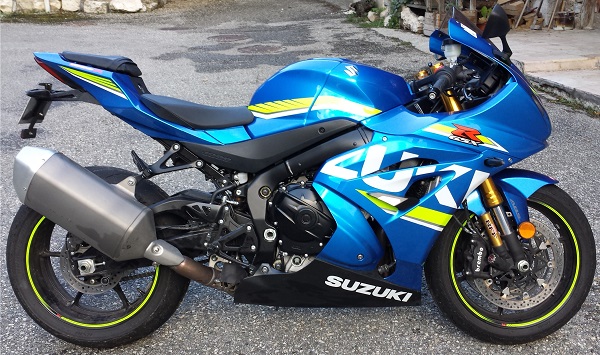
Presented at the 2015 Milan Motor Show as the " GSX-R Concept ", the L7 (L for 201-, 7 for 2017) took its time arriving at dealerships. 18 months later, the final version is almost identical to the 2015 prototype.
And in hindsight, we can say: this marketing peculiarity has largely fanned the freshness of the 2017 GSX-R 1000, which goes on sale with a design and features that have been known for almost a year and a half. But beyond this commercial originality, have no fear: this is an all-new GSXR. To illustrate this, the Japanese manufacturer has announced no fewer than 600 new parts.
And on paper, this is quickly confirmed. The Gex 1000 has changed gear and wants to hit hard. In 2017, it gains 17 horsepower and loses 3 kg (2kg on the R version). The new GSXR now boasts 202 horsepower, whereas it had been capped at 185hp since 2009. An eternity in the category!
How does it work technically? Well, the 999.8cc 4-cylinder engine has been totally redesigned. Smaller and lighter, it is above all more powerful and a little more 'supercarré'. Bore has been increased from 74.5mm to 76mm, and stroke from 57.3mm to 55.1mm. Compression ratio rises to 13.2:1 (12.9:1 before).
Torque is 12mkg, up from 11.9. No great leap forward, but that's not where the GSX-R 1000 R makes the difference. In fact, it inherits a variable valve timing system derived from the MotoGP GSX-RR (a system using 12 steel balls which, thanks to centrifugal force, act on intake timing). This ingenious system is designed to combine mid-range torque with high watts in the rev range, and the valves are now operated by lugs rather than buckets, enabling higher revs. The red zone rises from 13,500 rpm to 14,500 rpm! That's right!
If the new GSX-R 1000 mill has indeed caught up with the competition (at least on paper), its chassis has also been redesigned and the equipment updated:
Ride-by-wire replaces the good old cable throttle; 10-level traction control is finally present (phew); and ABS (non-disconnectable) is now coupled to an IMU inertial unit that manages all 6 axes. The old needle-type rev counter has been replaced by a monochrome alphanumeric display, not very cheerful but more modern and complete. We'll come back to this later. In terms of extras, the machine comes standard with Low RPM Assist, Easy Start and Launch Control.
The "R" version in this test also has an "up and down" shifter, which would certainly have deserved to be fitted on the basic version to meet the new standards of the category. But Suz is right to point out that its ground-to-ground missile is the most affordable on the market....
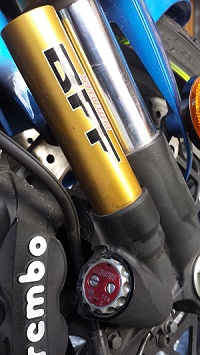
New engine, new frame, new brakes. An unprecedented cocktail for the most powerful GSX-R 1000 ever built. But it's also the most agile, the lightest, the slimmest - in short, the best, according to the Hamamatsu company! Shall we try it out? Engine, action!
Well, not just yet. Before we head for the handlebars and orbit the garrigue. A quick static point.
While the 2017 Gex 1000 is the most powerful bike ever created, it is also advertised as the most compact. And that's obvious at first glance! The very short wheelbase (1410mm), the 95mm headroom and the 23.2° rake all contribute to this feeling of smallness. The engine is 6.6mm narrower and 22.2mm shorter than before. And there's no mistaking it. During my urban peregrinations on it, at least twice I was hailed: "Is that the new 750?" or "Is that your 600 in the parking lot?" Argh... Vexing, isn't it?
After explaining that the 600 and 750 had been sacrificed on the altar of Euro 4, I had a chance to chat with his fine analysts, who seemed baffled to discover that this pocket(super)bike cubed 1 liter and sent 202 drunks. But the ultimate jibe came from my dearest and dearest, who sent me without flinching, as I proudly straddled my mount: "It looks like a toad on a matchbox." By way of background, I'm neither Dwayne Johnson nor The Mountain of Westeros. But rather the average person (1m80) who hasn't overindulged on either soup or protein.... So, as you can see, the bike is compact and narrower than before, as we'll see later.
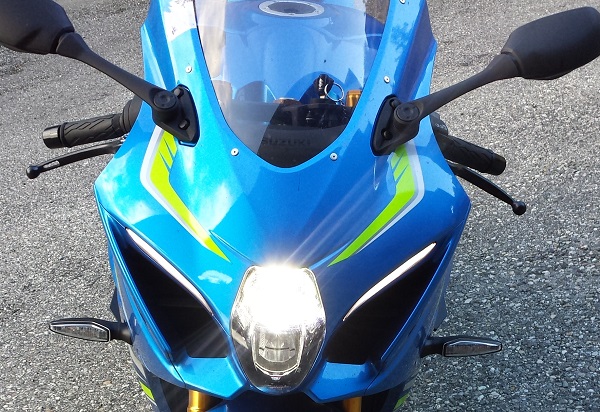
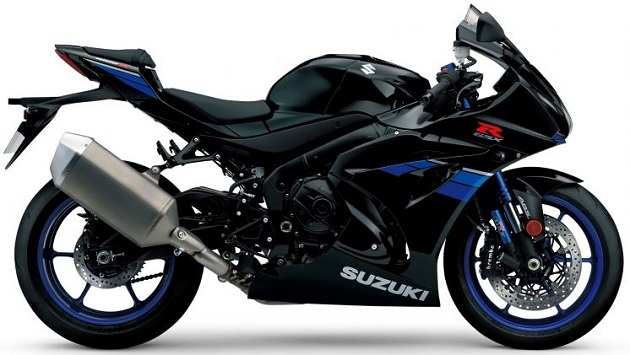
The turn signals, which have been grafted onto the rear-view mirrors since 2005, are now back in place on the fairing. We like to think that this is because the mirrors are easy to dismantle, freeing them from all connections for use on the racetrack....
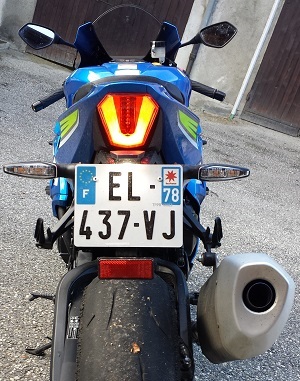
The same applies to the rear. The indicator lights, previously integrated into the rear shell, are lowered onto the plate support. As a result, the taillight is much more restrained, which nicely refines the lady's torso.
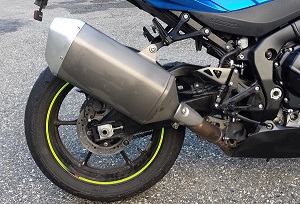
I'm not going to dwell on the enormity of the pie-scoop exhaust, which is just waiting to be removed and put in a box at the back of the garage... We know the constraints of anti-pollution standards, but with the same imperatives, the CBR1000R, R1 or ZX10R offer sexier appendages. In any case, much less bulky! Yikes.
But the GSX-R doesn't give a damn about my feelings... It knows that it will be judged above all on its sporting attributes, not on beauty criteria.
So let's get going. Saddle up!
Launch countdown procedure
THREE!
Removal of crew access arm (uncoupling ...)
TWO !
Initiate thruster launches and activate safety devices (contact....)
ONE !
Thruster ignition.
IGNITION!!!
Apply a little pressure to activate the starter. The starter is launched and runs on its own until the engine is fully started. Suzuki calls this 'Easy-Start' and offers it on a large part of the range. Clearly, we found this function a bit of a gimmick. The engine starts in ¼ of a second, making this "assisted start" almost invisible. But why not..
Rumble. The engine finally comes to life, awakening the heart of the bike and the rider.
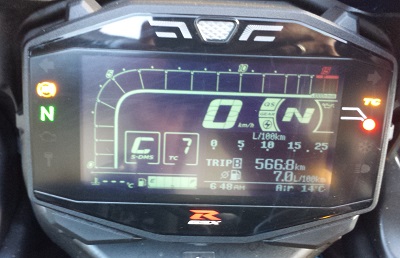
A quick glance at the dashboard. Whereas the previous generation had a good old-fashioned needle-type rev counter with a remote display, the L7 has entered the 21st century with a rather austere but much more modern LCD display, topped by an imposing shiftlight. Complete with all the usual information, including the indispensable rev counter, tachometer, TCS mode, injection profile and gear engaged. There's also information on fuel consumption, battery voltage and engine and exterior temperatures... Readability is quite good (even with the sun at your back) and can be set to 6 brightness levels. In use, this instrumentation is efficient, and navigation via the large two-way button on the left-hand commodo is fairly straightforward, if a little time-consuming. Not forgetting its sporting DNA, the GSX-R 1000 also features a lap time display. Only one parameter troubled us a little: instantaneous fuel consumption, represented by a horizontal bar. A strange and original choice. On the other hand, we welcome the presence of a fuel level display! This essential data seems destined to disappear from the category (CBR1000RR, ZX10R and R1 do without!), but it makes sense given the limited capacity of the fuel tanks (16 liters for the Gex 2017).
A special feature of this R version: the display is inverted, with white lettering on a black background, whereas the opposite is the case on the base version
Bootstrap.
Once the first gear is engaged and before the clutch lever is released, the gearbox is quite noisy at standstill, producing mechanical "brololololololololololos" that are rather above average. Enough, in any case, to raise a questioning eyebrow in attentive ears.
Off we go. The Low RPM Assist, a torque-acting system designed to prevent stalling at low revs, keeps a discreet eye on things (a bit paradoxical on a bike requiring a fair amount of experience).
The millstone gathers momentum and the crew take their first turns on the wheel.
Confirming the work done on the bike's size, the feeling of compactness is immediate. It's almost as if you're riding a GSXR 750! In its 2017 version, the Gex 1000 offers a slightly more "forward" riding position than the previous generation, and gives up a little comfort in its quest for performance. Especially on this "R" version, where the open-work fork crown is set a little lower. The half-handlebars, however, offer a fairly open angle for a good, wrist-friendly grip. This will be important for the brave who prefer everyday use. Leg flex is within the norm, but not excessive. The height of the 16-liter fuel tank has been trimmed by 21mm to allow the rider to merge better with the machine. The seat leans slightly forward, but is less plunging than on some Italians. And the icing on the cake is that the seat is almost comfortable, thanks to a good thickness of foam! Good for longer trips. In fact, nothing hinders the rider's movements, and the feeling of sportiness is instantaneous. One small regret: there's no adjustment for the footrests or clutch lever. It's a shame on a machine that's likely to wander between road and track. And even more a pity when you consider that older models had these settings..
But that doesn't mean you won't quickly feel at ease. Like its predecessors, the 2017 quickly proves intuitive to drive, thanks to a natural grip that will enable it to perform well on the road too.
But for the moment, it's on the racetrack that things are happening
Launched onto the Var track's 3.8 layout, we "calmly" discover the very wide playing field and warm up the joints and rubber. At first glance, the bike is lively and responsive, with natural agility and even handling. But once the elements are up to temperature, and as we exit the Pont bend, another element is about to blow up in our faces, temporarily cannibalizing the bike's other qualities!
As we twisted the throttle at the start of the pit straight, we discovered what Suz' had been preparing for us for so long: a crazy f :*$#! engine!
Let's be clear. The new GSXR 1000's 202 horsepower are there for all to see! We were expecting a generation clash, given that the old GSX-R 1000 was so far behind the times, but here we're blown away by the explosiveness of the new mill and by the display of power it offers, so full is it at every level. It's simple: after 6,000 rpm, it'll launch you into the red zone at 14,500 rpm. We'll spare you the arithmetic, but that's a range of 8,500 rpm to keep your eyes glued to the back of your eyeballs!
To be more precise, the 4-cylinder has plenty of length everywhere and all the time, but after 8,000 rpm, the variable valve timing provides a boost of power that catapults the crew into the stratosphere. But this is achieved without the "kick in the ass" effect experienced with other types of variable valve timing (such as Honda's V-TEC, to name but one). And that's quite salutary, as putting the throttle in the corner on corner exit and suffering an unmanageable surge of horsepower could have proved suicidal. Here, the potato is certainly distributed in a big ladle, but in a coherent, non-trapping way, and in a more linear fashion than on the old Gex.
The marriage of the generous engine, the efficient shifter and the roar of the engine makes for some ecstatic moments when revving up. Because let's face it, despite its unglamorous appearance, the GSX-R's exhaust enhances the raucous, powerful and rewarding vocals of the Japanese 4-cylinder.
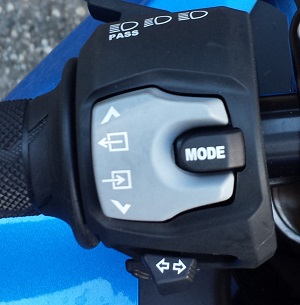
The GSX-R is still equipped with S-DMS, allowing you to choose between 3 engine modes (A, B or C). Mode A, the most liberating, unleashes all the artillery and was therefore used 90% of the time. Mode B is slightly less generous, and slightly calms the grindstone's ardor if you want to get to work without too much brain damage. Mode C is designed for rainy conditions. It effectively tempers the engine's ardor at low revs. However, these 3 settings do not restrict the engine's 202 hp! To select one or other of the injection profiles, simply press the button on the left-hand control unit twice, then cut the throttle to confirm your choice.
Mode A locked.
With the engine screaming and your head on the handlebars, it's easy to get your butt back into the saddle, thanks to the deep seat that allows even the tallest rider to find room behind the bubble and fairing. The fuel tank is 21 mm lower, making it easier to bend over. Propelled along at 260 km/h, you'll get to the 1st tight right-hand bend very, very quickly.
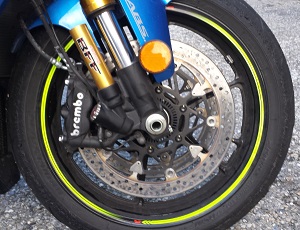
It's a good thing the ABS is set up properly, because unfortunately it's neither adjustable nor disconnectable (unless you fiddle with the fuses). Another complaint: why insist on using rubber hoses on braking systems designed to take a beating? Avia" hoses aren't that expensive, and they wouldn't be a luxury, especially on the R version! It's certain that these hoses will eventually lose their rigor under heavy use, or at least age more poorly.
Let's get on with the fun. The bike is well slowed down and the nose doesn't dive too much, thanks to the good work of the hydraulics and weight transfer. The forks sink in quickly at first, before being effectively braked. All that's left to do is to dive towards the chord and tip the bike onto the corner, which the GSX-R 1000 does naturally and without complaint, rigorously following the rider's gaze. To enhance cornering agility and front-end feedback, the engineers straightened the engine block by 6° and moved it forward 20 mm towards the wheel axle. The result is a very nimble bike that takes on corners with gusto, requiring little effort to position itself at the entry to the curve and to stay on course on the corner. Slightly less incisive than an R1 or RSV4 RR, it offers an agility/stability balance that few offer. The reworked chassis is undoubtedly up to the task.
As the electronic throttle is very well "connected" to the rear wheel, you can easily manage the throttle on the corner while preparing your exit.
And when it comes to re-accelerating at the end of the bend, the 4-cylinder is able to give free rein to all its power, without taking the load off the steering. Once again, the bike stays on course, this time with a straight nose, thanks to the extended swingarm and traction control, which does its invisible work, only betrayed by the yellow TCS warning light that lights up out of the corner of your eye. Here, set at level 3 (10 being the most intrusive), it's freewheeling before kicking in, allowing for a few delightful glides.
However, the cartridge monoshock seems to lack the stiffness to fully exploit the machine's power under acceleration. Indeed, some slight rear-end movement can be felt, which could also be attributed to the high-performance Bridgestone RS10 tires, but which show their limits when the stresses become very great. Fortunately, the standard steering damper limits the risk of steering wobble.
Riding the 2017 GSXR1000R, I ended the day with a smile on my face, and without being rinsed out. This new Gex has set the bar very high for me. Its impressive engine and relative ease of use give it a very healthy fire character. The electronic upgrade is also a success. Without going overboard, the Suzuki is equipped with the essentials, but does them well. No adjustable engine braking or electronically-controlled dampers that require you to sleep with the manual. It leaves that to others and favors a simplicity that enhances the riding experience.
Back home.
Debriefing. And continuation of the test under more 'metro-work-sleep' conditions.
Not designed for everyday use, the GSX-R 1000 R is nonetheless ideal for open roads. Its trunk between 5,500 and 9,500 rpm makes for quick acceleration, and the engine's suppleness makes it easy to pick up sixth gear at 50 km/h (2,500 rpm). Its easy-going chassis will allow it to make a few forays into the hills. But don't expect to set a time on the Montvernier switchbacks. The GSX-R 1000 R aims for the top step of the podium. Not at the summit of Petit Saint Bernard.
As an everyday companion, it will of course have its limits. Firstly, in terms of comfort, although this is kept to a minimum with handlebars that don't strain the wrists too much, and a thick seat. In any case, you'll be much better off than your passenger, who will be focused on hating you and finding an excuse to skip the next ride. But if he (or she) comes back for more, marry him (or her)!
The electronic throttle, which was perfect for track use, is a little rougher in 'normal' use. There are jerks on the throttle opening and closing phases, which are a little annoying when the environment demands that we manage our speed. Once the brain is calibrated, this discomfort (especially felt on Mode A) dissipates.
On the other hand (and this is a real plus point for the Gex), the high-end, racing Showa fork/shock absorber combination of this R version isn't the most slapdash on the road, effectively smoothing out any bumps without sending shockwaves down the spine. Few of our competitors can boast such smooth damping!
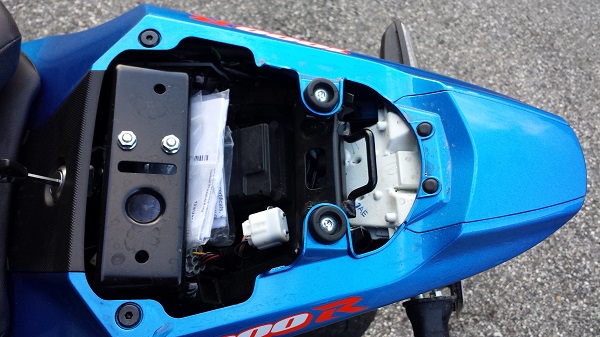
On the practical side, it's impossible to store anything under the passenger seat, as this compartment is crammed with electronics and the valve actuator. Oh yes, sorry! We managed to get some papers in there..
Time to go home.
And it's in the dark that the GSX-R makes its way home. Well, not really, because its full LED eye is piercing. In full headlight, a powerful white beam sweeps through the darkness and guides us home with ease.
A heavy downpour allowed me to test the bike's minimalist protection. Aerodynamic efficiency having taken a back seat, the fairing sides have been reduced to the bare minimum, barely protecting the inside of the thighs. So we're left to suffer and console ourselves with the bubble, which protects the shoulders and even the bottom of the helmet quite well, which isn't bad compared to other hypersports in the category.
Switching to C mode (rain mode) is mandatory. The bike becomes more docile and allows you to avoid taking unnecessary risks on wet roads. The higher anti-slip setting limits the bike's loss of traction. In these tricky conditions, the slightest angle causes the TCS warning light on the dashboard to go crazy, and the micro-cuts in the traction control make themselves felt. Which is very reassuring.
As the last few kilometers tick by, it becomes clear that, like its predecessors, the 2017 GSX-R 1000 retains its road feel (as evidenced by the non-disconnectable ABS, fuel gauge and road 'comfort') and remains welcoming despite its compactness.
With the engine steaming and steaming, the Gex arrives at its destination and plunges the garage into darkness with a flick of the key, sounding like the end of this test drive.
After several hundred kilometers in its company, the assessment is categorical: The new 2017 GSX-R 000 R clearly lives up to expectations and its prestigious name. Expected for a decade, the revival of the Gex is a true demonstration of strength from the Hamamatsu firm. Firstly, thanks to its new engine, which may be more linear than before, but is impressively powerful and one of the fullest in its class. Its precise chassis, combining agility and stability, combines with this fiery temperament to make the GSX-R 1000 R a tough opponent in a category that is losing ground commercially speaking, but which still inspires us with the display of know-how it allows manufacturers to make. And just like the bike it replaces, this new Gex retains a minimum of 'on-road' spirit, with a sporty but not radical riding position, a rather effective bubble and suspension that copes well with irregularities in the road surface.
The only real negative note in all this is the concomitant disappearance of the GSX-R 750 (and 600) from the European catalog, in the same year as this 1000 is updated in the most striking of ways.... (There's talk of a comeback for the 750 at the end of 2018!)
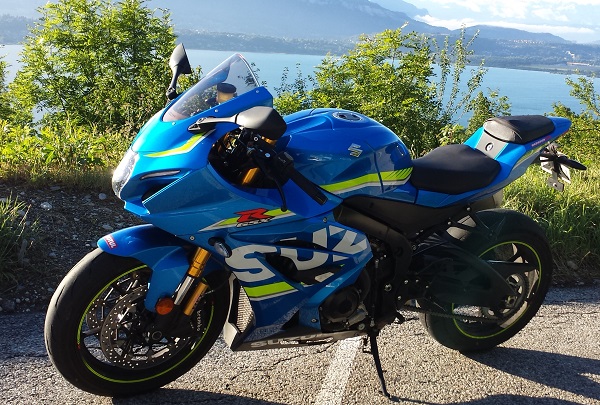
The price of the standard GSX-R 1000, set at €16,599 (the lowest in the 200 hp hypersport segment), rises to €19,399 for the R. The price of the Racing version is also well placed to challenge the competition. Starting with the year's other big newcomer, the Honda CBR 1000 RR Fireblade, which retails for €17,999 in its standard version and swells to €22,499 in the SP version with its shifter and pilot-controlled suspension. Lighter and better-finished, the CBR lacks a little pep to keep up with the Suzuki.
Admittedly, the 2017 GSXR 1000 R can be criticized for being less flashy than its siblings, which will penalize it in the eyes of fans of beautiful objects to show off. Indeed, we would have liked a more polished finish and a less drab TFT-style dashboard. But in the end, this stylistic simplicity suits it well, given its cutting-edge design (its variable valve timing is a success), which is also simple and effective. And if you're a fan of performance and thrills, you'll find what you're looking for in this winning missile.
Equipped with its top-of-the-range suspension and efficient electronics, the 2017 GSX-R 1000 R avoids the pitfall of excessive electronics and prefers to keep things simple. The result is an efficient, intuitive machine that's just waiting for the next endurance season to confirm its full potential..
Fuel consumption in road mode: 5.2 liters per 100km.
M.B - Photo credits D.R.

 helmet
 Gloves
 jacket
 braking
 Chain kit
 Oils
Oils Find an intercom
 Parts
Parts Luggage
 Tires
Tires France
Bikers' reviews Leave a review - 7 reviews
take another look at the exhaust cartridge... Rating : 4/5 Respond to BBE38
Suzuki can't be taught to make remarkable bikes
Rating : 5/5 Respond to Jo-barr