
Motorcycle specifications Honda CRF 1100 L Africa Twin Adventure Sports 2020 Biometric passports


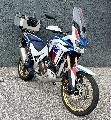
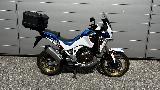
presentation of the CRF 1100 L Africa Twin Adventure Sports 2020
When I was a kid, bikers with sand in their dreams and ears were like the privateers of the horizons. A backpack, a 660 Ténéré, a G/S, an Africa Twin or a 650 Djebel, a knife, a passport, a pack of cigarettes and off you went. There wasn't much power and almost nothing in the way of electronics. The ignition maybe.....?!?! No, not always and not often.
The Africa Twin revival has nothing to do with those days, but it's still a real inspiration. The Adventure Sports series is also looking to sneak far beyond the hills with its increased range and protection provisions. By the time it becomes the 1100, it has shed this role and become a true demonstration of Honda's power. The Honda 1100 Africa Twin Adventure Sports II is no longer an expedition; it's a diplomatic-strategic raid.
This more 'well-traveled' version is distinguished, today as yesterday, by its thicker physique. It's not a question of ego or exaggerated presence, but the desire to offer greater protection for the pilot. What's more, when it comes to roads, travel and long stages, you need more autonomy. Here, the fuel tank holds 24.8 liters of fuel. 6 more than theAfrica Twin, 1.4 less than the previous version. No big deal, though: Honda still claims 500 km of cruising at a leisurely pace.
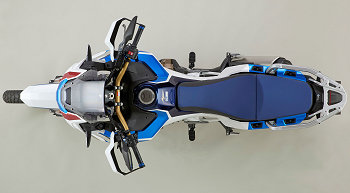
Unlike the standard Africa Twin, which has been stripped of certain practical aspects, the Adventure Sports has retained some very practical travel accessories. Anchorages for suitcases, a good-height windscreen (adjustable to 5 positions), and a redesigned plate combining passenger handgrips and luggage rack are all still there. Serious efforts have also been made to improve on-board access. The seat height has been lowered by 50 mm to the same height as the std model. The seat height is now 850 or 870 mm. Combined with a 40 mm narrower saddle, it will be much easier to get on this machine and put your feet down at every stop.
A tubular metal cage is retained, as are heated grips, a large motor shoe and a 12V socket. However, with the two extra pupils under its bevelled gaze, one suspects that many other things have approached this skiff of the roads and sands.
These two small light units are for bend lighting. In keeping with modernity, an IMU control unit is also on board, enabling more electronic functions. These include additional projectors, active on 3 levels and automatically activated. Above them, the daytime running lights also adjust automatically, but this time according to ambient light intensity.
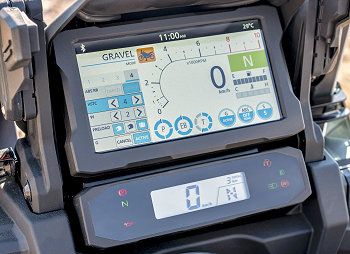
Now that we're in the silicon, let's move on to phase 2. Active and passive safety, active and passive comfort... Everything that raises the level of performance.
So, there's an IMU, there's sensors, there's chips and algotithmes... To enable torque control to work more efficiently. The HTSC offers 4 power levels and manages 3 engine braking options. It can be disconnected when needed or desired. The 1100 also features wheeling control in 3 levels: 1 - the wheel can be lifted, but the system prevents any sudden movement; 2 - the wheel is lifted, but only moderately; 3 - the system prevents the wheel from leaving the ground. This module can also be deactivated, for those who like to have a guard rail. Also thanks to the IMU, ABS has become cornering. This means that braking can be relieved when cornering if there's a risk of a spill.
Don't go away, you'll forget the Driving Modes. 6 modes are available, allowing dynamic response according to different laws for the electronic modules. Choose from a road, urban, track or off-road mode, or 2 personalized mappings. Each one affects power level, engine braking and ABS. I've included all the details at the end *.
Between the fuses and cables, you'll also find cruise control, automatic turn signals and an 'emergency braking' mode that makes them convulse, plus optional DCT gearbox and pilot-controlled suspension. But first, let's take a look at what's inside.
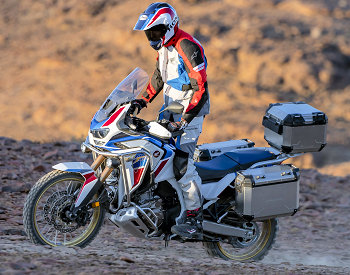
Let's be brief about the engine evolution, and move on to the definitions of each joint and nut. The changes concern the cylinder head (totally revised), injection housings, higher valve lift, an exhaust valve, new sensors in place of the Lambda probe, more precise gears and a smaller clutch that's smoother on the lever.
As for the chassis, Honda has followed the same layout as on the 1000, but has taken care to make substantial changes. The frame's strength and rigidity have already been optimized. New main tubes have made it possible to remove one of the cross-tubes, saving even more weight. There's more rigidity in the steering column; the rear end has changed from steel to aluminum, and is no longer welded but bolted to the frame; the swingarm is also new, lighter and stiffer; there are still 21" and 18" spoked wheels, now tubeless; the brakes retain their 310 mm petal discs with 4-piston radial calipers. For the front. At the rear, a single-piston caliper bites a 256 mm disc.
Suspension is little changed. Except for a reduction in travel of 22 mm at the front and 20 mm at the rear. The bike thus loses just as much ground clearance, with 250 mm separating the belly from the ground. The 45 mm Showa inverted fork is adjustable for rebound and compression. The rear shock, from the same manufacturer, benefits from more possibilities, adding preload to the other two parameters.
Few changes ?!? That's not quite true... There's a big change, as an option. Do you remember the acronym EERA used earlier?
No mode to suit you? Don't worry: the USER mode lets you adjust the damping force with your fingertips.
Thus equipped, the bike gains 2 kilos. But you can go even further with high value-added options.
By choosing the DCT gearbox version. Honda's robotized gearbox is increasingly efficient, although it still lacks that little something that no AI can replace. Instinct, or something like that. Maybe free will? Well, who cares? What's important is that the operation of this box is a real comfort. It will be even more efficient with the inertial unit.
The all-automatic D mode may be a little too cushy, but in town, you can leave it to its own devices and drive smoothly. Once you've got the hang of it, the S mode and its three variations (S1 - S2 - S3) allow for more responsive driving. A nice, practical extra is that you can take control of the gears at any time, with a flick of the + or - buttons.
Oops, we're on soft ground! Perfect, there's a G mode, for Gravel, designed to give you a better feel for traction.
Of course, the DTC option comes at a price. More like two, in fact: 10 kilos and 1000 roros.
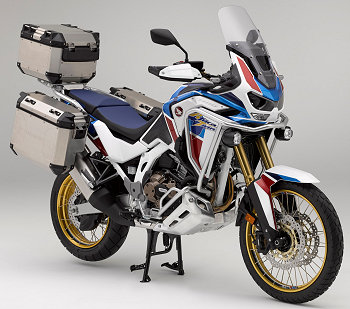
M.B. - Manufacturer's photos
driving modes in detail:
- TOUR: for heavy-duty use, with passenger and luggage; maximum power level (1), engine braking at level 2 and anti-lock braking on curves.
- URBAN: for most situations; intermediate power level (2), engine braking at level 2 and anti-lock braking on curves.
- GRAVEL: for track/TT use. Minimum power level (4), low engine braking (3), anti-lock braking activated but specific off-road settings. In this configuration, ABS cannot be disconnected on the rear wheel.
- OFF-ROAD: intermediate power level (3), low engine braking (3), anti-lock braking activated but specific off-road settings. ABS can be disconnected on the rear wheel.
- USER 1 & 2: allows the rider to define two distinct personalized settings. He can choose his power level (between 1 and 4) and engine braking level (between 1 and 3), as well as the type of ABS intervention (road/off-road settings).
by Greg
Greg is the founder of Motoplanete—a website created in 2001 to share his passion with his friends and showcase as many motorcycle models as possible to his readers. Self-taught and a jack-of-all-trades, his discovery of the world of motorcycles led him to work as a photographer, rider, team manager, web developer, graphic designer, editorial assistant, and editor-in-chief.
 Share
Share
Key facts Honda CRF 1100 L Africa Twin Adventure Sports (2020) : What you need to know before you buy
Highlights
- Enhanced capabilities
- More accessible seating
- More engine space
Weak points
- Too many electronic crutches
- Sharp rise in price positioning
Prices
| Basic version | |
|---|---|
 France France |
16,499€
|


Performance
- Max speed : over 200 km/h (124.30 mph)
- Average fuel consumption : 4.90 liters/100km (0.48 mpg)
-
Estimated range
: 506 km (314 miles)
Calculated range until tank is empty, not verified.

Specifications Honda CRF 1100 L Africa Twin Adventure Sports 2020
- Chassis
- Frame : Double beam + single split steel cradle
- Fuel capacity : 24.80 liters (6.55 US gallons)
- seat height adjustable between 850 mm and 870 mm
- Length : 2,330 mm (91.73 in)
- Width : 960 mm (37.80 in)
- Height between 1,560 mm (61.42 in) and 1,620 mm (63.78 in)
- Wheelbase : 1,575 mm (62.01 in)
- Weight when fully loaded : 238 kg (525 lb)
- Front axle
- Reverse telehydraulic fork Ø 45 mm, Wheel travel : 230 mm (9.06 in)
- Braking 2 discs Ø 310 mm (12.2 in), radial mounting, 4-piston caliper
- Front tire : 90 / 90 - 21 → Order this type of tire
- Pressure : 2.25 bar
- Transmission
- 6 stage gearbox
- Secondary by chain
- Rear axle
- Mono-damper, Wheel travel : 220 mm (8.66 in)
- Braking 1 disc Ø 256 mm (10.08 in), single-piston caliper
- Rear tire : 150 / 70 - 18 → Order this type of tire
- Pressure : 2.5 bar
- Motor
- two-cylinder online , 4 strokes
- Injection
- Cooling system : liquid
- 1 ACT
- 4 valves per cylinder
- 1,084 cc
- 102 ch (100.60 hp) to 7,500 rpm
- 10.70 mkg to 6,250 rpm
- Power-to-Weight Ratio : approx. 2.16 kg/ch
- Torque-to-Weight Ratio : approx. 20.31 kg/mkg
- Compression : 10.1 : 1
- Standard equipment
- Brake assist : ABS as standard
- Bluetooth
- Heated grips
- Practical information
Essentials
 Motoblouz
 LaBécanerie


Maintenance
Excessive grease was applied to the O-ring of the reservoir piston in the ABS (Anti-lock Braking System) modulator. As a result, foreign matter may adhere to the grease and become pinched in the check valve during braking, causing input pressure leak and increasing the braking distance.
The fuel injection system may malfunction, causing fuel injection and ignition to stop. The engine may stall while driving, creating a risk of accident. In the case of vehicles with dual-clutch transmissions, a malfunction in the fuel injection program may cause the clutch to disengage, resulting in a loss of power.
The horn does not sound and/or the headlight cannot be switched from low beam to high beam. The malfunction of these components can lead to an accident and injuries.
Information source du rappelGallery





Compare the CRF 1100 L Africa Twin Adventure Sports to its competitors
Compared to its 5 direct competitors, this CRF 1100 L Africa Twin Adventure Sports offers an appealing positioning, managing to stand out in certain specific areas. It stands out with top speed of 200 km/h. Regarding fuel budget, it proves to be the most thirsty of the group with 4.9 l/100km.
Acceleration
Fuel consumption
Range
Torque
Power
Power-to-Weight ratio
Torque-to-Weight ratio
Speed
CO² emissions
FAQ Your frequently asked questions about the CRF 1100 L Africa Twin Adventure Sports 2020
- What is the power of the CRF 1100 L Africa Twin Adventure Sports?
-
The CRF 1100 L Africa Twin Adventure Sports 2020 develops a power of 102 ch (100.60 hp)
- What is the torque of the CRF 1100 L Africa Twin Adventure Sports?
-
The maximum torque of the CRF 1100 L Africa Twin Adventure Sports 2020 is 10.70 mkg to 6,250 rpm.
- What is the maximum speed of the CRF 1100 L Africa Twin Adventure Sports?
-
The CRF 1100 L Africa Twin Adventure Sports 2020 is capable of reaching a top speed of over 200 km/h (124.30 mph) on the track.
- What is the weight of the CRF 1100 L Africa Twin Adventure Sports?
-
The CRF 1100 L Africa Twin Adventure Sports 2020 has a a weight when fully loaded of 238 kg (525 lb).
- What is the fuel consumption of the CRF 1100 L Africa Twin Adventure Sports?
-
Average fuel consumption is estimated at 4.90 l/100km (0.48 mpg) according to the WMTC cycle.
- QWhat is the seat height of the CRF 1100 L Africa Twin Adventure Sports?
-
To ensure good accessibility, the CRF 1100 L Africa Twin Adventure Sports 2020 offers a minimum seat height of 850 mm (33.46 in). The integrated adjustment allows you to adjust the riding position to suit your needs.
- What is the price of the CRF 1100 L Africa Twin Adventure Sports?
-
The price of the CRF 1100 L Africa Twin Adventure Sports 2020 is 16,499€ in France
- What size tires should I put on my CRF 1100 L Africa Twin Adventure Sports?
-
The standard size for a CRF 1100 L Africa Twin Adventure Sports 2020 is 90 / 90 - 21 for the front, and 150 / 70 - 18 for the rear.
- Where can I find high-quality used CRF 1100 L Africa Twin Adventure Sportss?
-
You can find used CRF 1100 L Africa Twin Adventure Sports at great prices on MotoPlanete, in the section dedicated to them—models from professionals and private sellers, as well as spare parts.
News
-
2026 MXGP of China: Herlings Unbeatable, McLellan Delays the MX2 Title
-
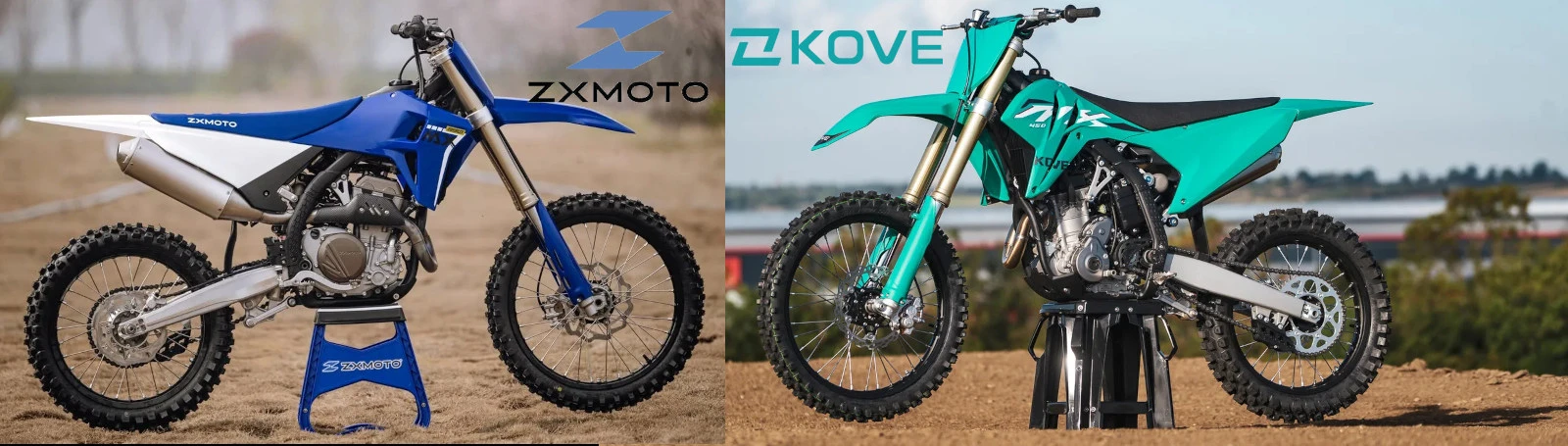
MXGP 2027: Kove and ZXMoto Join the Championship
-
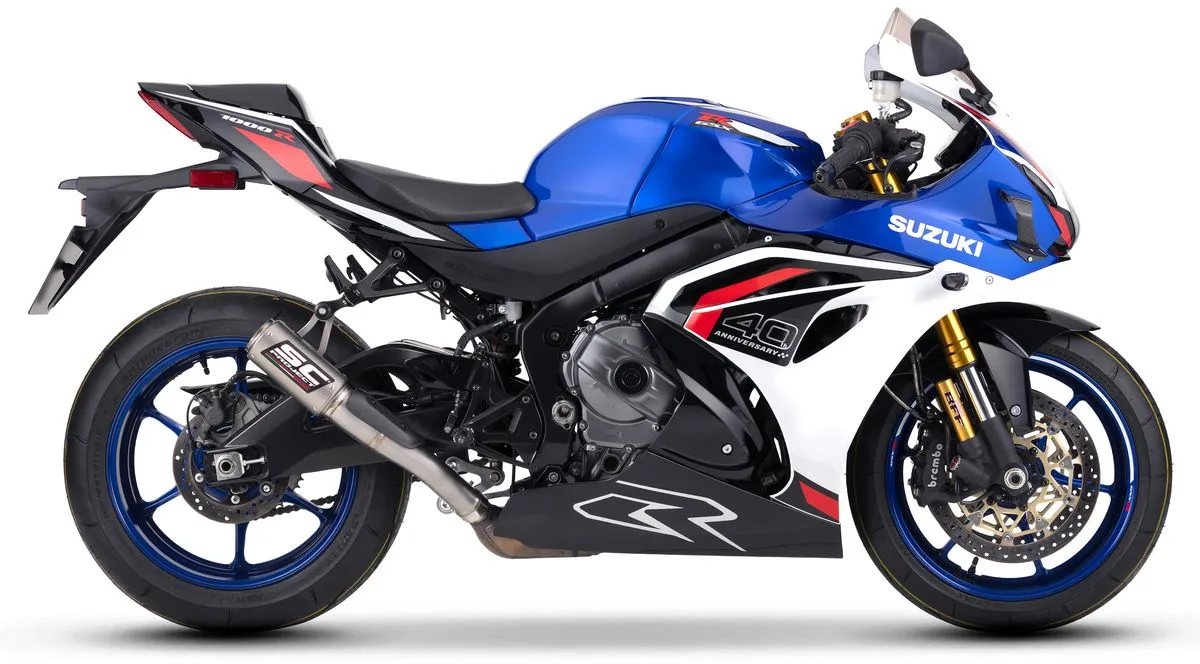
SC Project is working on the 2026 Suzuki GSX-R1000R.
-
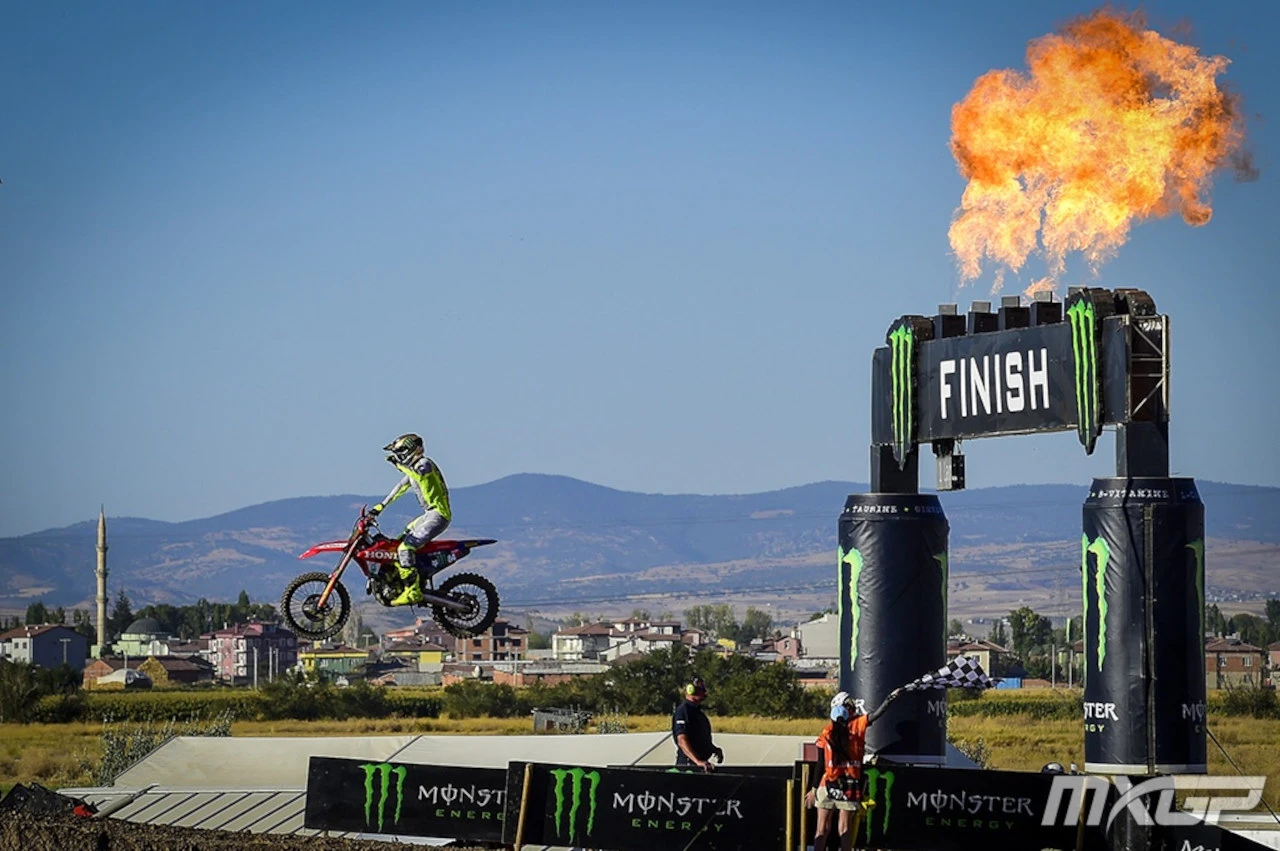
2026 MXGP of Turkey: Herlings Crowned World Champion!
-
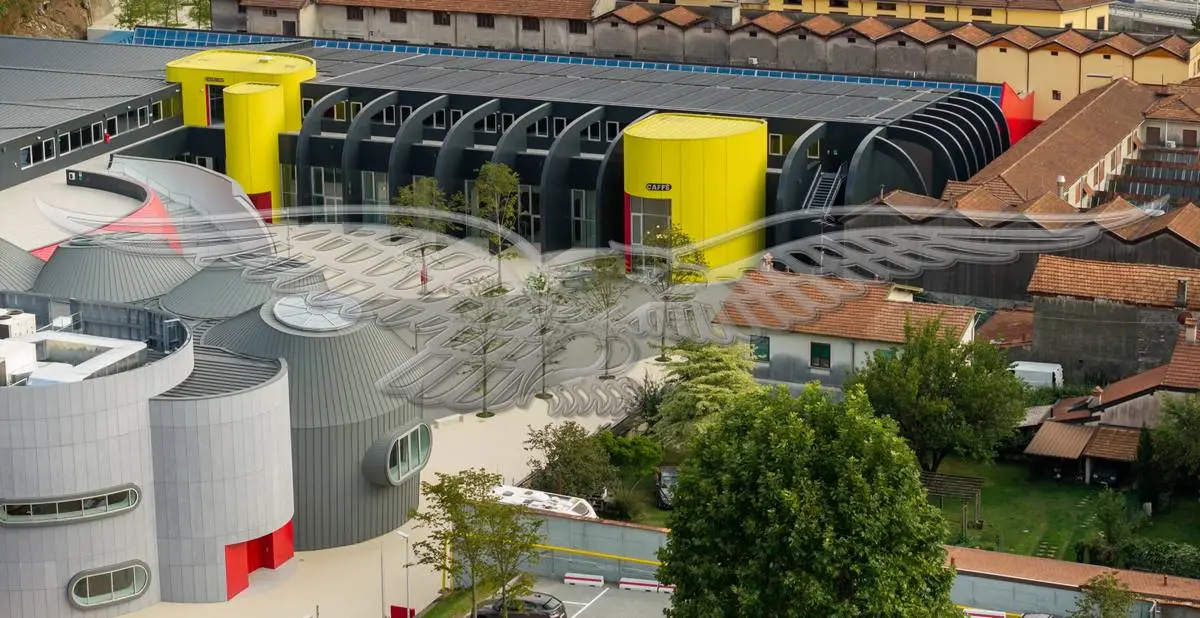
Moto Guzzi: In Mandello, the historic factory is taking on a new scale.
-
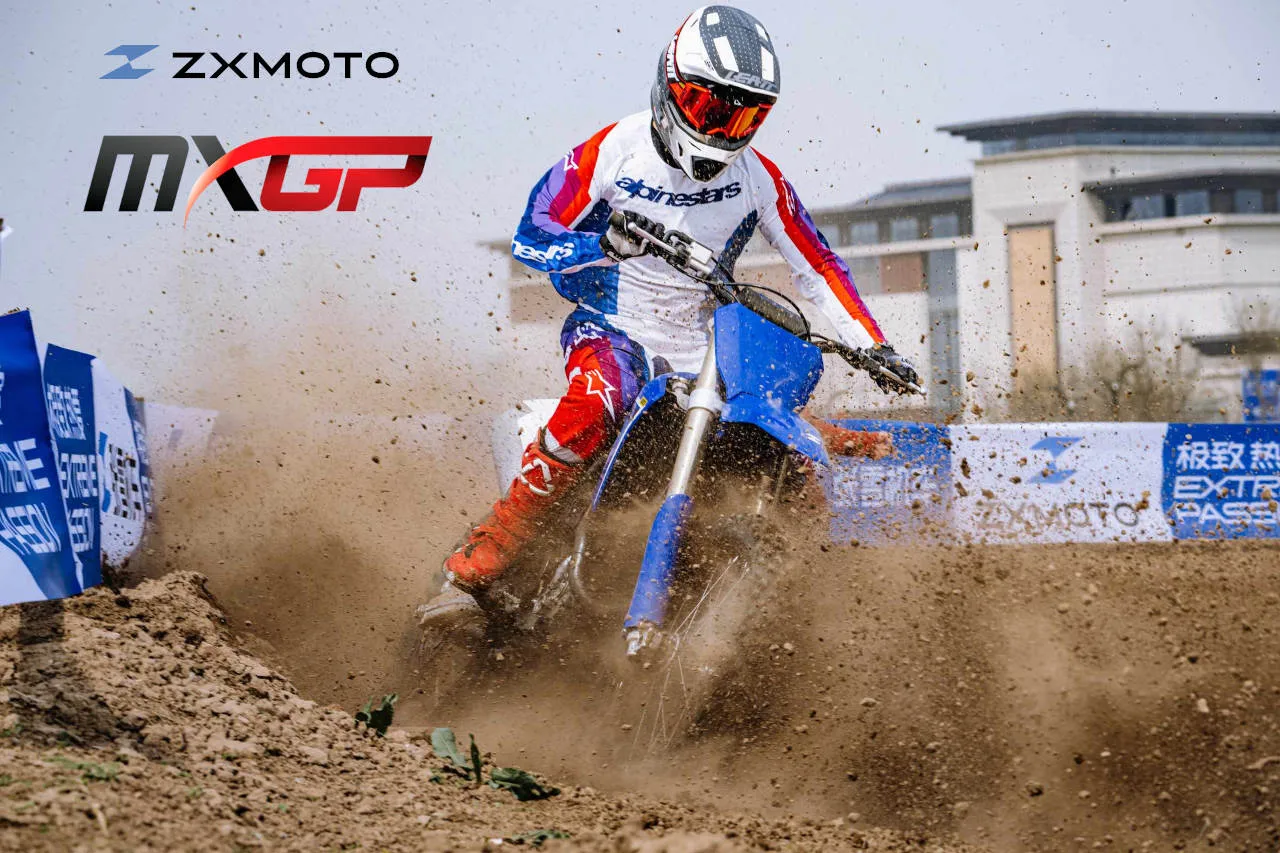
ZXMoto in MXGP 2027: The Hypothesis of an Off-Road Earthquake
-
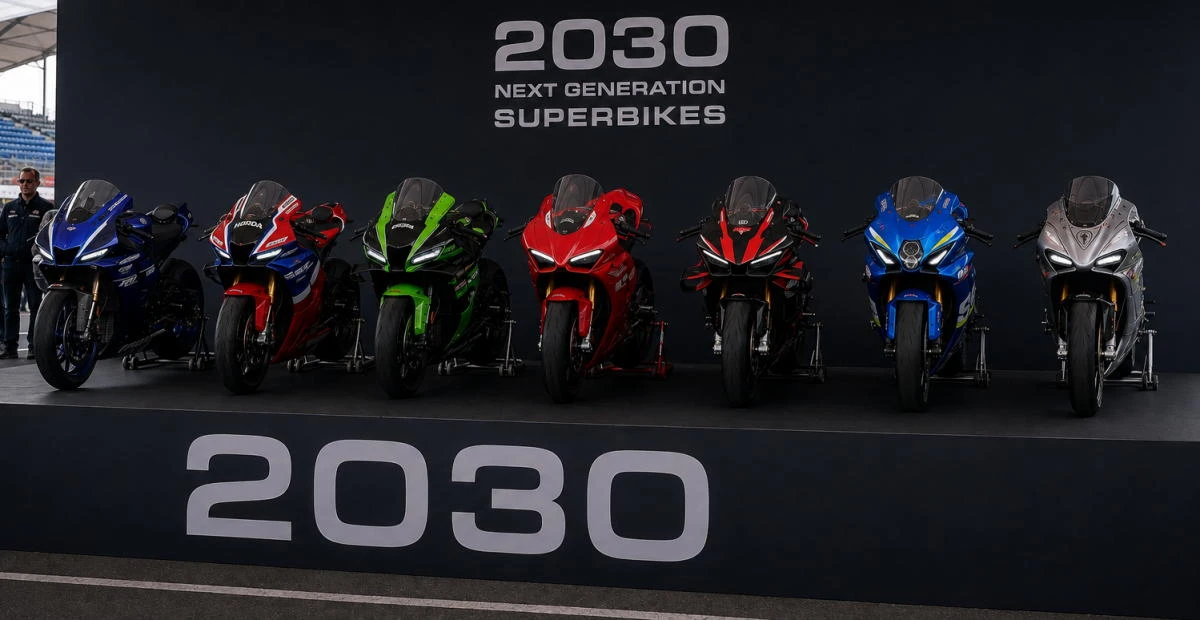
Superbike - Will 240 ch sport bikes soon be available at dealerships?
-
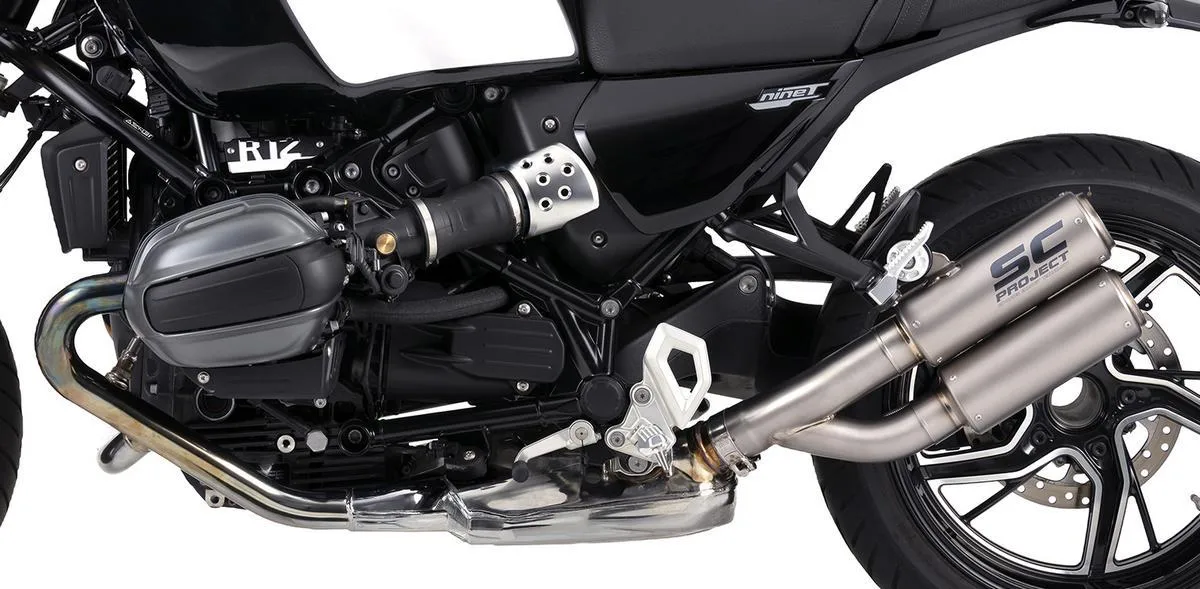
2 new SC-Project mufflers for the R 12 NineT and G/S.
-
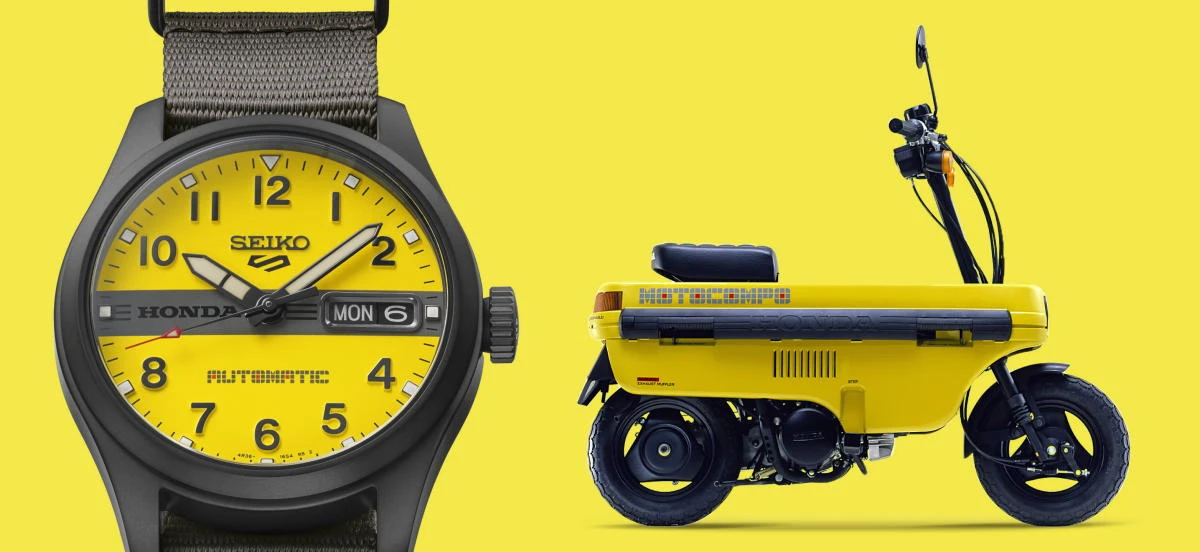
Seiko unveils a watch inspired by the Honda Motocompo.
-
The new motorcycle models of 2026 and the evolutions.

Bikers' reviews Leave a review - 9 reviews
In all, I must have fallen 8 times with it, including 3.5 times while driving (1 time in the garage). First time by touching the footbrace (first day with crash bars fortunately), second on a wet manhole cover, 3rd on a wet downhill slope after a tiny brake stroke. The last fall was fatal, as when I tried to stop on the side of the road, my foot didn't touch the ground and I toppled into a rut, causing the oil to piss into the electronics. It was an incredible bike that I'll always remember, one that forged my experience, but not enough to keep it. Choose motorcycles in your size: if you have trouble on your first try, you're likely to have a lot of trouble later on. Take care of yourself, and enjoy the road without putting yourself in danger. Rating : 3/5 Respond to Le rêveur
article conforms to reality Rating : 5/5 Respond to eric
Already 6000 km on the odometer since 12/12/19 Rating : 5/5 Respond to bernjack
My question is simple, I would like someone to tell me
1000t/mm in 1re2e3e4e5e6e
Thank you for your answer
Michel Rating : 4/5 Respond to honda