
Motorcycle specifications Honda XL 750 Transalp 2023 Between the road and the cliffs


presentation of the XL 750 Transalp 2023
For some years now, ersatz sand, dunes and vastness have been twirling between the trails and SUVs. Adventure is just around the corner, but the wheel only touches it a little. And then there are the memories. The memory of a moment in the valley, when a valiant two-cylinder engine seems to provoke the mountain.
The crutch will happily sit between the tarmac and the gravel. In the final stretch of the twentieth century, the Transalp lent itself to all sorts of uses. A bit of road, a lot of town and a dose of mud stuck to it like a glove. Back in its 750s, this mini-AfricaTwin takes on the same desires, but with many more solutions.
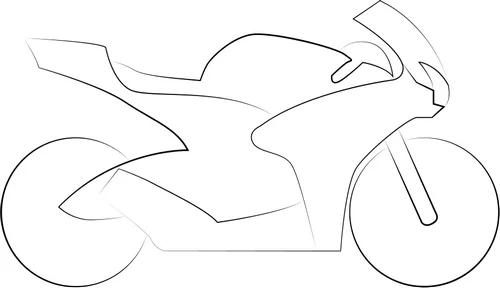
Following in the footsteps of the new Hornet, Honda has minimised risk-taking with the Transalp suit, which is dynamic but restrained, a little all-purpose and ultimately lacking any real punch. The old 700 was much more daring.
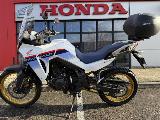
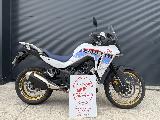
Fortunately, beyond the sad, attaché-case grey or black colours, a sympathetic, vintage trio of blue, red and white refreshes the senses. This dress takes its inspiration directly from the 1987 XL 600.
The new appetites of the Transalp, combined with the process of common platforms, led to a new ideology for its powertrain. After 25 years with a V-twin, the engine now uses a parallel twin. Less expensive to build, less cumbersome and lighter, this powerplant takes the Transalp to a very promising summit.
91bhp! That's something we're not used to from Honda's mid-size trails. It all makes sense once you discover that this block is shared with the new Hornet. A good dose of wattage, enabling it to look good in the segment. The days of 50/60 drunks on the go are now a thing of the past. The new free zone now boasts between 79 and 98 horsepower.
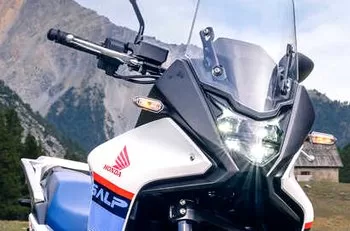
Let's put our finger gently where it hurts. A trail needs to be light. A sine qua non if you want to go anywhere. That's not really the case here, as the bike weighs in at 208 kilos fully loaded. That's a long way from a CRF 300L... but still 6 units less than the 700 of another era.
But that's hardly surprising, given that the Transalp is in the (low) middle of the pack in this sector: 204 kilos for the Yam Ténéré or theAprilia 660 Tuareg, then.... Wow! 230 kilos for the 800 V-Strom, 227 for the 750 GS...
Whatever the protagonist, an enduro-style game is out of the question. The theme of exploration remains, however, with the Honda's chassis. The front wheel measures 21 inches, the universal size for climbing over rough terrain. Its 9 cm-wide tyre will allow you to carve your own furrow and engage as you should. The rear is also the right size for a real trail bike, with a 150 over 18 inches. All mounted on spoked rims, of course.
As the thin tyres will take care of handling, Honda has opted for stability and homogeneity with a long wheelbase of 1,560 mm and a 27° caster. The relatively open steering angle of 42° makes it easy to turn the car just outside the lane.
The suspension also plays its part. The equipment appears to be more than adequate, with a Showa inverted fork with separate SFF-CA functions and a Pro-Link shock absorber. Both are adjustable, but only for preload. Generous travel completes the suspension package, with 200 mm at the front and 190 mm at the rear. Reassured by its 21 cm of ground clearance, the 7 and a half Transalp can smile. Pavements, roots and dinosaur bones can all be tackled without hesitation.
The Transalp has evolved in all areas, including braking. Who remembers its small 256mm discs? Who cares now that the rider can rely on 310 mm discs, with 2 pistons in each caliper. ABS is present, and fortunately can be deactivated at the rear for off-road fun. To prevent the action of the 256 mm rear disc, you need to go into User Mode.
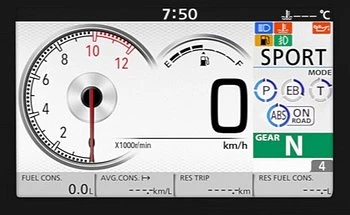
The last point where the Transalp enters a new world is electronics. All the Transalp's creators had to do was go to the R&D department, and they came back with a Ride by Wire throttle, torque control (5 settings), engine brake management (3 settings), adjustable ABS, several engine power levels (4), a 5-inch colour TFT screen to monitor all this and more (4 display themes), as well as 5 Riding Modes. Here are their prerogatives: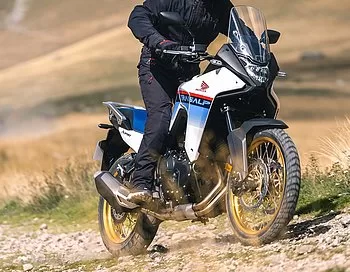
Sport : Engine power is set to 4, ABS to 2, while engine braking and torque control are set to 1, to ensure maximum performance with minimum intervention from the electronics.
Standard :With this intermediate mode, engine power and torque control are set to 3, while engine braking and ABS are set to 2.
Rain :a mode adapted to difficult conditions, with engine power set to 1, engine braking and ABS set to 2 and torque control set to 5, for smoother, safer driving.
Gravel :designed for off-road use, with power set at 2, engine braking at 3, torque control at 4 and ABS at 1.
User :This mode allows the rider to define his own parameters for each function and store them in memory: from 1 to 4 for power, from 1 to 5 for torque control, from 1 to 3 for engine braking. ABS intervention on the rear caliper can also be disconnected.
Another good point. With the new ergonomics of the controls, the horn no longer takes up half the available space. The efforts made to improve everyday life on board are there for all to see, with a USB socket and luggage rack as standard, smartphone-bike interaction via Bluetooth, automatic stop indicators, an upright and natural riding position that also allows you to stand up off-road and almost 17 litres of fuel on board - enough to ride for a good while without having too much weight in the tank.
Not so great: the seat is a little high, at 850 mm; the windscreen is not adjustable; the handguards and engine cover are optional; and the USB is under the seat; it would have been more practical to fit it in the cockpit. It would have been more practical to install it in the cockpit, but the space is there... as an option.
Then there's the tricky question of pricing. In the past, a Transalp cost around 10% more than a Hornet, with which it shared neither engine nor chassis. Honda has not been able to maintain this small price differential, but the 750 is priced to take on the 700 Ténéré, 660 Tuareg and 850 GS. To name but a few.
With the return of the Hornet and Transalp in quick succession, Honda is aiming to make a big impact in the mid-size segment. The trail has a lot going for it, with a clear appetite for off-roading - much more so than the previous generation. The competition can tremble. Even theAfrica Twin is not immune to having a few customers stolen from it.
M.B -Manufacturer photos
by Greg
Greg is the founder of Motoplanete—a website created in 2001 to share his passion with his friends and showcase as many motorcycle models as possible to his readers. Self-taught and a jack-of-all-trades, his discovery of the world of motorcycles led him to work as a photographer, rider, team manager, web developer, graphic designer, editorial assistant, and editor-in-chief.
 Share
Share
Key facts Honda XL 750 Transalp (2023) : What you need to know before you buy
Highlights
Weak points
Prices
| Basic version | |
|---|---|
 Germany Germany |
11,090€
|
 Spain Spain |
11,000€
|
 Italy Italy |
10,690€
|
 France France |
10,599€
|
 United Kingdom United Kingdom |
€9,699
|
 United States United States |
$9,999
|


Performance
- Max speed : approximately 200 km/h (124.30 mph)
- Average fuel consumption : 4.35 liters/100km (0.54 mpg)
-
Estimated range
: 389 km (242 miles)
Calculated range until tank is empty, not verified.
History

Specifications Honda XL 750 Transalp 2023
- Chassis
- Frame : Diamond-type steel
- Fuel capacity : 16.90 liters (4.46 US gallons)
- Seat height : 850 mm (33.46 in)
- Length : 2,325 mm (91.54 in)
- Width : 838 mm (32.99 in)
- Min height : 1,450 mm (57.09 in)
- Wheelbase : 1,560 mm (61.42 in)
- Weight when fully loaded : 208 kg (459 lb)
- Front axle
- Reverse telehydraulic fork Ø 43 mm (1.69 in), Wheel travel : 200 mm (7.87 in)
- Braking 2 discs Ø 310 mm (12.2 in), 2-piston caliper
- Front tire : 90 / 90 - 21 → Order this type of tire
- Transmission
- 6 stage gearbox , manual - optional shifter
- Secondary by chain
- Rear axle
- Mono-damper, Wheel travel : 190 mm (7.48 in)
- Braking 1 disc Ø 256 mm (10.08 in), single-piston caliper
- Rear tire : 150 / 70 - 18 → Order this type of tire
- Motor
- two-cylinder in-line , 4 strokes
- Injection Ø 46 mm
- Cooling system : liquid
- 1 ACT
- 4 valves per cylinder
- 755 cc
- 92 ch (90.70 hp) to 9,500 rpm
- 7.70 mkg to 7,250 rpm
- Power-to-Weight Ratio : approx. 2.13 kg/ch
- Torque-to-Weight Ratio : approx. 25.1 kg/mkg
- Compression : 11 : 1
- CO² emissions: 103 g/km
- Standard equipment
- Brake assist : ABS
- Bluetooth
- Practical information
Essentials
 Motoblouz
 LaBécanerie


Maintenance
The spring hook on the main stand is not strong enough to withstand the welding force. It may break when the main stand is operated, causing the vehicle to fall. In addition, the spring hook can detach while driving, causing the main stand to touch the ground and the vehicle to fall, increasing the risk of injury.
Production dates: 24/01/2023 - 01/12/2023
Gallery


Used
Find this used XL 750 Transalp on MotoPlanete





Compare the XL 750 Transalp to its competitors
Compared to its 6 direct competitors, this XL 750 Transalp offers an appealing positioning, managing to stand out in certain specific areas. It stands out with top speed of 200 km/h, while also delivering price tag of 9999 €. With 7.7 Nm of torque, it feels a bit less lively during mid-range roll-ons.
Price
Acceleration
Fuel consumption
Range
Torque
Power
Power-to-Weight ratio
Torque-to-Weight ratio
Speed
CO² emissions
FAQ Your frequently asked questions about the XL 750 Transalp 2023
- What is the power of the XL 750 Transalp?
-
The XL 750 Transalp 2023 develops a power of 92 ch (90.70 hp)
- What is the torque of the XL 750 Transalp?
-
The maximum torque of the XL 750 Transalp 2023 is 7.70 mkg to 7,250 rpm.
- What is the maximum speed of the XL 750 Transalp?
-
The XL 750 Transalp 2023 is capable of reaching a top speed of approximately 200 km/h (124.30 mph) on the track.
- What is the weight of the XL 750 Transalp?
-
The XL 750 Transalp 2023 has a a weight when fully loaded of 208 kg (459 lb).
- What is the fuel consumption of the XL 750 Transalp?
-
Average fuel consumption is estimated at 4.35 l/100km (0.54 mpg) according to the WMTC cycle.
- QWhat is the seat height of the XL 750 Transalp?
-
To ensure good accessibility, the XL 750 Transalp 2023 offers a minimum seat height of 850 mm (33.46 in).
- What is the price of the XL 750 Transalp?
-
The price of the XL 750 Transalp 2023 is €9,699 in United Kingdom. It is displayed at $9,999 in the United States, at 10,599€ in France, at 10,690€ in Italy, at 11,000€ in Spain and at 11,090€ in Germany.
- What size tires should I put on my XL 750 Transalp?
-
The standard size for a XL 750 Transalp 2023 is 90 / 90 - 21 for the front, and 150 / 70 - 18 for the rear.
- What colors are available for the XL 750 Transalp?
-
For the 2023 model year, the XL 750 Transalp is available in several colors: white / blue, grey and black.
- Where can I find high-quality used XL 750 Transalps?
-
You can find used XL 750 Transalp at great prices on MotoPlanete, in the section dedicated to them—models from professionals and private sellers, as well as spare parts.
News
-
CFMOTO 675SR-R: Official Motorcycle of the WorldWCR Starting in 2027
-
News on the Street Triple 798, Bonneville 400, Tiger 900, and Tiger 1200.
-
2026 MXoN in Ernée: Belgium Wins, France Falls
-
Furygan offers an airbag vest designed specifically for women.
-
Top 10 Best Scooters of 2026: Our Complete Ranking.
-
Motorcycle Intercoms—A Practical Guide to Choosing the Right One for Your Needs.
-
HJC is gearing up for a big year in 2027, with eight new helmets.
-
Triumph succeeded BSA in the Motocross World Championship.
-
BMW S1000RR Recall Alert: Risk of Engine Shutdown
-
The new motorcycle models of 2026 and the evolutions.

Bikers' reviews Leave a review - 35 reviews
Also, congratulations on the article, which I found informative and very well written ;-) Rating : 5/5 Respond to nialanourlof
I am 5'6", ride with a passenger, and with the low seat, there are no problems.
I would have liked the E-clutch that just came out, but with the quickshifter, it's a real pleasure.
My only criticism is that I find it a little too noisy (some people will like that) and the throttle response a little too abrupt in 1st or 2nd gear.
It's the perfect bike to give confidence to a new A2 license holder. It will never give you any nasty surprises and will never scare you. Rating : 4/5 Participate in the conversation
On the other hand, the marketing gimmick doesn't work: offering a cheaper naked bike that, once properly equipped, costs the same as its rivals is a real shame ... Especially since a bike designed for off-road riding that doesn't come with an engine cover and hand-guard is very average! Rating : 4/5 Respond to Maupi
comfortable: I can spend a whole day on it without complaining about either the saddle or the riding position, whereas on my S1000XR I had to stop every 1.5 hours at the risk of a sore buttocks... Handy: admittedly, it's not the best-handling bike on the market, but it holds its own in its field of expertise, which is none other than riding in "cool" mode, just like its predecessors.
°engine: it can do anything you want, it's playful and elastic, you can stay in the low rev counter zones and, the next second, do a little spike to make the engine's superb melody play. The negative points are, in my opinion, only aesthetic and protective: headlight without personality and not very useful when it's really dark, windscreen not very protective (changed for a Puig high windscreen). In the end, a bike that suits everyone for a use that will vary according to the situation. Rating : 5/5 Respond to Nico
Bravo HONDA Rating : 5/5 Respond to lo19
And the basic equipment is lacking to say the least: no hand-guards, no engine mount and a low exhaust for a bike designed for off-roading, it's very average ... As for the rest, Honda seems to have done a good job (as is often the case), with a good range and a bike that performs as well off-road as it does on the road ... In short, a good trail bike, but a little too heavy! Rating : 3/5 Respond to maupi
1400km today, with a few minor faults: the gearbox lock-up is noisy at low revs (below 3000rpm), while gear shifting is faultless whatever the engine speed. The saddle is not really uncomfortable, but after 2/3 hours, you start to feel it, which isn't too bad. Just take it to a saddler and forget about it (I had to replace the saddle on my NT1100, which is a touring bike...).) As for qualities, the suspension smoothes out the road, a delight. I mainly ride on small roads and mountains in the Savoie region, where the asphalt is sometimes really degraded, and the comfort of the suspension is very pleasant, combined with a perfect riding position and smooth controls. Braking is also top-notch, with no excessive fork dive under hard braking, a real treat in the mountains...
The engine is a success, and you can climb a mountain pass without dragging your feet... leisurely rides on a trickle of gas are also part of the program, and at this rate of speed it's 3.6l/100, which means you've got plenty of range if you ride in leisurely mode.
Protection is beyond reproach, and I've fitted the high honda bubble and ride with my 1m72 helmet open.
The base price is attractive, but you have to buy the optional accessories, and that can go up quickly. I fitted almost all the accessories to the xl750 myself, and when I took it apart, I was really pleased, the fairings, like the dashboard, are mounted on rubber rings into which pins fit, making them extremely easy to disassemble and reassemble, without the risk of breaking a part. That's a detail I really appreciate, and one that's going to make maintenance much easier - I've left bits of plastic on other bikes when removing the fairings.i'm very satisfied with this transalp750, and I'm sure I'll enjoy many great rides. Its performance, comfort and low running costs make it a success. Rating : 5/5 Respond to Phil73
What more can I say? Fabulous! Rating : 5/5 Respond to Datsun
They're capable of making this type of twin-cylinder, as are 21/17-inch mounts and efficient electronics (but that's not enough, the USB plug is for city dwellers, if the guy can't do a bypass...). But also basic equipment: clamp, cases, multi-position bubble...)
Something in the 7-8,000€ range. Rating : 3/5 Respond to Aituk
I'd like to see some serious consos comparisons published. Would that be too much to ask, journalists? Rating : 5/5 Respond to tatico
The price remains to be seen. 11,000€ would be a load of rubbish, because what's more than on the Hornet? 50€ for the bubble, which will have to be changed anyway, 50€ for the fairing, no handguards, no engine cover, no accessible USB port (A SCANDAL)... Will the suspension cost €3,000, or will Honda try to make the Hornet profitable with the Transalp?
One thing's for sure for me: above €10,000... I'd say we're being taken for a ride. What a shame! Rating : 4/5 Respond to Lawz
The Ténéré has better suspension and is 4kg lighter, with more equipment (engine mount and hand guard in particular). As far as the Suzuki is concerned, they offer an almost complete package for 11500€ (engine cover, full adjustable suspension, hand guards, shifter !!!... and maybe even a center stand). It's certainly a lot heavier than the transalp (230kg TPF), but if you add all that up, you'll probably get up to 220kg... And that's a lot lighter on the wallet.
Something to think about ^^ Rating : 5/5 Participate in the conversation
Given the supply problems, now is the time to choose, so if Honda doesn't give a price, too bad I'll go for a Ténéré. Rating : 5/5 Respond to Jlr
this 750 is rather pretty, well finished, power revised upwards, which was sometimes lacking on the 650/700, as a general rule you buy a transalp for long-distance touring, lost back roads, transalp users need autonomy more than useless overpower, and it seems well calibrated at this level
From this point of view, I think that the spirit of the transalp will live on with the arrival of this new xl750, and that it will remain the "Swiss Army knife" of motorcycling for those who want
a reliable motorcycle that can go anywhere, with good touring qualities and without devouring the restaurant budget!
Now I'll have to part with my 650, which isn't easy, but I had a dilemma 4 months ago when I parted with my pan european 1300 for an NT1100, and if the decision was hesitant, I really don't regret my choice. After 5000km in 4 months, the NT1100 is at ease everywhere, whether climbing passes (there's no shortage of them in Savoie) or touring (a 640km day trip from my Savoie/ventoux/baronnies/vercors/savoie)
a bit off-topic, but all that to say that with a Honda, you're not taking any big risks
I've owned many motorcycles, including all HONDA road and trail bikes, which leads me to believe once again that this new TRANSALP will be a success
all this to say that this TRANSALP 750 is likely to do the same to me as my NT1100
i'd like to see it join my NT1100 in my garage. Rating : 5/5 Respond to Phil73
then, with its 92hp, compare it to the Versys 650, Ténéré 700 and Tracer 7 with only 70hp..
What a joke, Honda will thank you..
already the f750gs puts 1mkg on it... 8.5 at 6000rpm
don't even get me started on the two 850 900 tigers...
you should have put the V85TT 8.5 mkg at 5000 or the f850GS 9.4 mkg at 6250 rpm, or the Norden and KTM, which within 10 hp offer us 10.2 mkg at 6500 rpm
then we'd have realized that honda had screwed up its comeback by offering us a roadster/skyscraper hybrid...
certainly not wanting to overshadow the AT
common sense should have made them produce 8.5 or 9 mkg for 92hp and increase the AT by 100cm3 and 10hp and 1.5 mkg..
It's a real shame... just like the NT1100, which simply cannibalized AT sales... They're not in the wind at all at Honda. Rating : 4/5 Respond to Cris15