


Only four months have passed since the end of the 2024 edition, and all eyes are now on the next one, again in Saudi Arabia. While the venue remains unchanged, other changes have been made. Let's take a look at what's new for 2025.
Saudi Arabia, home to the world's biggest sporting events
Last weekend, Amaury Sport Organisation (ASO), through the intermediary of Dakar race director David Castera, presented the route for the 2025 edition. There was little doubt about it, Saudi Arabia will indeed host the Dakar Rally in its entirety for the 6ᵉ consecutive time since the arrival on its territory in 2020. After 11 appearances in South America and 30 on the African continent, the rally-raid confirms that it is destined to settle in Asia and more specifically in the Arabian Peninsula.
The Dakar Rally, formerly known as Paris-Dakar, is one of the world's most grueling and prestigious car-bike races. Its reception by the Saudis is part of a wider strategy to develop sports tourism in the country and improve their image on the international stage. The motor sports discipline is proof that, while Saudi Arabia is keen to take on the biggest events, it is also capable of keeping its own from now on.
All you need to know about the Dakar Rally 2025: Dates, route, events...
The suspense wasn't over where Dakar 47 would take place, but rather the layout of the route. Over 12 stages from January 3 to 17, 2025, the Dakar will explore new regions of Saudi Arabia and challenge drivers and navigators with a route that is more intense and varied than ever.
A new start and a longer route
For the first time in its history, the Dakar Rally will take off from Bisha, in the south of Saudi Arabia. From south to north, the rally will feature a 100% new first stage, just like the 3ᵉ and 4ᵉ for that matter. This new starting town marks the beginning of a route that is already shaping up to be longer than the 2024 edition won by Ricky Brabec, with a total distance of around 8,500 km.
Dunes, queen of the course
Fans of fine sand will be delighted: competitors will have to tackle more than 50% dunes along the route. Particularly technical marathon stages and timed specials await drivers in what could be described as no-man's-land, the Empty Quarter. The Empty Quarter has become an emblematic part of the Dakar program in Saudi Arabia, and will be crossed during the final days of the race. The Empty Quarter desert is well suited to French driver Adrien van Beveren, who took advantage of it to increase his lead last year.
Adrien van Beveren, for La Voix du Nord
I like the course description. Having more sand suits me, as does finishing in the Empty Quarter. The 48-hour stage will be over 900 km long, so it'll be a physical challenge. The route appeals to me and suits me well. It's going to be tough, and there's going to be a lot of tension right up to the final days.
The "48 Heures Chrono" special extended
The three-time winner of the Enduropale du Touquet (2014-15-16) mentioned that the 48 Heures Chrono event, successfully introduced this year, will be renewed, with the distance almost doubled to 950 km (compared with 540 km in 2024). For two days in the first week, the drivers will navigate "blind" unassisted over even more varied terrain, putting their endurance and adaptability to the test.
This test will take place on the way up to the northern pebbles, rather than in the middle of the Empty Quarter. However, sleeping under the stars in the heart of the dunes seems to have won over many participants. As compensation, a mattress will be added to the tent, and the ration will be slightly improved for the occasion. Also, an XXL bivouac, which hosts the verifications and the big start, has been placed in Bisha for each stage in this sector.
Unique challenges for each category
For the first time, vehicles in the different categories - bikes, cars and trucks- will tackle several stages (five in all) with distinct routes. This new arrangement will offer unique challenges to each group of competitors, taking into account the specificities of their vehicles and driving styles. It will also limit overtaking between cars and bikes. This will have a direct impact on co-drivers, who will be responsible for interpreting the roadbook and guiding the route, as they will not be able to follow the tracks of the two-wheelers.
Emphasis on safety... and strategy!
The real novelty of this Dakar 2025 is the appearance on the map of these five events, announced as having different routes for bikes and cars, which will encourage autonomy."In terms of navigation, it's going to be fun, they'll inevitably try to make calculations so as not to open the way, but they won't be able to do it every time. It's great for strategy!" says David Castera.
It's a daring choice, which complicates the organization of the course, but which is motivated by several reasons, starting with the safety of the participants. First and foremost, the safety of motorcyclists, who are often overtaken by 4x4s and SSVs during the day, forcing them to pull over in the dust. More generally, this measure ensures that most of the race takes place in daylight:"I wanted to allow the last competitors to come in at night as little as possible. By doing two routes, you get the last competitors off much earlier in the morning. It's dangerous and tiring to systematically finish the stages at night. They'll experience a completely different Dakar
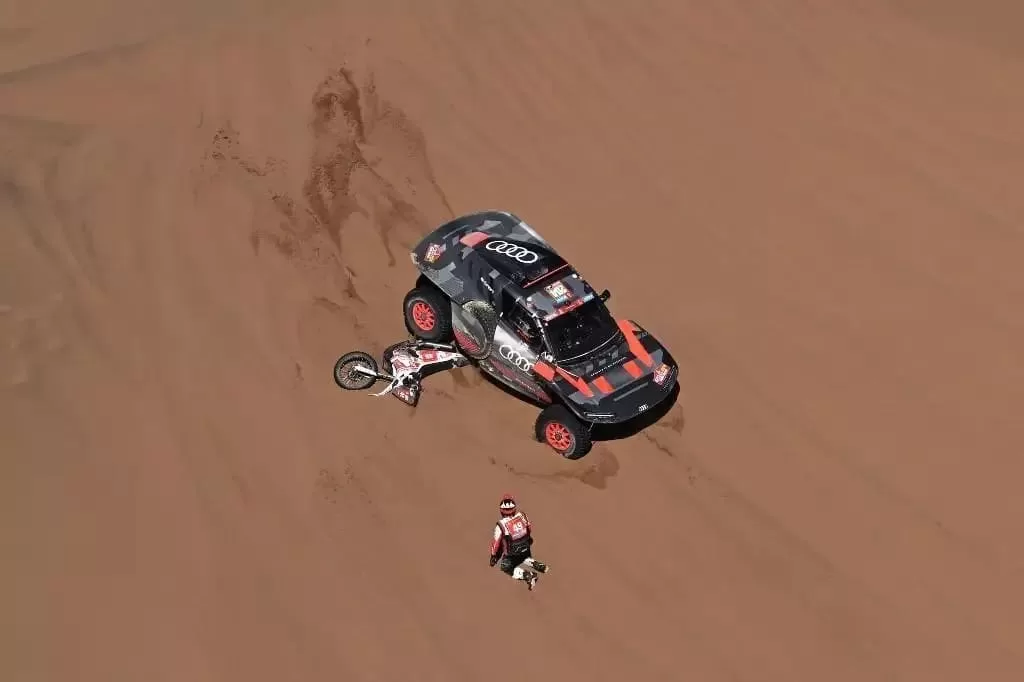
An image that could be avoided following the new measures taken for the
photo: PATRICK HERTZOG - AFP
Spotlight on electric and hydrogen vehicles
By 2030, all Dakar car and truck classes will be made up of carbon-neutral vehicles. To get there, the Dakar, which authorized teams to take part with electric or hybrid cars earlier this year, is planning a gradual introduction of alternative energies, including hydrogen. The Dakar encourages innovation with specific rules designed to foster the competitiveness of these machines and promote a more sustainable future for the rally.
Four years after the creation of the Dakar Classic, it is therefore logical to see the arrival of new vehicles in the historic regularity race. The "Mission 1 000" will be open to the generation of cars and trucks registered between 2000 and 2005.
Dakar Rally 2025: End of the adventure in Shubaytah
All good things must come to an end, and Shubaytah will mark the final whistle of this adventure in an ocean of dunes. For the final stage, cars and motorcycles will start in a row, as "a reminder of what makes up the DNA of the adventure", with fond memories of Lac Rose in Senegal. This time, it won't be the water, but the sandy expanse that will see the drivers flee, by the dozen, in the middle of nowhere.
These are the first lessons to be drawn from a 2025 edition that promises to deliver some beautiful images. "The Dakar has to be earned", says David Castera, so these two weeks promise to be both particularly challenging and promising. With its new challenges, spectacular scenery and commitment to innovation, the rally promises an unforgettable adventure for all two-wheel sport enthusiasts. In any case, we're ready to bring you the latest edition...
 Share
Share
 helmet
 Gloves
 jacket
 braking
 Chain kit
 Oils
Oils Find an intercom
 Parts
Parts Luggage
 Tires
Tires

Bikers' reviews