
Motorcycle specifications Bridgestone GTR 350 1967 Too serious a threat


presentation of the GTR 350 1967
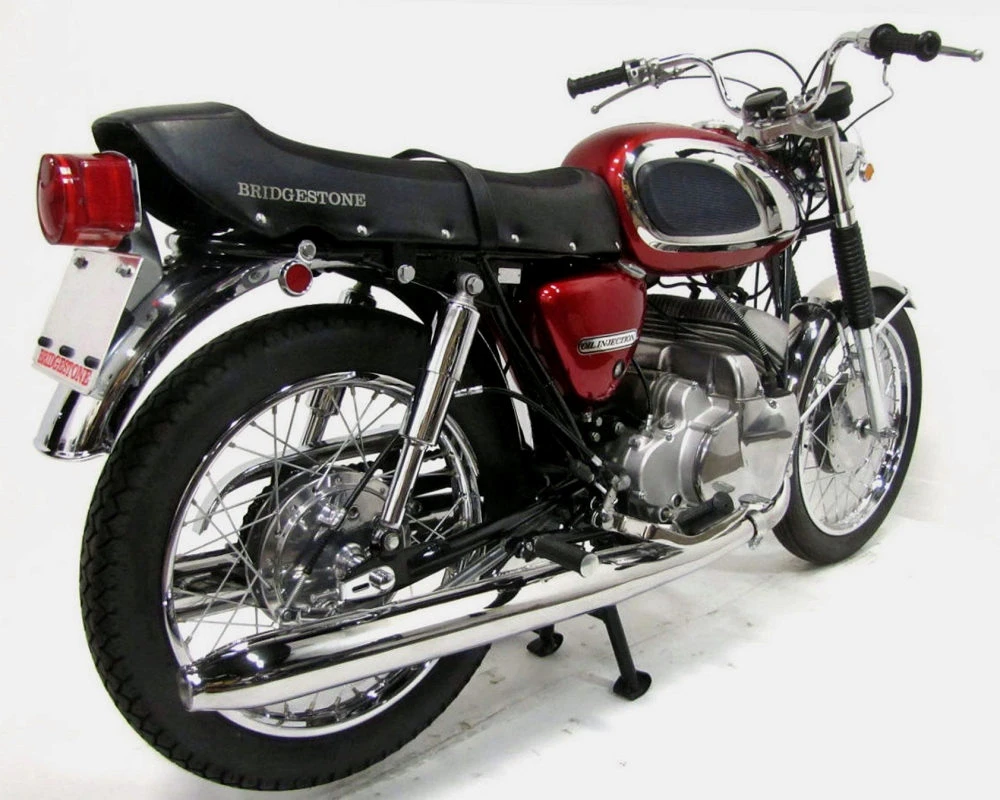
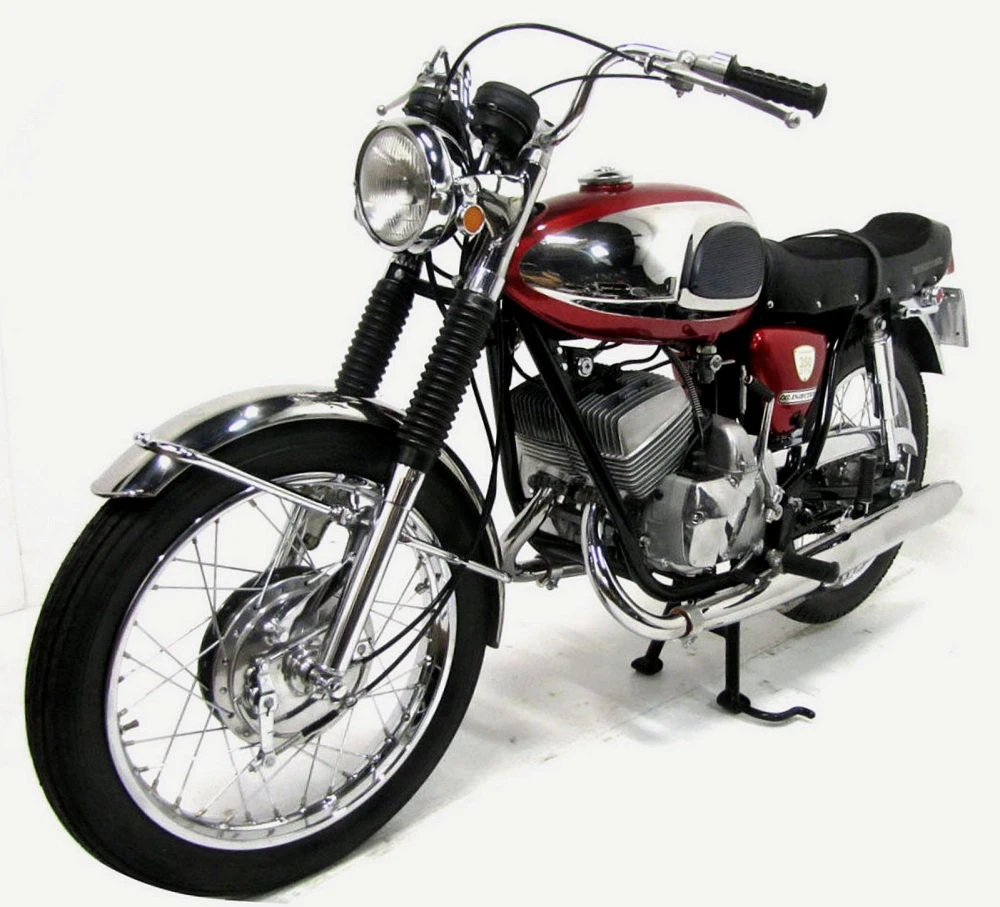
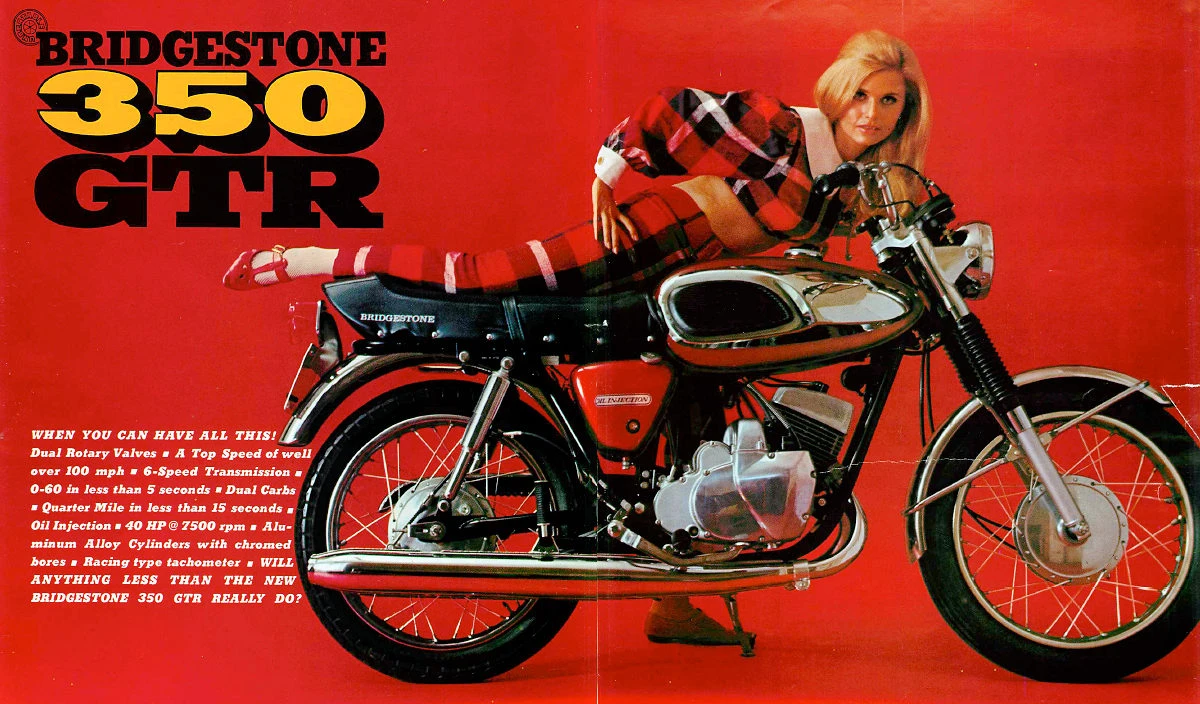
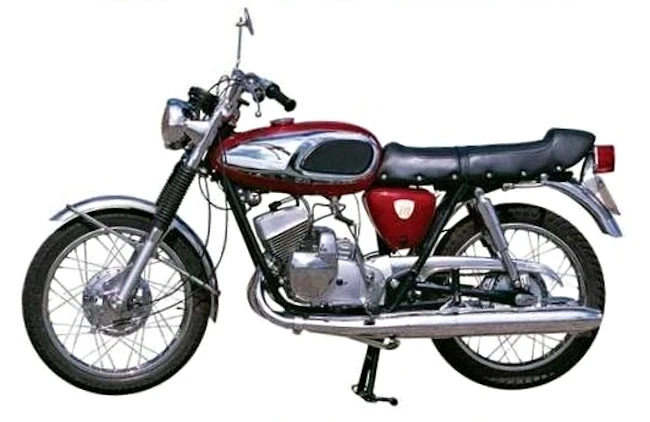
The Bridgestone GTR 350 is a paradox in motorcycle history. As the technological flagship of a brand that is now a world leader in tires, it is both the crowning achievement of its brief stint in motorcycle manufacturing and the machine that symbolized the end of that adventure. Despite its qualities of performance, innovation and craftsmanship, it never achieved the commercial success it had hoped for, and disappeared as quickly as it appeared. The story of the GTR 350 is not one of engineering failure, but rather of a vision ahead of its time, unable to find its place in a saturated market.
Bridgestone's motorcycle adventure
Bridgestone's entry into the world of motorcycles dates back to 1952, with the production of motor-assisted bicycles. The company's motorcycle division, renowned for its advanced engineering, quickly evolved into the design of mopeds and full-fledged motorcycles, all powered by 2-stroke engines. Production focused mainly on export to the USA, where Illinois-based exclusive importer Rockford Motors played a crucial role.
1958 marked the start of "real" motorcycle production with the 50 cm3 BS Champion model. The company's success took on a new dimension in 1965 with the launch of the BS-90 range. Bridgestone took advantage of the bankruptcy of other Japanese manufacturers such as Lilac and Tohatsu by recruiting their engineers, who brought with them valuable expertise in fast 2-stroke engines, acquired through racing activities. This infusion of talent has enabled Bridgestone to position itself as a serious competitor, capable of producing technologically sophisticated motorcycles.
The GTR 350: a laboratory of innovation
A technological heart: the engine
The heart of the Bridgestone GTR 350 is an air-cooled 345cc parallel-twin 2-stroke engine, introduced in 1967. With a bore of 61 mm and a stroke of 59 mm, this engine was a feat of engineering that produced a claimed 37 hp at 7,500 rpm.
The engine's most notable innovation is its rotary disc-valve induction system. Unlike conventional engines of the time, the GTR used a rotary distributor for each cylinder, enabling more precise management of intake gases. This technology conferred a decisive competitive advantage, enabling non-symmetrical intake timing and offering more space for a more efficient scavenging port. It was this cutting-edge engineering that enabled the GTR 350 to outstrip rivals of similar displacement and outperform larger-displacement bikes in drag races. The GTR's reputation as a "superbike" stemmed directly from the performance this induction system gave it.
The GTR 350 wasn't content with just one feature. It incorporated other cutting-edge technologies for its time:
- Oil injection lubrication: a pump system, similar to Yamaha's, which eliminated the need to premix fuel and oil. Bridgestone added the sophistication of a crankcase oil level sight glass, a rare feature.
- Chrome-bored cylinders: Unlike other manufacturers who used cast-iron liners, Bridgestone developed a chrome-boring process for aluminum-alloy cylinders. This cutting-edge technology offered greater durability and reduced friction.
- Piggy-back alternator: The alternator was placed behind the cylinders and driven by gears. This solution, an industry first, enabled the engine block to remain relatively narrow, despite the 26 mm carburetors mounted on either side of the crankshaft.
- Dry clutch: an unusual feature on Japanese road bikes of the time.
Transmission and chassis
The GTR 350 was equipped with a six-speed gearbox, a rare feature at the time. Another feature that delighted riders was the bike's ability to change the position of the gear selector and rear brake pedals. This clever feature allowed riders to use either their left or right foot to change gear, an adaptation that demonstrated thoughtful, rider-centric engineering, taking into account the varying preferences of the time.
The rest of the GTR's chassis, on the other hand, was relatively conventional for its time. It used a double-cradle steel frame, gusseted forks and twin rear shock absorbers. Braking was provided by front and rear drum brakes.
A little-known marvel
The GTR 350's performance figures were nothing short of impressive. Although the claimed power rating was 37 hp and the official top speed was announced at 153 km/h, a road test carried out in April 1968 by the magazine
Motorcycle Mechanics reported a top speed of 174 km/h. This discrepancy is a fascinating detail for enthusiasts, as it confirms that the machine's true potential exceeded even its manufacturer's claims.
A perfect imperfection
Despite the general enthusiasm, critics also highlighted certain weaknesses. The double-cam front drum brake, while excellent on the 175 cc model, was judged "barely acceptable" on the GTR 350, less up to the task of matching the engine's power. In addition, the suspension, judged too soft, was a weak point affecting handling on uneven surfaces. The lack of good suspension limited the bike's ability to take fast corners.
Some riders were also disconcerted by the unusual layout of the gearbox, with neutral located below first gear. Finally, public reception was tinged with a certain distrust of a tire manufacturer embarking on the production of high-performance motorcycles, due in particular to initial reliability problems linked to oil seals and air filter parts that tended to break.
A paradoxical commercial failure
Despite its undeniable qualities, the Bridgestone GTR 350 was a commercial failure. Only 9,000 units were built between 1967 and 1971. The public was generally skeptical, and the bike's high price was also a major obstacle, as it was comparable to that of much more prestigious, larger-displacement models such as the Triumph Bonneville.
The commercial failure of the GTR 350 was a direct consequence of its technical excellence. Advanced technologies such as the rotary distributor induction system and chromed cylinders made the bike more expensive to produce. To compensate, Bridgestone had to set a high selling price, unwittingly placing the GTR 350 in direct competition with motorcycles with long-established reputations and legacies. It couldn't win this reputation battle alone, and the public wasn't prepared to pay such a high price for a machine from a manufacturer inexperienced in the market.
A conspiracy?
A myth has long persisted that the "big four" Japanese manufacturers (Honda, Yamaha, Suzuki, Kawasaki) pressured Bridgestone to stop producing motorcycles so as not to disrupt the market. While this myth is appealing, the truth is more complex and less romantic.
The real reason for Bridgestone's withdrawal from the motorcycle market was a strategic and rational decision. The motorcycle division was small and its profits marginal. Meanwhile, Bridgestone's core tire business was thriving, and its main customers were none other than the "big four" themselves. As a competitor, Bridgestone's motorcycle business was jeopardizing its most important commercial relationships. The GTR 350, with its technical superiority and high-end positioning, probably exacerbated this conflict of interests, making coexistence untenable. So it wasn't a question of intimidation, but a logical prioritization of its large-scale commercial interests.
Conclusion
The story of the Bridgestone GTR 350 is a fascinating tale of innovation, performance and commercial failure. It was a motorcycle ahead of its time, an engineering marvel and a thoroughbred on the road, capable of outperforming larger-displacement machines thanks to technologies that were revolutionary for the time. However, it failed to gain a foothold in a fierce market, weighed down by an excessively high selling price, directly linked to its manufacturing costs, and an insufficient reputation in the face of established brands.
In the end, Bridgestone's disappearance from the motorcycle market was not due to a technical defeat, but to a strategic choice to protect its wider commercial interests. Ironically, what caused Bridgestone's failure - its low production and unique history - was precisely what forged its iconic status among enthusiasts.
by Greg

Greg is the founder of Motoplanete—a website created in 2001 to share his passion with his friends and showcase as many motorcycle models as possible to his readers. Self-taught and a jack-of-all-trades, his discovery of the world of motorcycles led him to work as a photographer, rider, team manager, web developer, graphic designer, editorial assistant, and editor-in-chief.
 Share
Share
Key facts Bridgestone GTR 350 (1967) : What you need to know before you buy
Prices
| Basic version | |
|---|---|
 Japan Japan |
225,000¥
|
 United States United States |
$895
|
Model sold in 1967
Performance
- Max speed : approximately 150 km/h (93.20 mph)
- 0-100 km/h acceleration : 5.20 s
- Average fuel consumption : 5.20 liters/100km (0.45 mpg)
-
Estimated range
: 269 km (167 miles)
Calculated range until tank is empty, not verified.
Specifications Bridgestone GTR 350 1967
- Chassis
- Two-seater saddle
- Frame : double tubular steel cradle
- Fuel capacity : 14 liters (3.70 US gallons)
- Oil capacity : 1.50 liters (0.40 US gallons)
- Seat height : 815 mm (32.09 in)
- Length : 2,110 mm (83.07 in)
- Width : 825 mm (32.48 in)
- Min height : 1,115 mm (43.90 in)
-
Min. ground clearance : 144 mm (5.67 in)
- Wheelbase : 1,374 mm (54.09 in)
- Dry weight : 160 kg (353 lb)
- Front axle
- Telehydraulic fork Ø nc
- drum brakes Ø 193 mm (7.6 in)
- Transmission
- 6 stage gearbox , manual
- Secondary by chain
- Rear axle
- 2 lateral shock absorbers
- drum brakes Ø 193 mm (7.6 in)
- Motor
- two-cylinder online, parallel , 2 strokes
- 2 carburetors Ø 26 mm
- Cooling system : by air
- 345 cc
- 37 ch (36.50 hp) to 7,500 rpm
- 4 mkg to 7,000 rpm
- Power-to-Weight Ratio : 4.38 kg/ch
- Torque-to-Weight Ratio : 40 kg/mkg
- Compression : 9.3 : 1
- Starting system : kick
- Practical information
- Made in 9,000 copies
- Country of manufacture : Japan
Essentials


 Motoblouz
 LaBécanerie



Gallery
Models
1967
Used
Compare the GTR 350 to its competitors
FAQ Your frequently asked questions about the GTR 350 1967
- What is the power of the GTR 350?
-
The GTR 350 1967 develops a power of 37 ch (36.50 hp)
- What is the torque of the GTR 350?
-
The maximum torque of the GTR 350 1967 is 4 mkg to 7,000 rpm.
- What is the maximum speed of the GTR 350?
-
The GTR 350 1967 is capable of reaching a top speed of approximately 150 km/h (93.20 mph) on the track.
- What is the weight of the GTR 350?
-
The GTR 350 1967 has a a dry weight of 160 kg (353 lb).
- What is the fuel consumption of the GTR 350?
-
Average fuel consumption is estimated at 5.20 l/100km (0.45 mpg) according to the WMTC cycle.
- QWhat is the seat height of the GTR 350?
-
To ensure good accessibility, the GTR 350 1967 offers a minimum seat height of 815 mm (32.09 in).
- What is the price of the GTR 350?
-
The price of the GTR 350 1967 is $895 in the United States. It is displayed at 225,000¥ in Japan.
News
-
The 89th Bol d'Or: A Celebration of Racing Passion.
-
2026 MXGP of China: Herlings Unbeatable, McLellan Delays the MX2 Title
-
MXGP 2027: Kove and ZXMoto Join the Championship
-
SC Project is working on the 2026 Suzuki GSX-R1000R.
-
2026 MXGP of Turkey: Herlings Crowned World Champion!
-
Moto Guzzi: In Mandello, the historic factory is taking on a new scale.
-
ZXMoto in MXGP 2027: The Hypothesis of an Off-Road Earthquake
-
Superbike - Will 240 ch sport bikes soon be available at dealerships?
-
2 new SC-Project mufflers for the R 12 NineT and G/S.
-
The new motorcycle models of 2026 and the evolutions.

Bikers' reviews Leave a review