


some ideas are worth rediscovering. The scooter (in its general theme) has carried with it an image of a small urban machine, practical and playful since the dawn of time, with a rigorous driving style akin to the Savoyard sausage (the diot, for connoisseurs). But since the new century, the machine has become more comfortable, more competent, more powerful and more versatile. Honda's Forza 750, almost a GT in its macrocosm, is the pinnacle of this trend.
descended from the Integra RC62, this big baby has become strategic on the market and has to deal with a star dusegment. Opposite it, the famous Yamaha T-Max enjoys a strong reputation and a slightly sportier temperament. On the other hand, the Forza boasts a robotized gearbox that perfectly matches its mission and ambitions. The 2025 version takes efficiency one step further. Let's see how.
behind us, the Mediterranean and its accents of the Grand Bleu carpet the horizon with physiological freedom. It was near here that Enzo and Jacques began a fratricidal competition that inspired a generation of Luc Besson's poetic dreams. Less dreamy, more serious, the 7 and a half Forza presents a proud appearance with its reworked design. Its stature is more assertive, more mature, as if it had swapped its shirt for a suit. Still bourgeois but sharper, with a hint of squalor and a noble stance on its wheels, it's perfectly suited to a corporate executive or an uptown cab driver.

there's plenty of plastic on board, some of it very soft, giving a false impression of lightweight quality. As always with Honda, the assembly is serious, the finish very appreciable and the finish first-rate. But is the handlebar cover really necessary? Once on board, the Forza's imposing stature fades somewhat to make way for a sober environment dedicated to a ride somewhere between touring and comfort. But we'll discover that it can do more than that.
the phone goes to sleep in the small right-hand glovebox, a press on the ignition button (the key can remain in the pocket), a pull on the starter and the twin-cylinder wakes up with a discreet, well-bred rattle. A flick of the thumb to engage the DCT, and the group sets off through small Sicilian villages full of surprises.
in this environment, Honda's robotized transmission works wonders. At "take-off", the clutch bites with the same grip as an experienced human hand, keeping a small point of slip to moderate the roll, but ready to disengage completely to really get going. The old gearbox might have seemed to suffer a kind of hesitation at this stage, lacking the sensitive, cognitive approach of the human "feeling" - the new one, on the contrary, deliberately and confidently manages this "hesitation". Bluffing! When turning on the throttle, or when performing plateau-like maneuvers, the maxi-scoot moves as well or better than with any other type of transmission, having eradicated the little hiccups sometimes encountered on older generations.
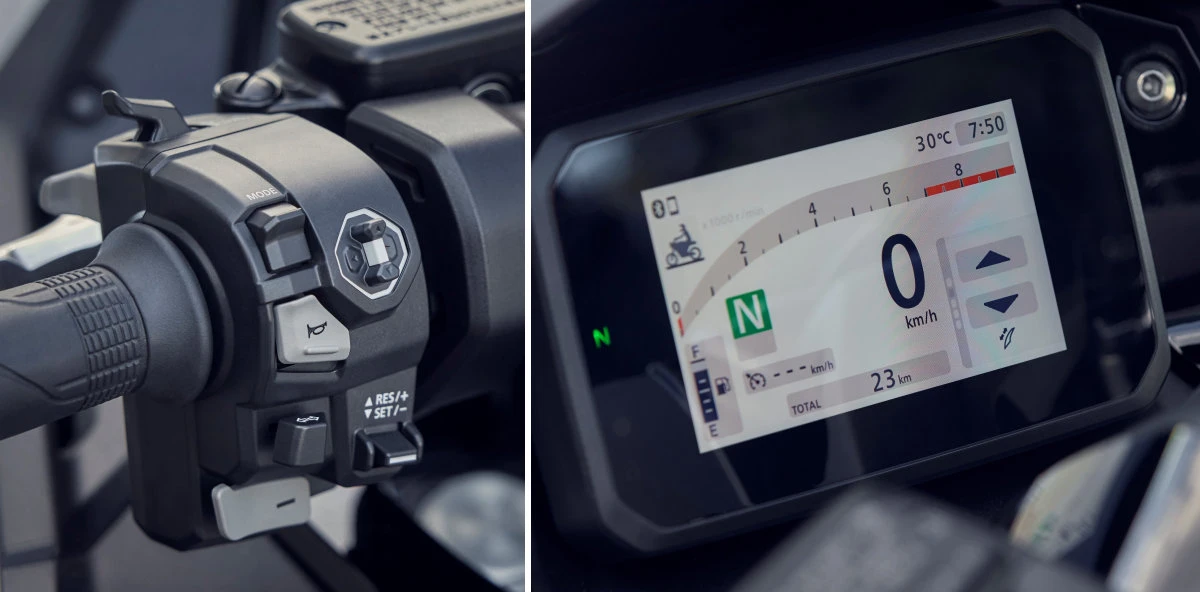
the Dual Clutch Transmission can be operated in either Driving Modes or Manual mode, with left-hand shifting, but its efficiency is such that it remains in Automatic mode at all times. In Sport mode, it can delay upshifts by letting the engine rev up, and sometimes retains the gear when the throttle is not fully engaged, to keep the engine revving. A behavior in keeping with its name, but not really with its engine.
after all, the Forza's twin isn't the most at ease in high-speed use. In fact, it wasn't designed for it. Its playground is the mid-range, where it makes optimum use of its torque. Consistent, with a smooth response and a certain depth of sound, it allows you to extract yourself from city situations, aided by the gearbox's short first ratios. Pick-up is frank and energetic, giving the impression that sporty riding is on the cards as the twin becomes wilder.
except that when you start to tease it more wickedly, the block continues its effort in a less flattering noise, with accents of culinary tools. The pursuit of acceleration continues, but with less enthusiasm than when it takes advantage of the "fat zone" of power. And yet its strength is 58 bhp, seasoned with almost 7 mkg of torque. But the mechanics are subject to the law of their origins, dating back to the NC 700s, with a technical design designed to save money (and not to save money, mind you). The 745 cm3 prefers GT behavior, which will be the rule for 90% of Forza use. For moments in a hurry, this business scooter is still capable of 170 km/h. Without veering off course or waddling around corners. Stability in all situations is proven, accompanied by a healthy, homogeneous chassis. Only the slight negative thrust in the back might bother you a little. But who likes cruising at this kind of speed on a scooter-GT?
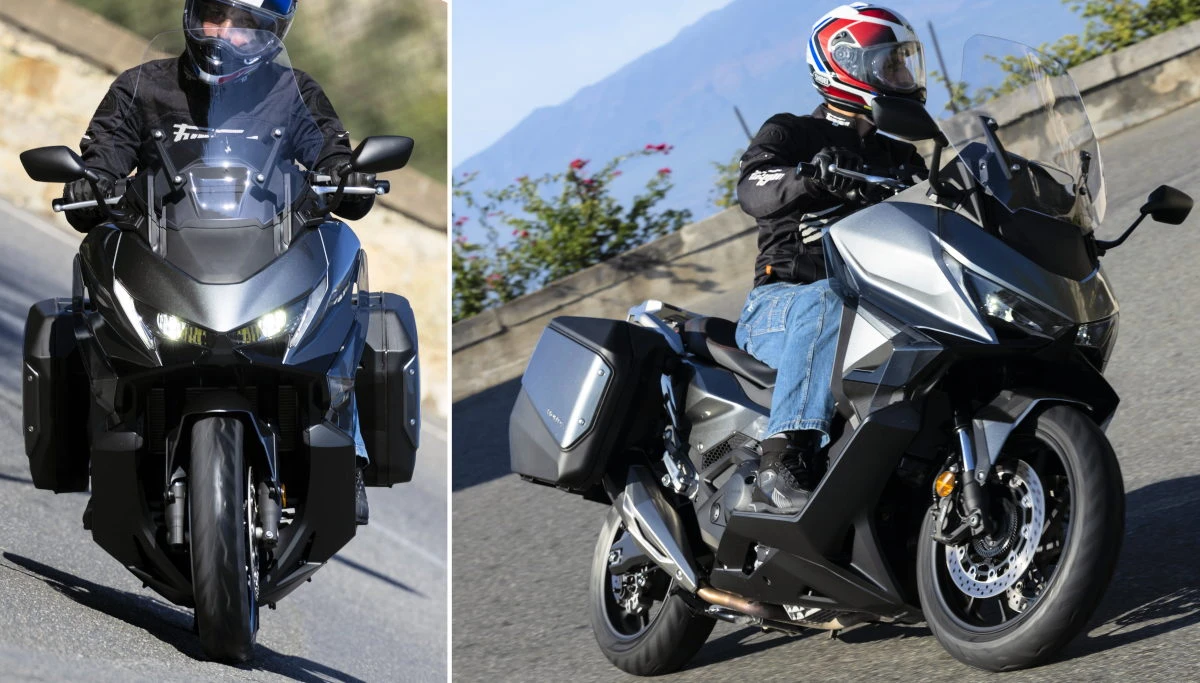
with 236 kilos in the buffet, you can't expect ballerina-like handling. And yet, with its low engine position, quality suspension and well-thought-out geometry, the Forza instantly puts you at ease, engaging and cornering at a flowing, even engaging pace, but without bouncing from one to the next. Reassuring at all times, it doesn't lose its grip on the scars and crevices of the road, and barely locks in when entering a curve a little too optimistic and the brakes too insistent. Its damping works beautifully, with a remarkable digestion of asperities, leaving a good reading of the road and a well-calibrated firmness. Only in the case of certain high compressions would we have appreciated a slightly softer shock absorber stop. But that's quibbling.
the Forza's mass finds a good braking lieutenant in Nissin's 4-piston radial calipers. They attack the 320 mm discs with suppleness, providing easy, even metering, with plenty of power in the jaws when needed. Road-holding braking, but the bite could be more incisive. As for the ABS, you really have to slam on the brakes to activate it.
the area in which the Honda 750 Forza best expresses itself remains, as you'd expect, dynamic touring. Its bow protects the legs well, the seat is comfortable and the bubble deflects air away from the forehead to protect the torso and minimize pressure on the helmet. All this in the upright position.
Because when brought up to its base, it quickly becomes noisy when the speed goes out of town. The height change operation is electric, with some manipulation of the multifunction pad by the left thumb. Personally, and in the opinion of many, a dedicated button would have been nicer and more practical.

except that Honda wants to simplify its control system. The on-board display is teeming with information (better arranged than before, with more orderly graphics) and settings as you enter the menus. The abundance of electronics has enabled the manufacturer (and others) to develop and even over-develop functionalities, but it's not always easy to create intuitive navigation. The backlit controller and its paths take a little time to learn, or rather to get used to its logic, and then enable a host of operations. In fact, if the Standard, Sport or Rain driving modes don't suit you, Honda has included two User modes for setting acceleration, engine braking, traction control or DCT management to your liking. Note: if you deactivate Traction Control (or HSTC torque control), it will return the next time you restart the machine. Among the things to review, the turn signal control (still....) is not yet perfectly in line with the thumb's natural trajectory, and activating the warning system requires some research. Why not place it near the opening buttons? There's plenty of room, and it's right under your nose. On the other hand, DCT control is much more intuitive than before. The Japanese have fitted cruise control as standard, which we unfortunately didn't have the chance to try out.
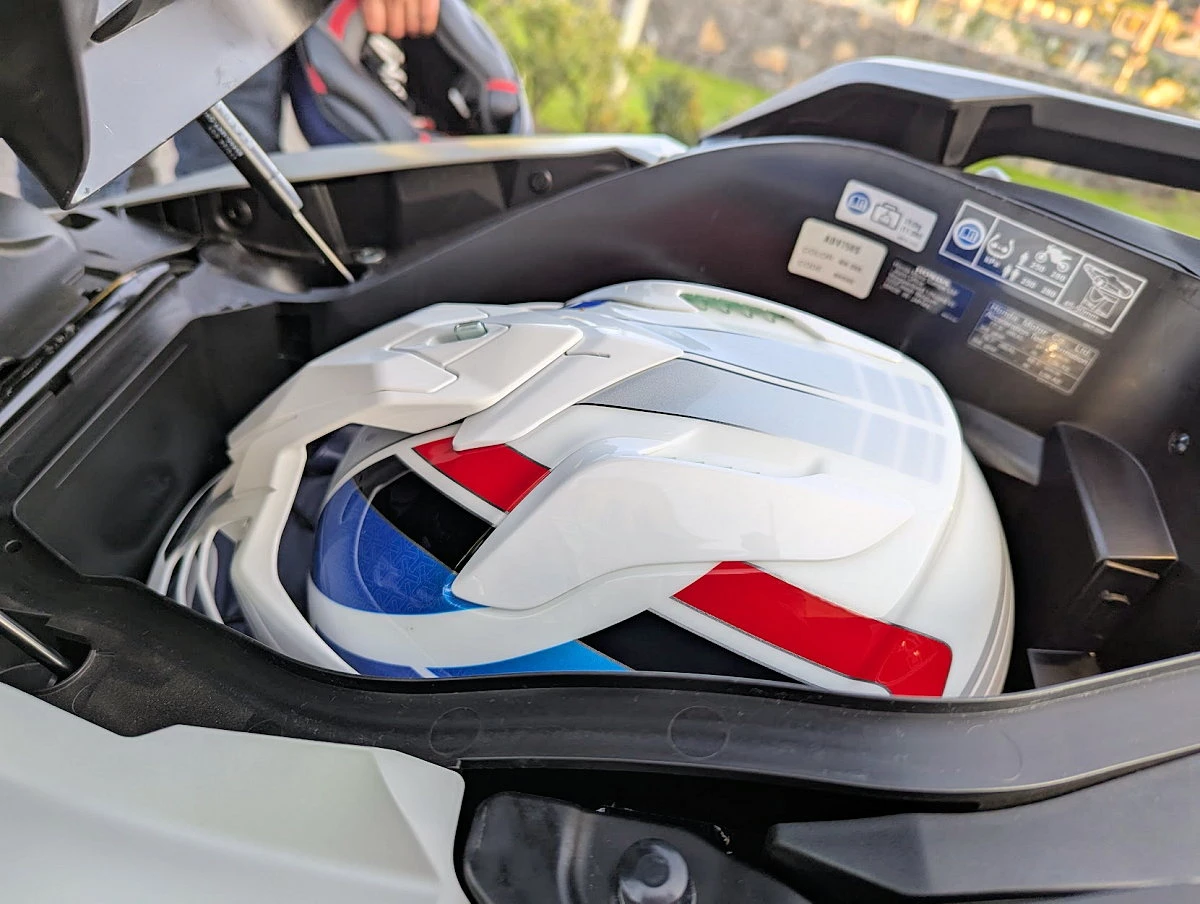
one of the strengths of a scooter, with which very few motorcycles can compete, is the large trunk under the seat. The forza's 22-liter recycled-material hull (Honda has great ambitions in this area) can accommodate a full-face helmet, even a crossover-type helmet with a cap. Make sure the front of the helmet faces downwards, and the base of the trunk, so that it fits snugly. The seat is easy to use, with a button on the center console and two retaining cylinders. The fuel filler flap is also controlled by a button of the same type. Keyless is transparent and practical on the Forza, which is not always the case with other manufacturers.
thanks to its set of suitcases (optional), the Forza transforms itself into a small sport-GT, capable of carrying a few belongings in makeshift dimensions. Almost a renaissance of the Deauville , with 20 years more technology. But don't expect too much: the right-hand luggage compartment, severely reduced by the exhaust pipe, can only be used as a briefcase, or even as storage for a rain suit. The left-hand hold is more convincing, with room for a small helmet. Small, eh? or a sponge helmet.
upgraded to Euro5+ standards, the Forza 750 doesn't undergo any major changes, but acquires a more enhancing touch and reinforces its qualities. Pleasant, easy-going, bourgeois (in the good sense of the word), more of a polo player than a water player, it lives up to its lineage and should still be able to take a bite out of its best enemy. Especially as it can count on its X-ADV brother, also modernized, to tackle a more "adventurous" picture. Its price is also in line with its claims. Strong but not exaggerated.
Greg Rattin - Manufacturer's photos
 helmet
 Gloves
 jacket
 braking
 Chain kit
 Oils
Oils Find an intercom
 Parts
Parts Luggage
 Tires
Tires
 France
Bikers' reviews Leave a review - 14 reviews
It's the best in terms of comfort and power—60 cv. Rating : 2/5 Participate in the conversation
It’s also worth noting that the dignity of those of us who aren’t very flexible will take a serious hit when getting on or off this scooter. The step-through is high, and so is the back of the seat; as a result, your shoes drag on the ground, which wears them down over time, or else you end up looking like a total clown, the kind who has to hop around to avoid wearing them out. If you’re easily embarrassed, only use it in the dead of night on a deserted street. If you have the right leg length, stick with your motorcycle. If you’re the type who can easily do the splits in jeans that are a little tight around the knees, the Forza is for you.
The transponder definitely needs to be in your pocket, not in the storage compartment under the handlebars. And even then, the Honda top case has some glitches, which—thankfully—can be fixed with the key. Nobody’s perfect, because as for the rest… it’s all good. Yeah, a Forza 1000—as Charlie says, I’d be interested in one too—but that’s because we come from the motorcycle world. But seriously, who buys a 750cc scooter? Who’s the core target audience?
Despite the limited time I’ve had to ride it, I’ve also noticed that it lacks storage space. It takes off with a kick—not quite as much as a BMW CE04, sure, but enough to catch you off guard if you’re too eager with the throttle coming out of a roundabout, for example—but after that, the throttle response flattens out a bit. I agree with Charlie about the sound. Even without an Akra, it has that nice “hum-hum” sound—and this is coming from a BMW rider who’s always appreciated the quiet of his RT. That hum-hum pleases me without waking up 10,000 people if I’m riding through Paris at night. It, too, gives us a bit of a false sense of reality, but it’s the engine response that reminds us we’re on a scooter and not a motorcycle. And it’s likely that brands—not wanting to compete with themselves—will never give the scooter style a chance. And yet, the Forza has the top speed; it has the storage space… So come on, Mr. Soichiro Honda—put in a little effort!
Only one brand—a true challenger—could pull this off because it doesn’t make motorcycles: Kymco. As a manufacturer exclusively of scooters, it could surprise us with a 1000 at an unbeatable price. And put the Tmax to rest once and for all.
And the Forza, while they’re at it. BMW didn’t want to stick around in this market. It didn’t take the right approach, in my opinion. Its 650GT lacked what makes the Forza so great: the sequential transmission, that pure pleasure. Putting a Peugeot 103-style gearbox on a high-displacement bike was setting it up for failure.
What I definitely don’t like is the side stand. It’s hard to position under your heel, very short—it makes me feel unsafe—and I find the bike leans too far over once it’s parked, which doesn’t help (see the second paragraph).
The most important thing, however, among all these considerations, is the pleasure. The pleasure of approaching the bike, looking at it, getting on, and hitting the road. It’s not objective, I’ll grant you that, but that’s how I feel every time—whether motorcyclists like it or not. I used to be one. And in my own way, I still am.
The road is wet from the last downpour. Yet I lean into the turns with confidence—the kind that comes from the bike’s balance. That sense of ease never leaves me, despite the riding position—sitting on my butt with my feet forward—which is highly unusual for a lifelong motorcyclist and means I’m no longer one with the machine but simply sitting on it. I’m just careful when twisting the throttle coming out of a turn—I’m still in Sport mode, which makes the Forza a bit twitchy. This power curve gives it some nice engine braking, just the way I like it—me, the BMW rider who brakes mainly by letting off the throttle. You can program two other modes besides Rain, Standard, and Sport—well, I’ll see. By now, I’ve already learned to love the endless roundabouts that France has been building in recent years. In manual mode, the Forza even has the good sense to make a “vroom” sound when downshifting, just as I would on my RT to make the shift smoother. It’s pleasing to the ear and reassuring while riding—it’s familiar territory, the right gear for the right situation.
I’m even starting to think it’s handsome—and I usually hate sharp angles and angular lines. Well, we evolve without even realizing it. My RT has taken a beating, but that’s another story altogether. Rating : 4/5 Respond to Jean
I’ll take Jean’s word for it about cornering—it’s a pure delight. The car’s overall balance really makes you want to tear up the mountain roads.
Even without the optional Akrapo, the sound is nice, and it decelerates with class in manual mode. Too bad the engine doesn’t measure up to the rest—it’s missing a few horsepower. Okay, okay, it’s not a motorcycle, but it feels so much like one... A Forza 1000? I’d take it in a heartbeat. Rating : 4/5 Respond to Charlie
With a lower center of gravity, a seat height 25 mm lower than my BMW’s, and weighing 40 kg less, I can see myself continuing on two wheels for a while longer. I’ll keep getting older under my helmet, but with my butt on a Forza.
In sport mode with the sequential gearbox, it’s a real treat—you can really push the gears. Sure, it’s just a scooter, but honestly, it’s more than enough to have fun on short suburban trips. Standard mode with automatic transmission for city riding because, let’s face it, that’s 90 percent of how we use our bikes. Built for the city, with its lane changes and smooth, smooth takeoffs at green lights, I even cleanly left in the dust some smart aleck who was showing off—you know, doing a wheelie with one foot on the seat, right in front of me on, don’t ask me what, a bike that’s way more of a “real” bike than a Forza
The ease with which it takes corners really makes you want to take a ride on winding roads—and take it from a Behemoth rider. Basically, I’ve gone from a big bike to a smaller one.
On the downside, the storage compartment under the seat isn’t big enough for just any helmet. Helmet with a large head won’t fit—same goes for the top case. It’s true that the deeply cut bodywork above the rear wheel looks great, but if it were cut a little less deeply, it would have added some extra storage space. Another annoyance: the transponder’s range means you have to take it out of its little compartment—where it sits so neatly under the handlebars—to open the top case. Otherwise, tough luck.
Finally, coming from the “old world”—that of the 2007 RTs—it feels a bit strange to find myself in a world where electronics reign supreme. Hence my delight when I tried the sequential mode. It’s the only bit of a return to the past that the Forza offers, but it deserves credit for offering it at all. As for that little adjustable windshield, its effectiveness is almost on par with the large windshield on my RT. But let’s wait for the rain to put it to the test.
In conclusion, the hardest part is leaving something behind. A scooter isn’t a motorcycle, but this one does the job damn well—and in the city, better than many motorcycles. My left hand now stays on the handlebars when I pass motorcyclists—such is life. Rating : 4/5 Respond to Jean
Very satisfied.
Great looks and finish (typical Honda).
Excellent balance in the city and great agility; the transmission is smooth and very quiet in all modes.
Some drawbacks: it feels heavy when stationary and during maneuvers; the menus are difficult to navigate and not very intuitive—they can even be dangerous while driving until you've mastered them and memorized them perfectly. Rating : 5/5 Respond to Patrick
The pleasure of driving is there, and given current traffic conditions, it's more than enough. And for fun, I take out my 350 RDLC from time to time. The 2025 model has been ordered Rating : 5/5 Respond to Jeje
I really missed it on the 2021 and as I've already put 35,000kms on it... I'm ready for the new one, as I can't ride a motorcycle anymore with my handicaps, it's the ideal machine! Rating : 5/5 Respond to Desmo
It's a 2-wheeled kangoo. Rating : 4/5 Respond to La buse
It's an SUV but Honda should put more pep in it, less electrical or electronic stuff. It has no soul. Rating : 4/5 Respond to Marco