
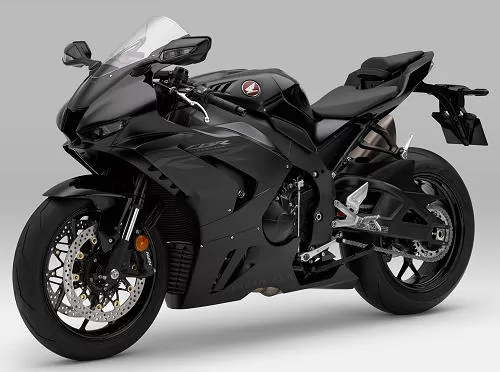
Motorcycle specifications Honda CBR 1000 RR-R Fireblade 2020 Above speed.


presentation of the CBR 1000 RR-R Fireblade 2020
The throttle is in the corner, twisted as it approaches agony. The launch control works as hard as it can, wondering if it's going to be overwhelmed by the enormous power that's just moments away. First gear - already illegal; second gear - a glimpse into the realm of speed; third gear - it's already too late to wonder. In any case, the bar graph continues its epilepsy; fourth - the CBR 1000 RR-R begins to show its true face, defying all current hypersports; fifth - km/h no longer matters; sixth - the gaze merges with the stopwatch as the Honda overtakes its destiny.
The 1000 Fireblade has entered another dimension. It has always been known for its "conciliatory" side, but now it's radical. It now has a single objective: Superbike. To win, to forget her years of victory drought. Completely new, she wants to crush her rivals, and shows up at the aspi of the Ducati V4R. Take a deep breath, open your eyes and give your imagination a piece of the pie before it's transformed on track: the new CBR 1000 RR-R spits out an impressive 217 horsepower!!!!
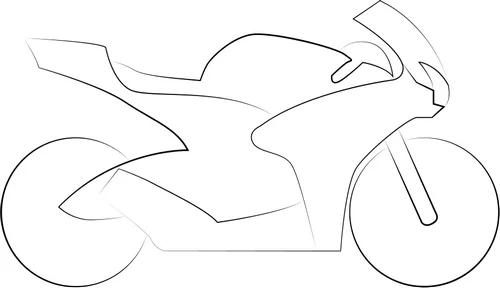
It's not a ladle or a bucket of power that the big CBR has gained, but a bowl. It was the least powerful of the bunch (192 hp), but now it's slapping the competition in the face. The increase is impressive: 25 hp more. This puts it de facto well ahead of its compatriots. The Kawasaki ZX-10 R, Yamaha R1 and Suzuki GSX-R are all out of action. The Aprilia RSV4 is skinned. Overpowered, the BMW S 1000 RR takes a slightly less salty slap. The CBR even manages to exceed the 214 hp of the 1100 Panigale, which is better equipped in terms of displacement (and torque). Only the V4-R holds its head high thanks to its exceptional technical solutions - for twice the price. Has Honda finally revived its love affair with the V4, deflated an RC 213 V engine and placed it in its new missile? Alas, no... Well, not quite. There's no need to take offence, because this CBR's in-line 4-cylinder pedals like a dream.
The dimensions in question are identical to those of the RC213V. 81 mm wide for each piston, with vertical movement over 48.5 mm. Nothing to do with the 76x51 mm of the previous CBR 1000.
In its turn, the Honda adopts latch-type valve timing, more suited to high revs. For the distri chain, a new system combines chain and intermediate sprocket. Inside the engine block, we find special coatings to reduce friction, titanium connecting rods weighing half as much as steel ones, forged aluminum pistons, multi-jet spraying to cool them, and a more closed intake valve angle, injection throttle bodies increased from 48 to 52 mm, ovalized intake and optimized exhaust ducts, work on water temperature stability around the cylinder liners, a more compact crankshaft and a new air intake to supply the 4-cylinder engine with fresh air.
To evacuate stale gases, Akrapovic took care of the exhaust system. As long as a Bazooka (hi Loris ;-), the titanium silencer processes the flow of fumes once they have passed the valve that contributes to maximum torque or power. It blows hard, it breathes hard through the channel running through the sight glass and steering column to the airbox.
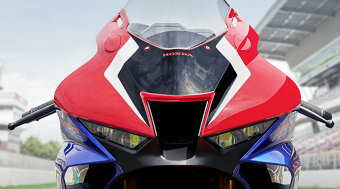
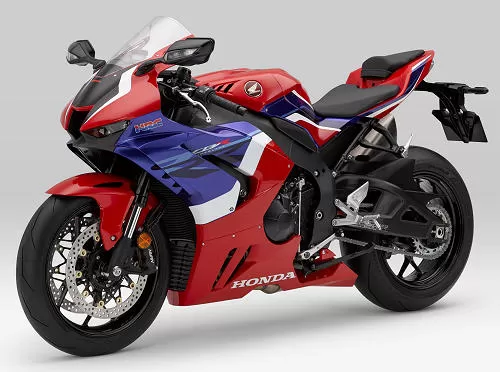
It may seem anecdotal, but this mouth in the middle of the face is a small piece of history. Honda waited almost 20 years to put it on its Fireblade, while the 600 got it back in 2007... inspired by the VTR-SP1, which inaugurated it.
By the way, doesn't the face of this 1000 CBR triple R look a lot like theex-600?
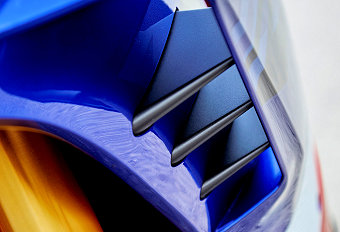
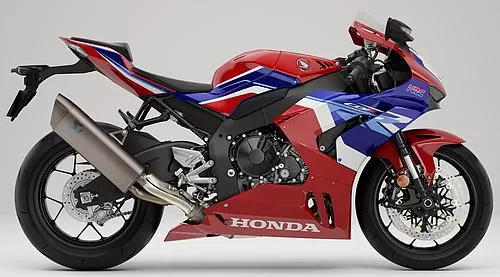
Unlike the Italians, who "added" these appendages, Honda totally integrated them into the design of the RR-R's fairing. This reflects the particular care Honda takes in designing its models, guided by a need for efficiency. Generating pressure on the front axle, the deflectors provide greater stability under braking and when entering corners. They also smooth out wheelies at acceleration, reducing the workload on the electronics, which in turn allows more power to flow to the rear wheel. More watts, more acceleration, more speed, and a stopwatch ready to be abused.
The aerodynamic treatment is not limited to the winged shoulders. The entire fairing, bubble and front fender have been designed to offer the best drag coefficient in the class. The fuel tank has been lowered by 45 mm, allowing the rider to sit more comfortably in the cockpit. The shoe has been stretched to create a simulated bend in front of the rear tire. A whole lot of little things to achieve a drag coefficient of 0.27. What does that mean? No idea - we're bikers, not Airbus engineers.
Its small headlights, front and rear, look ready to split the wind. The chassis prefers to focus on a new design to combat its eternal enemy, time.
True to its aluminum double-beam construction, the frame is completely new. Its rigidity has been significantly modified, with 18% more vertical rigidity, 9% more torsional rigidity and 11% less horizontal rigidity for greater feel. The swingarm has also been redesigned, increasing in length by 30.5 mm, with no increase in weight. A plus for traction, especially since the increased wheelbase (+50 mm) and the column angle (from 23° to 24°) will enhance stability. Rigidity has also been revised, with a 15% drop in horizontal rigidity.
So, the CBR has gone a little easy on the cheese and sausage? Not really, but it's 5 kilos heavier. That, plus the 1,455 mm wheelbase and increased caster, could make it less dynamic when changing angles... Except that the manufacturer has raised the center of gravity and optimized weight distribution.
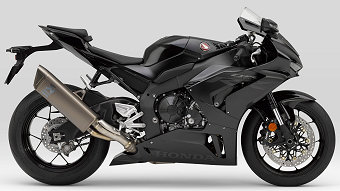
There are few changes on the damping side. The 1000 RR-R seems no more convinced than its predecessor to adopt the BFFF fork with offset cartridges found on the ZX-10R and GSX-R 1000 R. The BPF (Big Piston Fork) with large 43 mm pistons, an inverted model supplied by Showa, is still in use. Showa also supplies the Balance Free Rear Cushion Light, more compact and lighter than the BFRC without light of the previous CBR. Both are, of course, adjustable for preload, compression and rebound.
The brakes are even better, although Honda reserves the Brembo for the SP version. For the standard version, new Nissin calipers (instead of Tokico) offer reduced weight and greater rigidity. These radial clamps crunch 330 mm discs, 10 mm larger than before.
I didn't say anything, but there's still Brembo on board. For the rear brake caliper. Equipped with a 220 mm piston for gniaker the track.
One... Two... Three Showa items on the list. Oh yes, the Japanese company also supplies the HESD electronic steering damper. What's new is that it uses the IMU to react. The rider can set it to 3 parameters.
The big CBR has other surprises in store. The suit is on, helmet, gloves, etc.... until you realize that you've left the key in your pocket. No problemo! It's equipped with a keyless ignition system. The Smart Key unlocks the ignition and steering column.
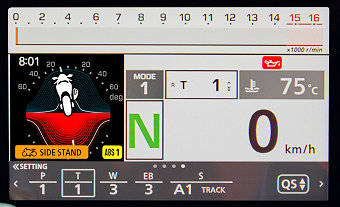
- Stop-start assist regulates engine speed at 6,000, 7,000, 8,000 or 9,000 rpm, so that the rider can concentrate on managing the clutch.
- Torque control, still adjustable on 9 levels, has been optimized. It can now also be adjusted according to the drift rate.
- Wheelie control can be set to 3 levels (same as ex-CBR 1000 RR).
- Engine braking has 3 intervention levels (idem...).
- The power selector goes from 3 to 5 levels.
- ABS cornering evolves. In addition to its cornering anti-lock management and stoppie control functions, it introduces two new modes: SPORTS for sporty use on the road, and TRACK to show off its skills on the track.
- Three Driving Modes are available for quick selection of appropriate settings (ditto...).
- Incomprehensibly, there's still no standard shifter on this hypersport.
- The instrument panel has been upgraded. A higher resolution, a larger 5-inch screen and a fully customizable display make it easy to read all the information. While the left thumb won't have much to do on this Fireblade, the right will get a lot more use out of the commodo. The set of controls is enhanced by a four-directional system for operating the color TFT display and driving parameters.
A well-stocked, beautiful world. It's not quite as dense as the electronics in an Italian car, but the essentials are there. The processors know they're going to have their work cut out for them, and they're already thinking about a hot spell when the cavalry is in high demand. The air vents on the fuel tank hood will take care of ventilating these neurons.
Nowadays, a 1000 CBR doesn't really belong on the road; it's designed for the track. That's certainly why Honda added an extra R to the machine's name. Its 217 horsepower are frightening, and show just how much Honda wants to take revenge in the merciless world of sports bikes. It offers even more in its version with semi-active Öhlins suspension and Brembo Stylema brake calipers. From now on, the Honda CBR 1000 RR-R is all about skyrocketing prices, no more compromises, no hesitation, and only one interest: to beat the clock.
M.B - Manufacturer's photos
by Greg

Greg is the founder of Motoplanete—a website created in 2001 to share his passion with his friends and showcase as many motorcycle models as possible to his readers. Self-taught and a jack-of-all-trades, his discovery of the world of motorcycles led him to work as a photographer, rider, team manager, web developer, graphic designer, editorial assistant, and editor-in-chief.
 Share
Share
Key facts Honda CBR 1000 RR-R Fireblade (2020) : What you need to know before you buy
Prices
| Basic version | |
|---|---|
 France France |
21,999€
|


Performance
- Max speed : approximately 300 km/h (186.40 mph)
- Average fuel consumption : 6.25 liters/100km (0.38 mpg)
-
Estimated range
: 256 km (159 miles)
Calculated range until tank is empty, not verified.
History

Specifications Honda CBR 1000 RR-R Fireblade 2020
- Chassis
- Frame : double aluminum beam
- Fuel capacity : 16 liters (4.23 US gallons)
- Seat height : 830 mm (32.68 in)
- Length : 2,100 mm (82.68 in)
- Width : 745 mm (29.33 in)
- Min height : 1,140 mm (44.88 in)
- Wheelbase : 1,455 mm (57.28 in)
- Weight when fully loaded : 201 kg (443 lb)
- Front axle
- Reverse telehydraulic fork Ø 43 mm, Wheel travel : 120 mm (4.72 in)
- Braking 2 discs Ø 330 mm (12.99 in), radial mounting, 4-piston caliper
- Front tire : 120 / 70 - 17 → Order this type of tire
- Pressure : 2.5 bar
- Transmission
- 6 stage gearbox , manual - optional shifter
- Secondary by chain
- Rear axle
- Mono-damper, Wheel travel : 137 mm (5.39 in)
- Braking 1 disc Ø 220 mm (8.66 in), single-piston caliper
- Rear tire : 200 / 55 - 17 → Order this type of tire
- Pressure : 2.9 bar
- Motor
- 4 cylinders online , 4 strokes
- Injection Ø 52 mm
- Cooling system : liquid
- 2 ACT
- 4 valves per cylinder
- 999.70 cc
- 217 ch (214 hp) to 14,500 rpm
- 11.60 mkg to 12,500 rpm
- Power-to-Weight Ratio : approx. 0.87 kg/ch
- Torque-to-Weight Ratio : approx. 16.11 kg/mkg
- Compression : 13 : 1
- CO² emissions: 148 g/km
- Standard equipment
- Brake assist : ABS as standard
- Practical information
Essentials
 Motoblouz
 LaBécanerie


Maintenance
During the production assembly process, the left cushion connecting plate was installed with the inside and outside reversed, which may cause an excessive load to be applied to it. As a result, the plate could break, causing a sudden drop in ride height and leading to increased risk of an accident.
If you're driving in first gear and at high revs, the surface of the oil cooler's resin pipe may overheat due to radiant heat from the exhaust. This can cause the resin hose to crack and the engine oil to leak. This may cause a fire, or the oil may adhere to the rear tire, causing the rider to fall.
Gallery


Used
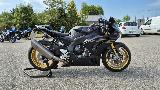
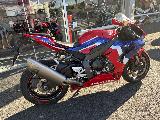
Find this used CBR 1000 RR-R Fireblade on MotoPlanete


Compare the CBR 1000 RR-R Fireblade to its competitors
Compared to its 6 direct competitors, this CBR 1000 RR-R Fireblade offers an appealing positioning, managing to stand out in certain specific areas. It stands out with power output of 217 ch, while also delivering top speed of 300 km/h. Its torque-to-weight ratio of 16.11 kg/Nm limits its punch at low revs.
Acceleration
Fuel consumption
Range
Torque
Power
Power-to-Weight ratio
Torque-to-Weight ratio
Speed
CO² emissions
FAQ Your frequently asked questions about the CBR 1000 RR-R Fireblade 2020
- What is the power of the CBR 1000 RR-R Fireblade?
-
The CBR 1000 RR-R Fireblade 2020 develops a power of 217 ch (214 hp)
- What is the torque of the CBR 1000 RR-R Fireblade?
-
The maximum torque of the CBR 1000 RR-R Fireblade 2020 is 11.60 mkg to 12,500 rpm.
- What is the maximum speed of the CBR 1000 RR-R Fireblade?
-
The CBR 1000 RR-R Fireblade 2020 is capable of reaching a top speed of approximately 300 km/h (186.40 mph) on the track.
- What is the weight of the CBR 1000 RR-R Fireblade?
-
The CBR 1000 RR-R Fireblade 2020 has a a weight when fully loaded of 201 kg (443 lb).
- What is the fuel consumption of the CBR 1000 RR-R Fireblade?
-
Average fuel consumption is estimated at 6.25 l/100km (0.38 mpg) according to the WMTC cycle.
- QWhat is the seat height of the CBR 1000 RR-R Fireblade?
-
To ensure good accessibility, the CBR 1000 RR-R Fireblade 2020 offers a minimum seat height of 830 mm (32.68 in).
- What is the price of the CBR 1000 RR-R Fireblade?
-
The price of the CBR 1000 RR-R Fireblade 2020 is 21,999€ in France
- What size tires should I put on my CBR 1000 RR-R Fireblade?
-
The standard size for a CBR 1000 RR-R Fireblade 2020 is 120 / 70 - 17 for the front, and 200 / 55 - 17 for the rear.
- Where can I find high-quality used CBR 1000 RR-R Fireblades?
-
You can find used CBR 1000 RR-R Fireblade at great prices on MotoPlanete, in the section dedicated to them—models from professionals and private sellers, as well as spare parts.
News
-
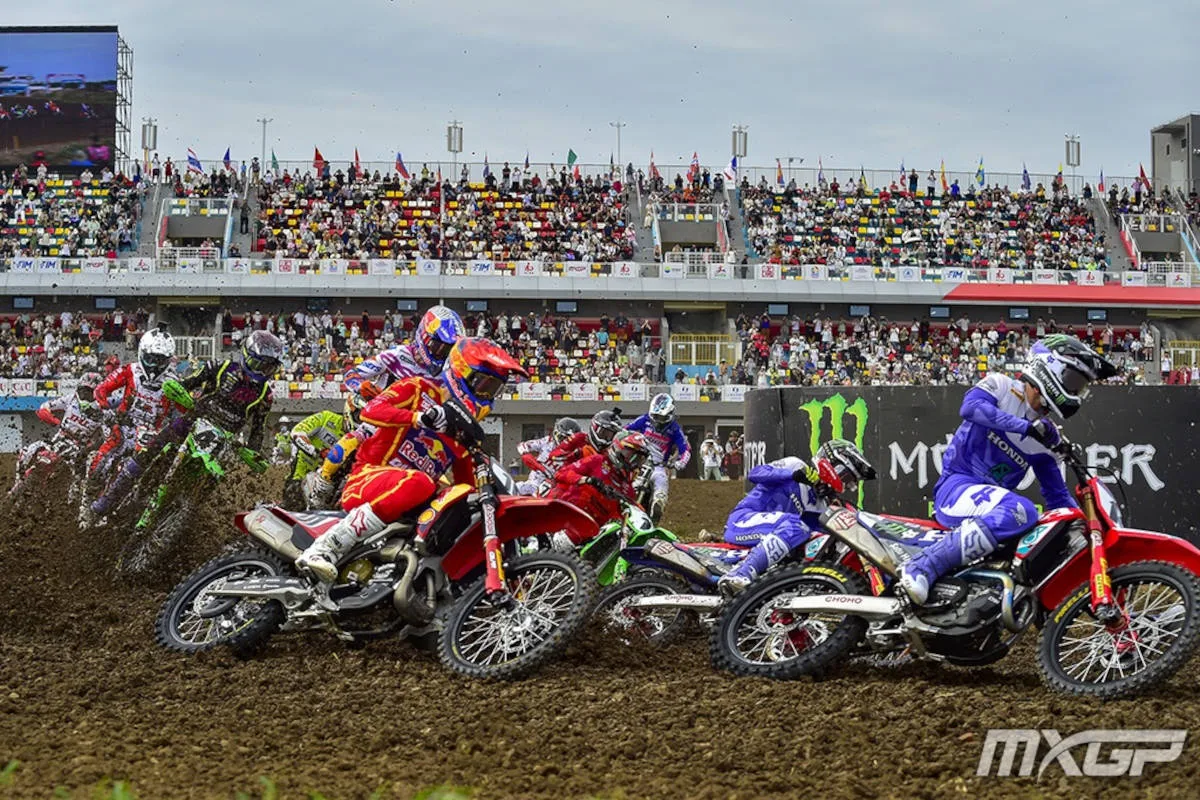
2026 MXGP of China: Herlings Unbeatable, McLellan Delays the MX2 Title
-
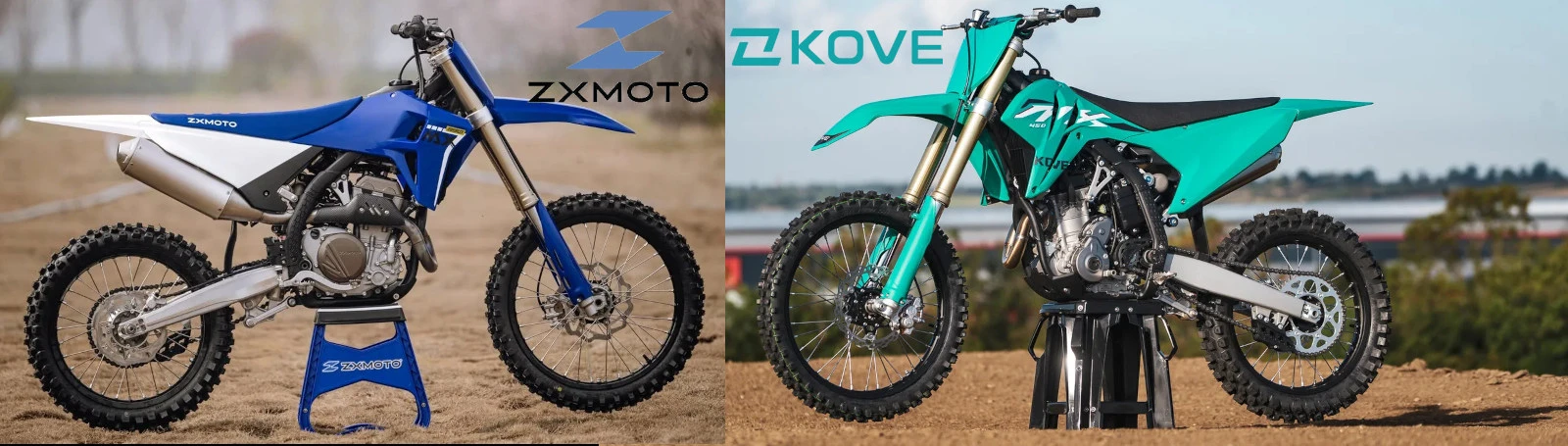
MXGP 2027: Kove and ZXMoto Join the Championship
-
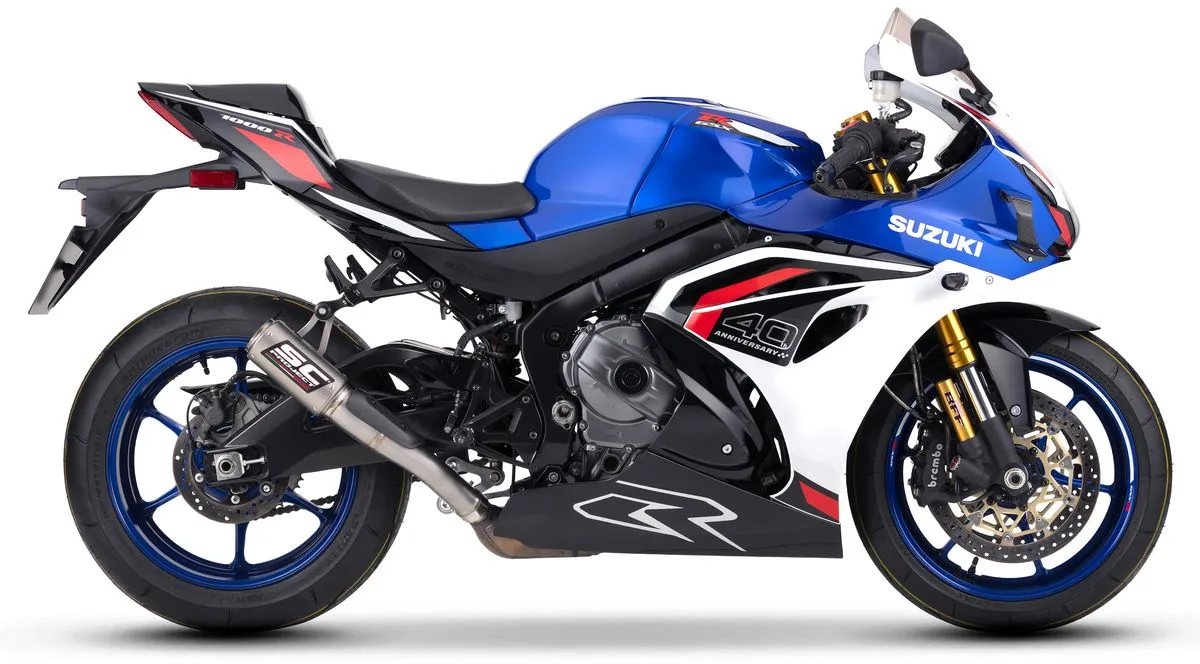
SC Project is working on the 2026 Suzuki GSX-R1000R.
-
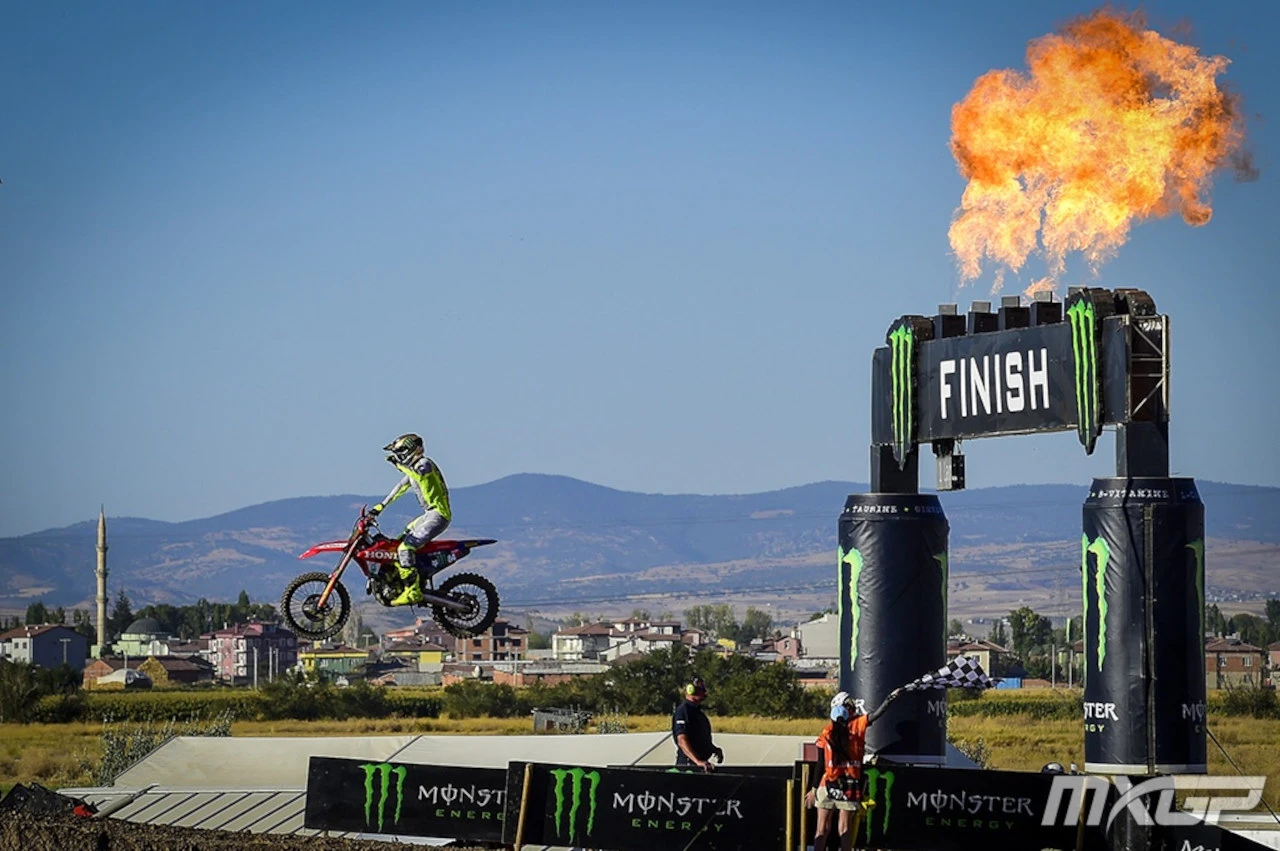
2026 MXGP of Turkey: Herlings Crowned World Champion!
-
Moto Guzzi: In Mandello, the historic factory is taking on a new scale.
-
ZXMoto in MXGP 2027: The Hypothesis of an Off-Road Earthquake
-
Superbike - Will 240 ch sport bikes soon be available at dealerships?
-
2 new SC-Project mufflers for the R 12 NineT and G/S.
-
Seiko unveils a watch inspired by the Honda Motocompo.
-
The new motorcycle models of 2026 and the evolutions.

Bikers' reviews Leave a review - 3 reviews
Unstoppable power, a chassis that responds to the touch of a finger
powerful braking
For me, this is a dream machine
Honda did it
I'm going to sign an order form Rating : 5/5 Respond to Jeep
When I see the elegance of the Panigale V4's muffler now...
The rear end is pure and sharp, revealing the magnificent swingarm. Italian style is inimitable.
Are the Japanese lacking in taste?
On the other hand, 2-pot sausages have their place on "old school" bikes, and I myself prefer my big granny with 2 pots rather than one
Or maybe some nice short, hand-crafted, curved pots with blue GP-style welds. Rating : 4/5 Respond to xjr1300