
Motorcycle specifications Triumph 675 Daytona 2015 England's strike


presentation of the 675 Daytona 2015
A veritable scarecrow for the Japanese in the SuperSport category, the Triumph 675 Daytona is one of those machines appreciated for its (high-level) performance, originality (3 cylinders) and personality. An excellent tracker, even more so in its R version, it could still rest on its laurels, even if the MV-Agusta F3 came to tickle it on its home turf. And given the state of the sports bike market, is the investment in an upgrade worth it?
For Hinckley, the answer is a resounding yes. There's no question of changing just a rear-view mirror or a footrest; the Daytona is evolving in every respect: chassis, engine, styling, everything.
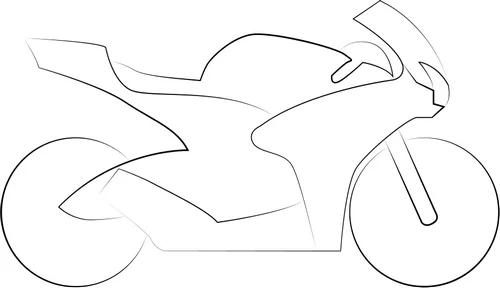
from the muzzle to the buttocks, the bodywork has been completely revised. With its taut lines, prominent edges and tapered rear end, the British car has eaten the knife. Too much, perhaps, as its silhouette leaks a taste of Japanese-ness. As seductive as ever, it is now more impertinent and less mischievous. The eyes have been angled and mirrored, and now end in plastic corners (not the most attractive effect). But the design isn't just there to seduce; it heralds a host of changes, from the engine to the chassis.
as with the majority of its machines, Triumph renews its confidence in the 3-cylinder engine... and introduces a new engine to boost watts and revs. This block is more super-square, with a bore increased from 74 to 76 mm and a stroke reduced from 52.3 to 49.6 mm. The spark plug now stops at 14,400 rpm, for an extra 500 rpm. Valves are now made of titanium, while the cylinder block is separated from the upper crankcase to better withstand power and internal pressures. Two injectors per cylinder, improved fuel intake, optimized airflow and reworked fuel injection reduce fuel consumption, strengthen power curves and gain 3 horsepower. The Dayto now spits out 128 bhp at 12,600 rpm. A small gain in torque allows it to peak at 7.6 mkg. Enough to ride with gusto and growl with conviction against its designated rival, the MV-Agusta F3 675. And to shamelessly provoke the R6 and its siblings. The 3-cylinder knows how to please with its sound and, above all, its availability. Filled and available well before the 4-legs, it doesn't take long to propel the Daytona into the sporting dimension. Especially since the featherweight of this sporty machine makes propulsion work easier, and even more so with this generation, which loses 1.5 kilos.
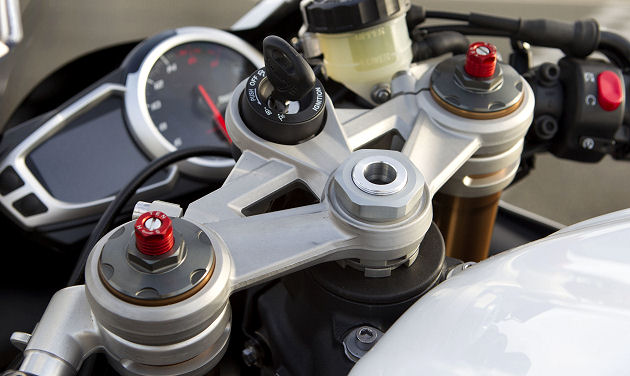
And that's where we came in. After all, the Dayto was already one of the lightest sports bikes on the market. Most of the weight savings were made on the rims, each losing 500g. Hinckley has also taken advantage of the new frame, with 8 sections instead of 11. Let's take this opportunity to review the geometry and make it more agile. The column is retracted by 1°, from 23.9° to 22.9°, and the headroom is reduced from 89.1 to 87.2 mm. The wheelbase has been shortened, and Triumph has adjusted the swingarm pivot. That's right, it's new too, and asymmetrically shaped. This is because space had to be made to accommodate the low-slung exhaust. Ah yes, here's a feature that's sure to make people cough. For many, the under-seat silencer was part of the Daytona 675's identity. Gone are those days. Sacrificed on the altar of efficiency, the exhaust has migrated under the engine. Love it or hate it, but the centralization of mass and agility gain their weight in efficiency.
If you thought the Daytona was as nimble and responsive as a young lady at a sale, get ready for the second markdown, because the pistarde has obviously improved everything that could make it more dynamic.
Suspension is by KYB, recalibrated and fully adjustable, with compression adjustment for high and low speeds. Braking is by Nissin at the front and Brembo at the rear, with 310 mm discs and 4-piston radial calipers. Rarely convincing, the rear brake defends itself with a 220 mm track where only one piston acts. ABS is available as an option; the Daytona's only electronic assistance system, it can be disconnected and features a circuit mode to play with rear-wheel drift. A new clutch with anti-dribble will also help avoid stern jostling. Engine management also gets involved.
Because the 675 Daytona loves the track. It's made for it, and its driving position will quickly make you understand. The seat has been lowered by 10 mm, but that's not going to do much for (relative) comfort. Under the seat, a new aluminum rear buckle refines the aesthetics. An impromptu trip to the track at the last minute? The Dayto has thought of that, and offers you a quick way to remove the plate/rear light assembly.
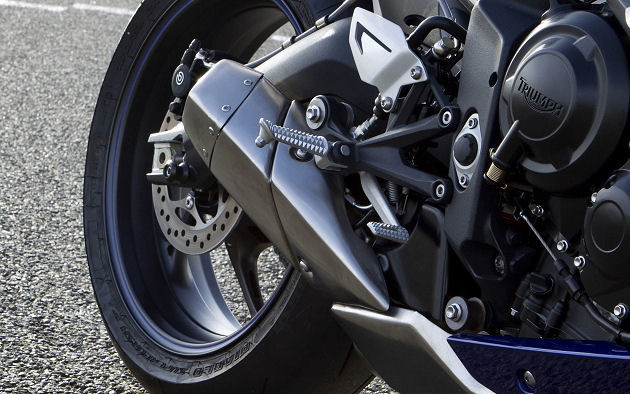
Already a highly accomplished machine, did the Daytona 675 need to evolve? Is it worth the effort in today's market? Triumph doesn't seem to have asked itself these questions. After all, isn't constant evolution the best way to stay ahead of the game? Revised from top to bottom, the 675 Daytona "phase 3" will only leave full-tech enthusiasts hungry for the assistance of traction control or multiple injection mapping. Perhaps for the next generation? In the meantime, the British model has a number of serious assets up its sleeve, including a level of efficiency that would be the envy of many a machine.
M.B - Manufacturer's photos
by Greg

Greg is the founder of Motoplanete—a website created in 2001 to share his passion with his friends and showcase as many motorcycle models as possible to his readers. Self-taught and a jack-of-all-trades, his discovery of the world of motorcycles led him to work as a photographer, rider, team manager, web developer, graphic designer, editorial assistant, and editor-in-chief.
 Share
Share
Key facts Triumph 675 Daytona (2015) : What you need to know before you buy
Highlights
- Even more agile
- Revised engine
- ABS sport
Weak points
- Sluggish market
- japanization' of design
- Confort sportif
Prices
| Basic version | |
|---|---|
 France France |
12,790€
|


Performance
- Max speed : approximately 260 km/h (161.60 mph)
Specifications Triumph 675 Daytona 2015
- Chassis
- Frame : aluminum perimeter
- Fuel capacity : 17.40 liters (4.60 US gallons)
- Seat height : 820 mm (32.28 in)
- Length : 2,045 mm (80.51 in)
- Width : 695 mm (27.36 in)
- Min height : 1,112 mm (43.78 in)
- Wheelbase : 1,375 mm (54.13 in)
- Weight when fully loaded : 184 kg (406 lb)
- Front axle
- Reverse telehydraulic fork Ø 41 mm, Wheel travel : 110 mm (4.33 in)
- Braking 2 Nissin discs Ø 310 mm (12.2 in), 4-piston caliper
- Front tire : 120 / 70 - 17 → Order this type of tire
- Pressure : 2.35 bar
- Transmission
- 6 stage gearbox
- Secondary by chain
- Rear axle
- Monoshock, Wheel travel : 129 mm (5.08 in)
- Braking 1 disc Ø 220 mm (8.66 in), single-piston caliper
- Rear tire : 180 / 55 - 17 → Order this type of tire
- Pressure : 2.5 bar
- Motor
- 3 cylinders online , 4 strokes
- Injection Ø 44 mm
- Cooling system : liquid
- 2 ACT
- 4 valves per cylinder
- 675 cc
- 128 ch (126.20 hp) to 12,600 rpm
- 7.60 mkg to 11,900 rpm
- Power-to-Weight Ratio : approx. 1.34 kg/ch
- Torque-to-Weight Ratio : approx. 22.22 kg/mkg
- Compression : 13.1 : 1
- Standard equipment
- Brake assist : ABS can be disconnected
- Practical information
Essentials


 Motoblouz

 LaBécanerie



Gallery


Models
2016


2015


2014


2013


Used


Compare the 675 Daytona to its competitors
Compared to its 5 direct competitors, this 675 Daytona holds a particularly dominant position, establishing itself as the benchmark across several key criteria. It outperforms the segment by combining torque of 7.6 Nm, power-to-weight ratio of 1.34 kg/ch, and torque-to-weight ratio of 22.22 kg/Nm. Its overall spec sheet reveals no noticeable weak points in this segment.
Acceleration
Fuel consumption
Range
Torque
Power
Power-to-Weight ratio
Torque-to-Weight ratio
Speed
FAQ Your frequently asked questions about the 675 Daytona 2015
- What is the power of the 675 Daytona?
-
The 675 Daytona 2015 develops a power of 128 ch (126.20 hp)
- What is the torque of the 675 Daytona?
-
The maximum torque of the 675 Daytona 2015 is 7.60 mkg to 11,900 rpm.
- What is the maximum speed of the 675 Daytona?
-
The 675 Daytona 2015 is capable of reaching a top speed of approximately 260 km/h (161.60 mph) on the track.
- What is the weight of the 675 Daytona?
-
The 675 Daytona 2015 has a a weight when fully loaded of 184 kg (406 lb).
- QWhat is the seat height of the 675 Daytona?
-
To ensure good accessibility, the 675 Daytona 2015 offers a minimum seat height of 820 mm (32.28 in).
- What is the price of the 675 Daytona?
-
The price of the 675 Daytona 2015 is 12,790€ in France
- What size tires should I put on my 675 Daytona?
-
The standard size for a 675 Daytona 2015 is 120 / 70 - 17 for the front, and 180 / 55 - 17 for the rear.
News
-
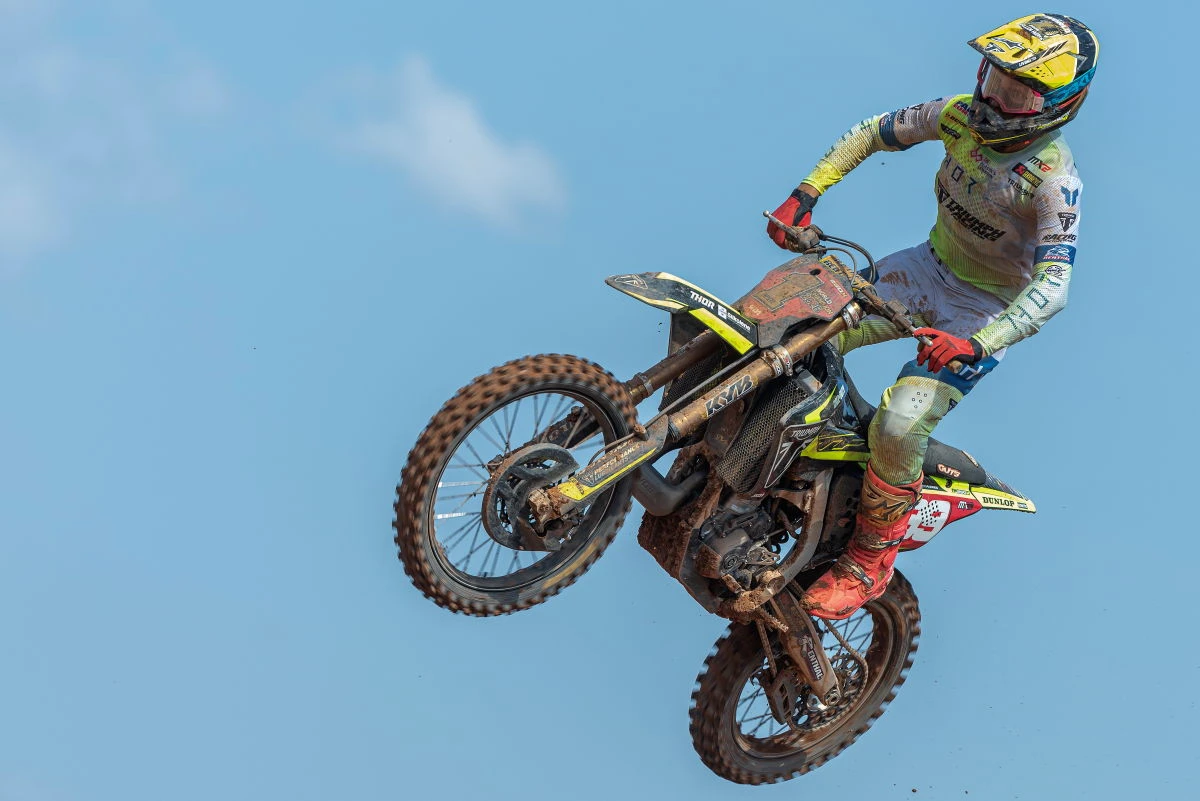
Triumph succeeded BSA in the Motocross World Championship.
-
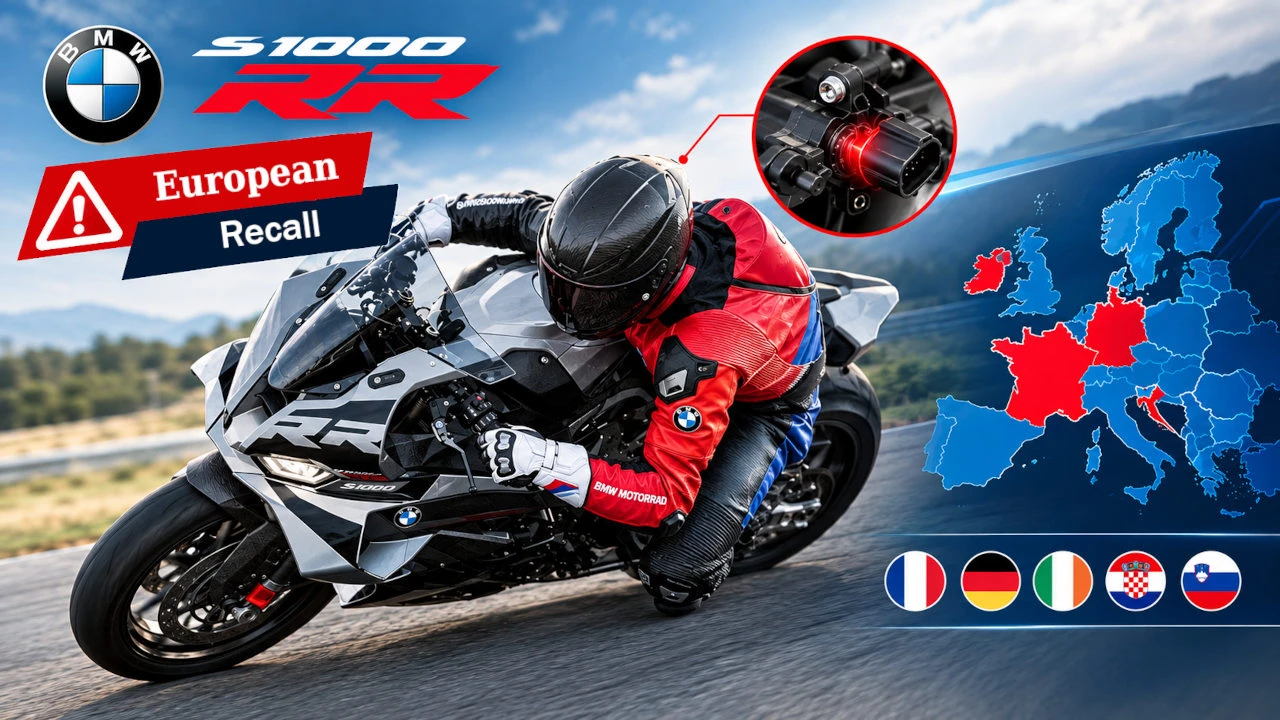
BMW S1000RR Recall Alert: Risk of Engine Shutdown
-
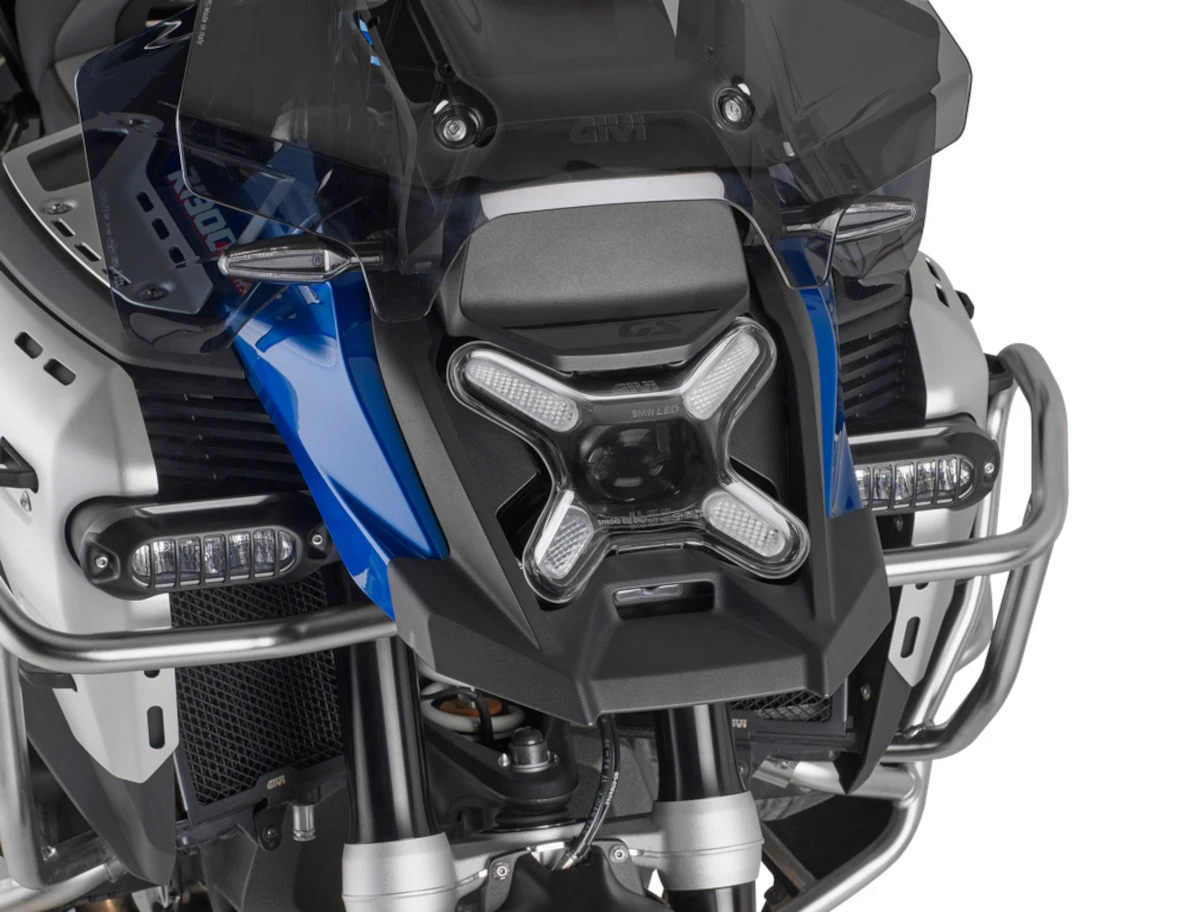
GIVI HLP Headlight Protector: Ténéré 700 and R1300GS
-
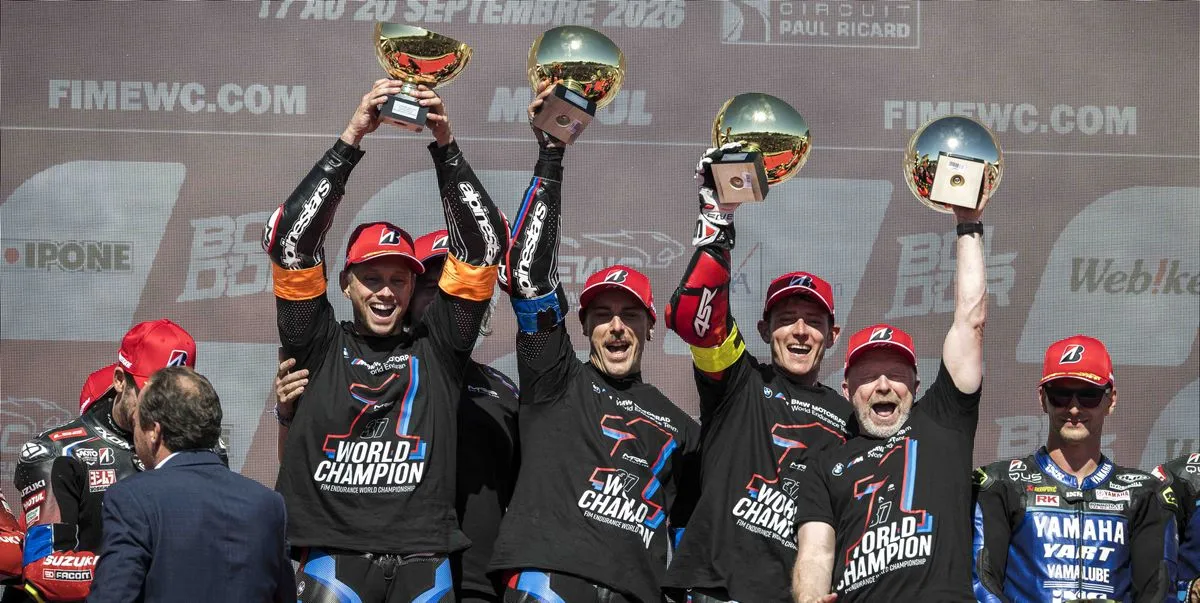
Victory and the championship title for BMW at the 2026 Bol d'Or.
-
The 89th Bol d'Or: A Celebration of Racing Passion.
-
2026 MXGP of China: Herlings Unbeatable, McLellan Delays the MX2 Title
-
MXGP 2027: Kove and ZXMoto Join the Championship
-
SC Project is working on the 2026 Suzuki GSX-R1000R.
-
2026 MXGP of Turkey: Herlings Crowned World Champion!
-
The new motorcycle models of 2026 and the evolutions.

Bikers' reviews Leave a review