
Motorcycle specifications Suzuki GSX 1300 R Hayabusa 2026 A meteor on the road


presentation of the GSX 1300 R Hayabusa 2026
In the different worlds of motorcycling, you'll find many references over the years for trails, sports bikes, GTs, etc.... But there is one motorcycle, one name, an absolute reference for pure speed: HAYABUSA.
A name that slams like a weapon, more menacing and impetuous than its generic designation GSX 1300 R. For 20 years, HAYABUSA has been the delight of hyper-fast big-cylinder enthusiasts and more or less crazy tuners.
The last decade has seen the extinction of these sacred monsters. Gone were the2nd-generation Hayabusa, the VFR 1200, and before that, the CBR 1100 XX... When it was the ZZR 1400 's turn to announce its retirement, its disappearance raised fears that no more interstellar cruisers would set their wheels on the old continent. But fortunately, Suzuki has stepped in to defend a genre that no longer exists. A reminder of a time when speed seemed like a grail.
Hope is reborn with this3rd generation GSX 1300 R Hayabusa. The bird has undergone a facelift, and its moult is a harbinger of provocation and fury. Except that...
You may find it painful or incomprehensible. But you'll have to accept it. The Hayabusa's strength was 197 horsepower in its second life. 13 years after this evolution, the bike announces... 190 horsepower.
For the first time in its existence, and going against the conventions of this kind of bike, the Hayabusa develops less power than before. It's surprising, almost unimaginable, totally disconcerting and almost insulting: the Hayabusa, which has dominated the headlines, fuelled fantasies, smashed the speedometers and crushed the 300 km/h mark, is now toning things down!

To make the cylinders even bigger without increasing the displacement to 1340 cm3, the engine-makers worked on the camshafts, pistons, connecting rods , combustion chambers , exhaust manifold, etc., as well as on the cylinder head,combustion chambers, fuel rails, airboxes, exhaust manifolds and forced-air ducts.
And if we're going to get our hands dirty, we might as well optimize oil circulation, rework the gearbox, install an assisted clutch with anti-dribble, redesign the water and oil radiators, reduce the size of the injection bodies (from 44 to 43 mm), lengthen the intake pipes and modify the throttle. Finally, it becomes Ride-by-Wire.
Maybe it 's still the same block... Suz hasn't doped it up like a white-hot grenade... But the efforts are there, with an obvious quest for more fun. It seems that the Hayabusa wants to reincarnate rather than evolve. The engine is a subtle demonstration of this, while the vision of the bike supports another approach.
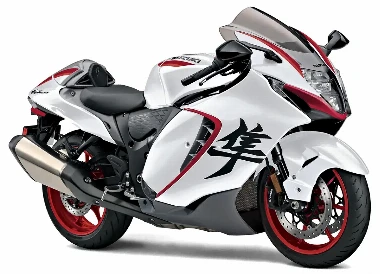
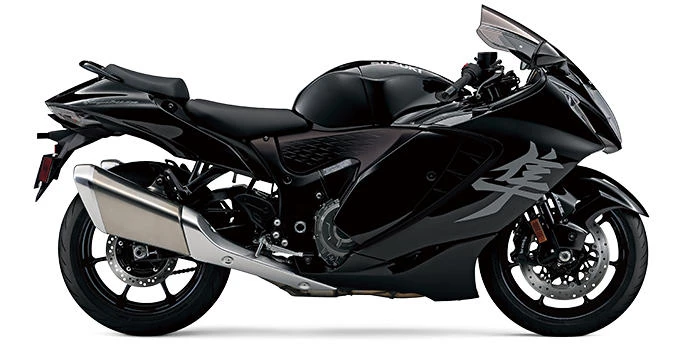
Suzuki's tour de force is to have completely redesigned the machine's bodywork while maintaining its stylistic identity. No part of the costume comes from the old one. However, it's immediately identifiable as a Hayabusa. That massive TGV front end, with its blinkers following the SRAD's inlets, that imposing, almost heavy profile cut for the most penetrating aerodynamics possible, that space-module rear end from a science-fiction film, and above all that impression of being able to keep the wind at bay even when stationary. We've never been able to tell whether the GSX 1300 R was beautiful or difficult - sooner or later, everyone was seized by its silhouette, ranging from fascination to amazement.

Perhaps more anecdotal, but still indicative of a complete redesign, various elements have been more or less operated by the design team. Openwork front mudguard, new 7-spoke rims, side covers under the fuel tank, redesigned 
Long as a boat, the Hayabusa has not given in to the trend for streamlined, lightweight sports bikes. That's one of the main grievances we'll remember. It has never been light, whatever its generation. Not that the engine will suffer from any difficulty in propelling its 264 kilos, far from it. Just two kilos have been shaved off the new model's weight. A rather meagre balance, given that Suzuki has spared no effort on improvements, with weight gained on a series of parts.
Do the mufflers have something to do with it? Yes; although their size is even more demanding despite their almost tapered styling, the exhaust system is 2054 grams lighter - and houses additional catalytic converters.

The biggest GSX R isn't just a ground-to-ground rocket. It has always been considered a formidable tourer too. It takes a further step towards comfort by mounting its half-handlebars on silentblocs and setting them back 12 mm. With a little less weight on the front, the riding position will be a little less tiring. Suz also promises extra manoeuvrability and greater freedom of movement for the rider.
It' s not designed to use the slider. It doesn't fight the same battles as the hypersports that have become more powerful than it. When the wind whistles behind its breath, its serenity is palpable. The chassis has been designed with this in mind, and improved in certain respects. The rear suspension and lightened exhausts change the weight distribution, settling on the perfect 50/50 balance. Suspension is still the same KYB elements, i.e. a 43 mm upside-down fork and monoshock. The internal parts of the fork tubes have been modified for better absorption. The shock absorber has also been redesigned for greater comfort and stability. Both are fully adjustable.
Suzuki could have taken advantage of this renaissance to introduce pilot-controlled suspensions. The Hayabusa and its on-road capabilities would be an excellent recipient for this type of technology. Not so. The Hamamatsu brand still refuses to equip its models with this technology, unlike most other manufacturers.
No variations are reported for the frame. This is one heck of a piece of aluminum, built in the great tradition of big sportbikes with its double-spar perimeter layout. No mention of the reinforced swingarm either.
The brakes are not as durable. Mass (M) x velocity (C) equals a huge amount of energy (E) that will have to be evacuated sooner or later. Quite a job for the Stylema supplied by Brembo. These 4-piston monobloc jaws are at the top of the Italian brand's range. The associated discs are 10 mm larger, reaching a diameter of 320 mm.

When the Japanese falcon first came out, its only electronics was fuel injection. ABS wasn't even worth thinking about - we had to wait until 2013 to get it. Then came a choice of 3 injection maps with S-DMS. Suffice it to say that in today's high-tech, silicon-pierced world, Granny Busa was totally out of touch with electronic assistants. Some might say "so what?
The gap has now been bridged with a major overhaul. It's a big slice of the pie, backed up by a novelty that's unheard of alongside the multiple layers of assistances:

- An IMU inertial unit optimizes power assist responsiveness.
- An active Up&Down shifter with two settings. One racing-style, the other softer. Can be deactivated.
-a 10-step traction control system to limit rear-wheel spin, which can be deactivated.
- Anti-wheeling, also with 10 levels, can be deactivated.
- Anti-stoppie, to prevent the rear wheel from catching on your back and keep the bike level.
- 3-stage Launch Control, to optimize standing starts. The engine speed limit is 4,000 rpm in Mode 1, 6,000 rpm in Mode 2 and 8,000 rpm in Mode 3.
- Engine braking control, also in 3 levels. This prevents dribbling or lurching of the rear wheel during heavy downshifts.
- A speed limiter. Mind you, not a Pit Lane Limiter, which operates within a certain speed range for pit stops. This is for setting a speed limit on the road, just like in a car.
- To complete the package, there's also a cruise control. Active between 31 and 200 km/h. This corresponds roughly to the Hayabusa's idling and cruising speeds.
- The Driving Modes are called S-DMS Alpha. There are 3 factory-preset (A - B - C) and 3 pilot-preferred (U1 - U2 - U3).
mode A (Active) sets Power Mode to 1, Traction Control to the lowest level of intervention, same for anti-wheeling, no engine brake control and shifter in mode 1.
mode B (Basic) is more homogeneous, with Power Mode on 2, Traction Control and anti-wheeling at mid-sensitivity (5), no engine braking control and shifter on 1.
for Mode C (Comfort), everything is set to maximum prevention. Power Mode at its coolest (3), ultra-sensitive traction control and anti-wheeling (10), still no engine brake control and the shifter in mode 2.
- Combined braking system: lever action activates front and rear calipers.
- Reactive ABS for cornering, adapting braking pressure to the angle of the bike.
- Hill-start assist, with rear brake activated for 30 sec.
- Emergency Stop Signal, a kind of warning system that engages when the brakes are applied hard and suddenly
-and Suzuki's classic Easy Start System, which allows you to start the machine by simply pressing the start button. The electronic system holds the starter until it clicks.
-then there 's the Low RPM Assist. It gives a little more throttle at the start or during slow changes to avoid stalling.
Are you done? Just about. Don't forget that all the lighting is now LED, right down to the cockpit indicator. I'll save the instrument panel for last. The Hayabusa has always had this cluttered instrument panel, as corpulent as the bike itself. In this age of digital technology, is it really a challenge to keep needles, gauges, large dials and apples?
In its defense, the style of the instrumentation remains faithful to its origins. The whole has been refined and embellished, and for nostalgics like me, it's a pleasure to see the little stems rushing to the right.
Suzuk' couldn't pass up a little surprise. Especially since the plethora of electronics means you have to display a lot of stuff. Between the rev counter and the tachometer, a small TFT screen makes its entrance. On contact, it pays homage to the Kanji Hayabusa, then displays assist settings and a host of other information. Angle measurement, brake pressure , acceleration rate, clock, gear engaged, fuel consumption, voltmeter, speed, range, temperature... There's too much.
Let there be no mistake. It's not just a new GSX 1300 R, but a major overhaul. The engine and chassis have been improved, but they're not new. In the pot, the manufacturer has mixed the drivetrain, the frame and the suspensions, and then half-cooked the ingredients to bring them up to date. Don't let it cool, add the big sauce to liven things up and serve it up at hurricane speed.

M.B - Manufacturer's photos
by Greg

Greg is the founder of Motoplanete—a website created in 2001 to share his passion with his friends and showcase as many motorcycle models as possible to his readers. Self-taught and a jack-of-all-trades, his discovery of the world of motorcycles led him to work as a photographer, rider, team manager, web developer, graphic designer, editorial assistant, and editor-in-chief.
 Share
Share
Key facts Suzuki GSX 1300 R Hayabusa (2026) : What you need to know before you buy
Highlights
- The return of a cult motorcycle
- Big electronic update
- True to the spirit
Weak points
- Less power than before
- Marché moribond
- No pilot-controlled suspension
Prices
| Basic version | |
|---|---|
 France France |
19,599€
|

Performance
- Max speed : 295 km/h (183.30 mph) on the odometer
- 0-100 km/h acceleration : 3.20 s
- Average fuel consumption : 6.70 liters/100km (0.35 mpg)
-
Estimated range
: 299 km (186 miles)
Calculated range until tank is empty, not verified.
History

Specifications Suzuki GSX 1300 R Hayabusa 2026
- Chassis
- Two-seater saddle
- Frame : perimeter with double aluminum stringers
- Fuel capacity : 20 liters (5.28 US gallons)
- Seat height : 800 mm (31.50 in)
- Length : 2,180 mm (85.83 in)
- Width : 735 mm (28.94 in)
- Min height : 1,165 mm (45.87 in)
-
Min. ground clearance : 125 mm (4.92 in)
- Wheelbase : 1,480 mm (58.27 in)
- Weight when fully loaded : 264 kg (582 lb)
- Front axle
- Reverse telehydraulic fork Ø 43 mm
- Angle de chasse : 23 °
- Preload, compression and rebound adjustment
- Braking 2 Brembo discs Ø 320 mm (12.6 in), radial mounting, 4-piston caliper
- Front tire (Tubeless) : 120 / 70 - 17 → Order this type of tire
- Pressure : 2.9 bar
- Transmission
- 6 stage gearbox , manual - shifter as standard
- Secondary by chain
- Rear axle
- Mono-damper
- Preload, compression and rebound adjustment
- Braking 1 Nissin disc
- Rear tire (Tubeless) : 190 / 50 - 17 → Order this type of tire
- Pressure : 2.9 bar
- Motor
- 4 cylinders online , 4 strokes
- Injection Ø 43 mm
- Cooling system : liquid
- 2 ACT
- 4 valves per cylinder
- 1,340 cc
- 190 ch (187.40 hp) to 9,700 rpm
- 15.30 mkg (150 Nm) to 7,000 rpm
- Power-to-Weight Ratio : approx. 1.32 kg/ch
- Torque-to-Weight Ratio : approx. 16.14 kg/mkg
- Compression : 12.5 : 1
- Starting system : electric
- CO² emissions: 157 g/km
- Anti-pollution standard : Euro 5+
- Standard equipment
- Brake assist : ABS
- Number of riding modes : 6
- ABS Cornering
- Aluminium rims
- Shifter
- Steering damper
- Gear indicator
- Cruise control
- Combined braking
- Start assist
- Hill Hold Control
- Launch Control
- Park assist
- Traction control
- Anti-wheeling control
- Engine-brake control
- Practical information
- Country of manufacture : Japan
Essentials
 Motoblouz
 LaBécanerie


Gallery


Models
2027
2026


2025


2024


2023


2022


2021


Used
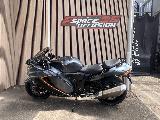
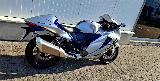
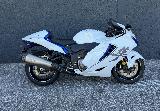
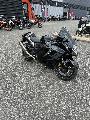
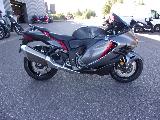
Find this used GSX 1300 R Hayabusa on MotoPlanete


Compare the GSX 1300 R Hayabusa to its competitors
Compared to its direct competitor, this GSX 1300 R Hayabusa offers an appealing positioning, managing to stand out in certain specific areas. It stands out with torque of 15.3 Nm, while also delivering torque-to-weight ratio of 16.14 kg/Nm. Its CO² emissions are the highest of the group, at 157 g/km.
Acceleration
Fuel consumption
Range
Torque
Power
Power-to-Weight ratio
Torque-to-Weight ratio
Speed
CO² emissions
FAQ Your frequently asked questions about the GSX 1300 R Hayabusa 2026
- What is the power of the GSX 1300 R Hayabusa?
-
The GSX 1300 R Hayabusa 2026 develops a power of 190 ch (187.40 hp)
- What is the torque of the GSX 1300 R Hayabusa?
-
The maximum torque of the GSX 1300 R Hayabusa 2026 is 15.30 mkg (150 Nm) to 7,000 rpm.
- What is the maximum speed of the GSX 1300 R Hayabusa?
-
The GSX 1300 R Hayabusa 2026 is capable of reaching a top speed of 295 km/h (183.30 mph) on the odometer on the track.
- What is the weight of the GSX 1300 R Hayabusa?
-
The GSX 1300 R Hayabusa 2026 has a a weight when fully loaded of 264 kg (582 lb).
- What is the fuel consumption of the GSX 1300 R Hayabusa?
-
Average fuel consumption is estimated at 6.70 l/100km (0.35 mpg) according to the WMTC cycle.
- QWhat is the seat height of the GSX 1300 R Hayabusa?
-
To ensure good accessibility, the GSX 1300 R Hayabusa 2026 offers a minimum seat height of 800 mm (31.50 in).
- What is the price of the GSX 1300 R Hayabusa?
-
The price of the GSX 1300 R Hayabusa 2026 is 19,599€ in France
- What size tires should I put on my GSX 1300 R Hayabusa?
-
The standard size for a GSX 1300 R Hayabusa 2026 is 120 / 70 - 17 for the front, and 190 / 50 - 17 for the rear.
- What colors are available for the GSX 1300 R Hayabusa?
-
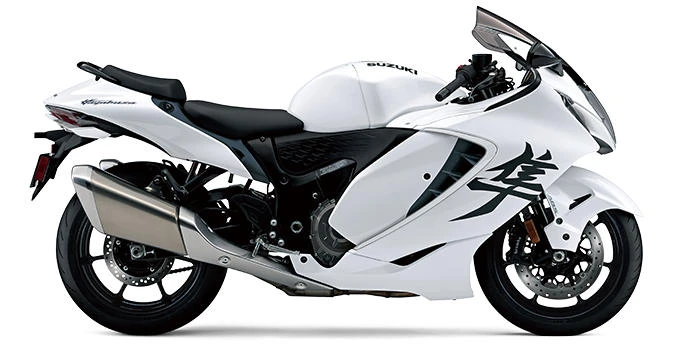
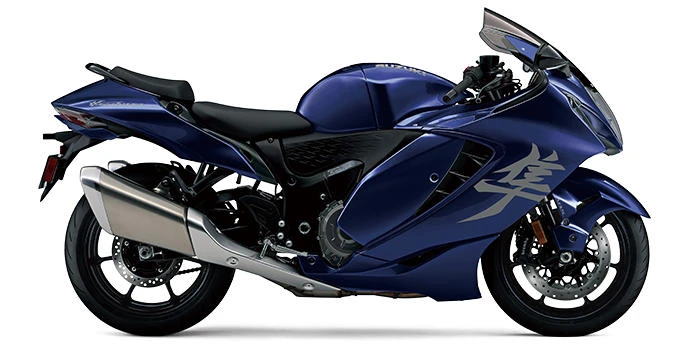
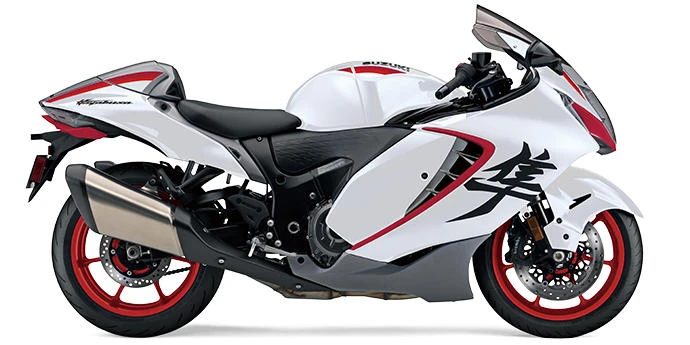
For the 2026 model year, the GSX 1300 R Hayabusa is available in several colors: grey, black, blue and white.
- Where can I find high-quality used GSX 1300 R Hayabusas?
-
You can find used GSX 1300 R Hayabusa at great prices on MotoPlanete, in the section dedicated to them—models from professionals and private sellers, as well as spare parts.
News
-
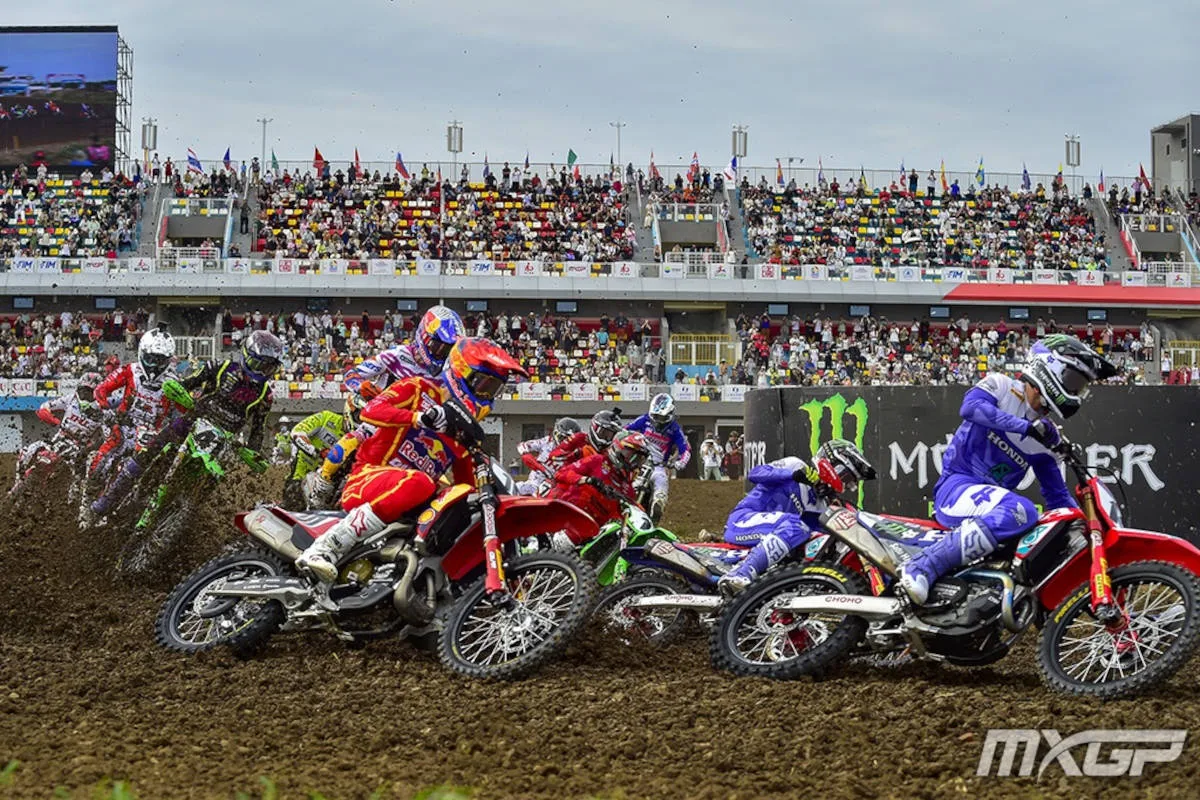
2026 MXGP of China: Herlings Unbeatable, McLellan Delays the MX2 Title
-
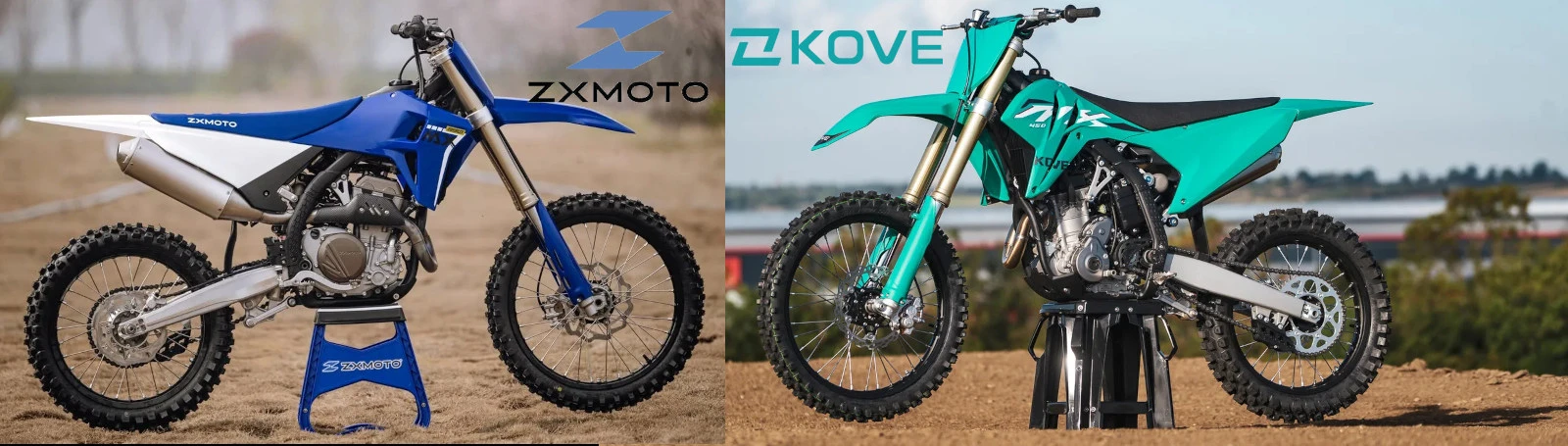
MXGP 2027: Kove and ZXMoto Join the Championship
-
SC Project is working on the 2026 Suzuki GSX-R1000R.
-
2026 MXGP of Turkey: Herlings Crowned World Champion!
-
Moto Guzzi: In Mandello, the historic factory is taking on a new scale.
-
ZXMoto in MXGP 2027: The Hypothesis of an Off-Road Earthquake
-
Superbike - Will 240 ch sport bikes soon be available at dealerships?
-
2 new SC-Project mufflers for the R 12 NineT and G/S.
-
Seiko unveils a watch inspired by the Honda Motocompo.
-
The new motorcycle models of 2026 and the evolutions.

Bikers' reviews Leave a review - 30 reviews
The English team at Bennets have clearly demonstrated this. This is thanks to a cleverly reworked power curve. The mid-range is more present, making acceleration more homogeneous across the board. Perhaps less demonstrative than the 2nd generation, but more effective. (I know the Gen2 well and I have a Gen3). Rating : 5/5 Respond to Steve
The gen3 is a real improvement on the previous versions: handling, the bike feels lighter (which is not the case), precision and stability in curves have been improved, braking is very effective and smooth, the power curve and torque have been improved, and the comfort of the shocks and posture has increased. Of course, it will never be a hyper sport bike, but that's not its vocation. Personally, I don't drive on the track H24. I don't have the wallet to buy a hyper-sport bike, nor do I have the money for expensive maintenance on fragile and expensive mechanics. The robustness and reliability of the mechanics make it an "economical" bike to buy and maintain. No motorcycle today offers such performance for less than 20K€. With very quiet torque steerage, you're looking at less than 5l/100km, and the bike is secure and very comfortable on all rough roads. Conclusion: I'd rather have a very good evolution than a bad revolution. Rating : 5/5 Respond to Rick73
QUEL BONHEUR DE ROULER SUR CETTE MACHINE .JE VOUS SOUHAITE DE POUVOIR ESSAYER CETTE MOTO VOUS COMPRENDREZ !!!! Rating : 5/5 Respond to alainquarantesix
The pots may not be pretty, but they're useful: a motorist dazzled by the sun ran a stop sign and hit me, but the pot took it all and I didn't even fall over - thanks to the big, ugly pots. Rating : 5/5 Respond to Didou
2 eme chose, les pots d' exhaust ok pour les normes pas de son mais, ils auraient pu donner un plus beau look, même les akra sont moche, je trouve trop fin on dirait des créquilles
I saw the nvl Suzuki B-King 2021 what a look and the rear wheel! They should have done the same! Rating : 5/5 Respond to hayabusa
This Hayabusa 2021 is the 7th in my possession. I had the 2 previous generations. What a disappointment! Powerful engine but too linear for my taste, shifter doesn't work properly, unbearable hill starting aid (doesn't release when the brake is released),
the mufflers are horrible, and what's more, Suzuki hasn't delivered the accessories I ordered 4 months ago, notably the seat cover
The only point of improvement is the braking, which is excellent
This Hayabusa no longer has the "rebellious" side of the old versions, and that's a shame
David. Rating : 5/5 Respond to David
Jack Rating : 5/5 Respond to Jack
First laps around the wheel, a more responsive bike with a lot more torque than before, the chassis is great, you can't feel the weight
For the moment, the bike is being run in, so no more than 5500 revs, or even 8000 up to 1000km, as requested by the Olby moto dealership, who are very serious and whom I recommend. I'll be back once the run-in is over to go into more detail. Rating : 5/5 Respond to Nono
After that, I love the look, the electronics are useful in winter (Traction Control) and they've kept the needles on the dashboard, I hear (I love it!)... So, why not?
But the Buza's bonus over the ZZR 1400 (which I've had for years) was the insane torque at 4000rpm!!!! Now, the torque has dropped, but moreover it's at 7000 rpm!!????? What???? You just don't get it... It's almost a waste, isn't it? Rating : 3/5 Respond to Looky
I've had 2, but as I've gotten older, I've lightened my bikes, so the Gsxr 1000 is the current choice Rating : 5/5 Respond to Aragon