
Motorcycle specifications Suzuki RM-Z 250 2017 Run incisif
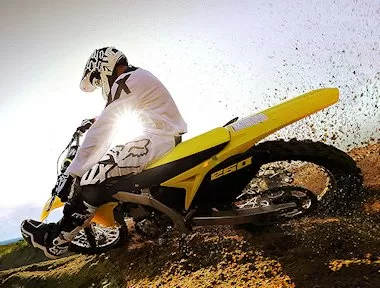

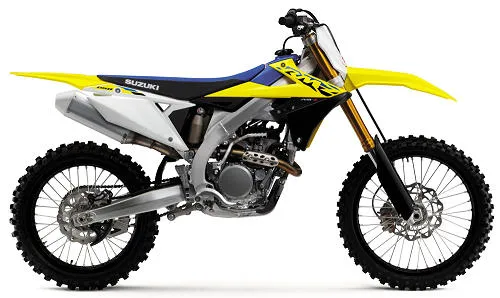
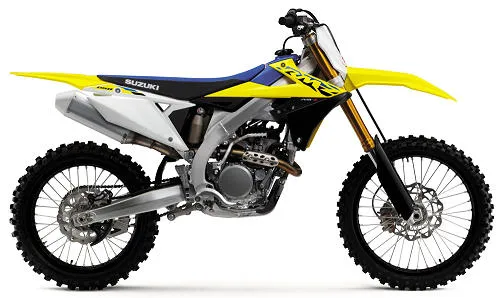
presentation of the RM-Z 250 2017
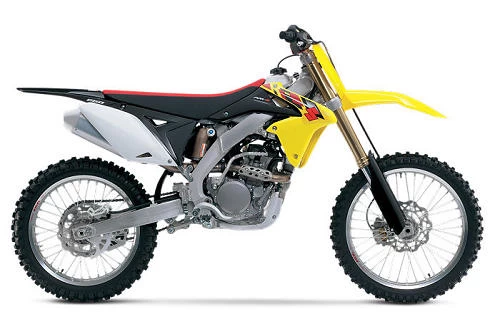
In order to maintain a high level of performance, the Suzuki RM-Z 250 builds on its 2016 evolution, while maintaining the good overall balance derived from the previous model. 2017 brings only a few cosmetic touches, wearing black on the rims, fork crown and deco points. Let's see how this model motivated itself last year:
engineering goals for the 2016 / 17 model:
/ Improved performance straight from the factory racing machines:
- Improved Suzuki Holeshot Assist Control (S-HAC).
- KYB PSF2 fork.
/ Engine performance:
- Wider rev range for power delivery.
- Reduced engine braking.
- Improved starting.
- Increased durability and reliability.
/ Driving performance:
- Increased cornering performance.
- Improved handling.
- Reduced overall weight.
- Improved feeling of absorption
suzuki Holeshot Assist Control (S-HAC)
suzuki Holeshot Assist Control (S-HAC) is a handlebar-selectable assisted start system derived directly from factory machines. S-HAC makes it easier for riders to start from the grid to encourage holeshots. Introduced in 2014 on the RM-Z 450, this system is now standard on the RM-Z 250, more sophisticated, more efficient.
suzuki Holeshot Assist Control (S-HAC) features:
1. Ignition mapping change for a quick start. (only during system operation)
2. Selectable in 2 modes depending on terrain conditions.
3. 3-stage start control for a more precise launch.
Since 2016, the S-HAC has analyzed the 3 stages of start-up, as Japanese engineers have broken down the start-up sequence into 3 phases.
The moments of start, gate crossing and acceleration are all different, requiring different engine characteristics for a better start. This leads to different settings for each phase.
- The S-HAC is selectable in 2 modes, so that the driver can adapt to the starting conditions.
- Mode A: for hard surfaces or slippery conditions on the starting grid. In operation, Holeshot Assist Control intervenes on ignition timing during the starting phase and when crossing the grid to reduce wheel slip and offer a moderate launch. It then brings the ignition forward during the acceleration phase to increase speed. 3 conditions can reset the ignition in normal mode: a time of 6 seconds after the start; shifting into 4th gear; or closing the gas pedal (the most frequent case).
- B mode: for grid conditions offering good grip and the need for an aggressive launch. In these conditions, the S-HAC advances the ignition timing to enable greater throttle response and acceleration on the straight. But the level of ignition advance is optimized for each of the 3 phases. The system returns to normal ignition under the same conditions as mode A.
- The system can be deactivated when starting assistance is not required.
- Mode selection: hold the S-HAC button for more than 0.7 seconds, until the LED flashes slowly. Release the button to engage mode A.
- To select mode B: hold the button for more than 1.8 seconds, until the LED flashes rapidly. Release the button to engage B mode.
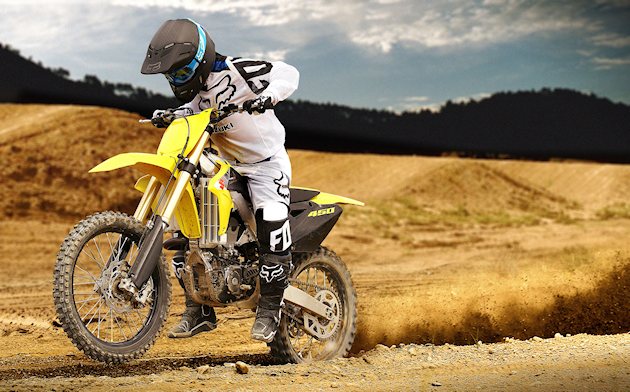
enhanced engine performance
to enhance engine performance, over 80 internal parts have been redesigned for the 2016 / 2017 model year. 10 main axes have guided this work:
1. Piston, piston pin and rings
- The piston now benefits from a shot-blasted surface treatment for greater durability. The shape and material of the piston remain unchanged.
- The piston pin has a DLC (Diamond Like Carbon) surface treatment, to reduce friction and improve durability.
- The rings now have an L-shaped cross-section. Sealing is improved and gas leakage reduced.
- These changes contribute to increased durability and power range.
2. Reduced crankshaft inertia and increased rotor inertia
- The weight of the crankshaft has been reduced (diameter reduced by 0.5mm) to reduce friction caused by oil vapours.
- The rotor weight is increased to compensate for the reduced crankshaft weight.
3. New intake camshafts and valves
- Intake and exhaust camshafts are modified for a wider range of engine performance.
- Intake valves are redesigned to increase compression ratio and intake efficiency. The compression ratio is increased from 13.5:1 to 13.75:1.
- These changes contribute to a wider powerband and smoother power delivery.
4. New decompression system
5. New kick pinion, idler pinion and breather pinion
6. New timing chain tensioner
7. New crankcases
8. Throttle opening angle increased from 0.6 degrees to 1.1 degrees.
9. New clutch cover, with added oil level window for easier maintenance.
10.aMA sound regulation (US specifications only)
- Internal silencer parts changed to comply with AMA sound
aMA sound control.
- The manifold is lengthened by 40mm to increase power at low and mid-range speeds.
with these engine changes, mid-range power and torque are optimized while maintaining maximum power. Power delivery is smoother and more linear for easy control.
chassis objective
1. Increase performance.
2. Maintain handling.
3. Reduce weight.
4. Improve absorption feel.
- Redesigned steering column. (same length as RM-Z 450)
- The inside of the pivot beams has a ribbed structure.
- Redesigned lower frame connection.
- Chassis weight is reduced by 2.5% compared to the previous model.
- All these changes optimize chassis rigidity while reducing weight, contributing to improved cornering performance.
the 2016 RM-Z 250 is equipped with PSF2, the latest version of KYB's pneumatic fork.
benefits of the PSF2 system
- Adjustment:
with a spring, the rider may need to change it to a softer or harder one depending on his weight or level. With the new PSF2 fork, the rider no longer has to buy additional springs. The rider can change the preload with an air pump to find the right setting. In addition to preload adjustment, rebound is now adjustable in two ways, in slow and fast speed.
- Lighter weight
the spring - the heaviest part of the fork's damping system - has been eliminated. The PSF2 is 1 kg lighter than the previous SFF.
- Increased damping performance.
thanks to a springless design, the fork body has been enlarged, providing better damping and more stable performance over time.
- Low friction
Without the spring, friction is reduced. Lubrication is constant.
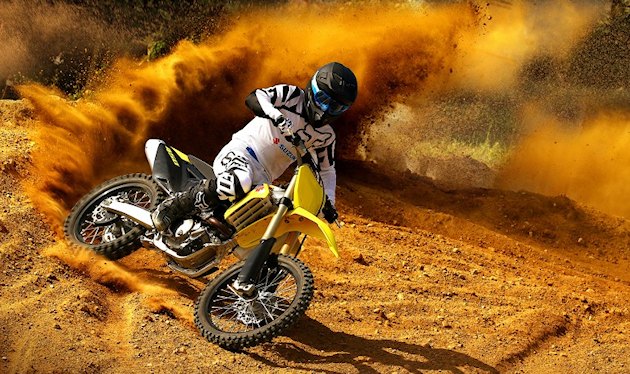
The new KYB shock absorber incorporates an adjustment system for easy access to settings. Slow and fast rebound and compression are adjustable on the shock absorber. In line with the suspension change, the shape of the suspension link spacer has been modified for improved feel.
redesigned front brake caliper for reduced weight; the new caliper is 10% lighter than the previous one.
new Dunlop tires
- The original Dunlop MX51 tires have been replaced by MX52s.
- The MX52 series has been designed with CTCS (Carcass Tension Control System) technology to optimize tire rigidity.
- For the rear tire, softer compounds have been used for the sidewalls to achieve a more absorbent feel.
renthal Fatbar aluminum handlebars. It's stronger and more vibration-absorbing.
the Excel aluminum rims have been specially designed to withstand all types of use.be resistant to all types of use, whether Supercross, Motocross or off-road in general.
two plugs are supplied for fine-tuning the injection settings according to terrain conditions. One enriches while the other depletes injection compared to the standard plug. The "richer" plug is better suited to muddy, sandy terrain, while the "poorer" plug is better suited to small, dry, hard terrain. So you can modify your machine's engine character to best suit your riding conditions, simply by plugging it in.
Information and images credits: Suzuki
by Greg

Greg is the founder of Motoplanete—a website created in 2001 to share his passion with his friends and showcase as many motorcycle models as possible to his readers. Self-taught and a jack-of-all-trades, his discovery of the world of motorcycles led him to work as a photographer, rider, team manager, web developer, graphic designer, editorial assistant, and editor-in-chief.
 Share
Share
Key facts Suzuki RM-Z 250 (2017) : What you need to know before you buy
 France
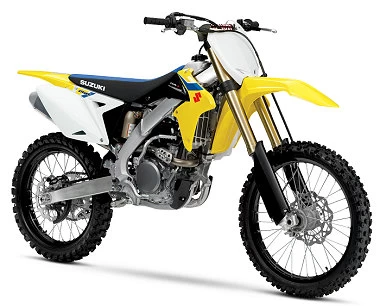
Specifications Suzuki RM-Z 250 2017
- Chassis
- Frame : aluminum perimeter
- Fuel capacity : 6.50 liters (1.72 US gallons)
- Seat height : 955 mm (37.60 in)
- Length : 2,170 mm (85.43 in)
- Width : 830 mm (32.68 in)
- Min height : 1,270 mm (50 in)
- Wheelbase : 1,475 mm (58.07 in)
- Weight when fully loaded : 106 kg (234 lb)
- Front axle
- Reverse telehydraulic fork Ø 48 mm
- Braking 1 disc, 2-piston caliper
- Front tire : 80 / 100 - 21 → Order this type of tire
- Transmission
- 5 stage gearbox
- Secondary by chain
- Rear axle
- Mono-damper
- Braking 1 disc, single-piston caliper
- Rear tire : 110 / 90 - 19 → Order this type of tire
- Motor
- single-cylinder , 4 strokes
- Injection
- Cooling system : liquid
- 2 ACT
- 4 valves
- 249 cc
- ≈ 38 ch (37.50 hp)
- Power-to-Weight Ratio : approx. 2.64 kg/ch
- Compression : 13.75 : 1
- Practical information
Essentials
 Motoblouz
 LaBécanerie


Gallery


Models
2025
2024
2023
2022
2021
2020
2019

2018
2017
2016
2015

2014
2013
Used
Competitors


Compare the RM-Z 250 to its competitors
Compared to its 4 direct competitors, this RM-Z 250 offers a fairly balanced positioning, sitting right in the middle of the category. On the spec sheet, it highlights power output of 38 ch and power-to-weight ratio of 2.64 kg/ch. Its power-to-weight ratio of 2.64 kg/ch betrays a bit of extra heft on the scales.
Torque
Power
Power-to-Weight ratio
Torque-to-Weight ratio
FAQ Your frequently asked questions about the RM-Z 250 2017
- What is the power of the RM-Z 250?
-
The RM-Z 250 2017 develops a power of 38 ch (37.50 hp)
- What is the weight of the RM-Z 250?
-
The RM-Z 250 2017 has a a weight when fully loaded of 106 kg (234 lb).
- QWhat is the seat height of the RM-Z 250?
-
To ensure good accessibility, the RM-Z 250 2017 offers a minimum seat height of 955 mm (37.60 in).
- What is the price of the RM-Z 250?
-
The price of the RM-Z 250 2017 is 8,299€ in France
- What size tires should I put on my RM-Z 250?
-
The standard size for a RM-Z 250 2017 is 80 / 100 - 21 for the front, and 110 / 90 - 19 for the rear.
News
-
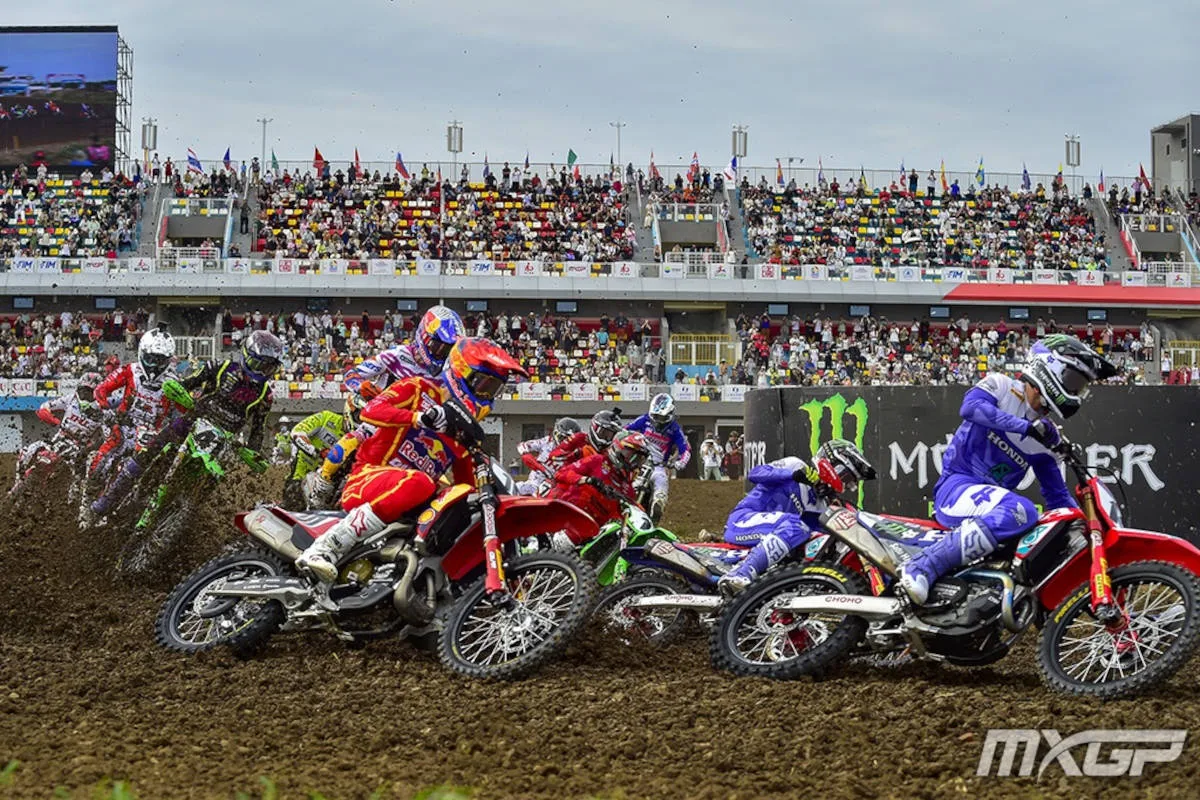
2026 MXGP of China: Herlings Unbeatable, McLellan Delays the MX2 Title
-
MXGP 2027: Kove and ZXMoto Join the Championship
-
SC Project is working on the 2026 Suzuki GSX-R1000R.
-
2026 MXGP of Turkey: Herlings Crowned World Champion!
-
Moto Guzzi: In Mandello, the historic factory is taking on a new scale.
-
ZXMoto in MXGP 2027: The Hypothesis of an Off-Road Earthquake
-
Superbike - Will 240 ch sport bikes soon be available at dealerships?
-
2 new SC-Project mufflers for the R 12 NineT and G/S.
-
Seiko unveils a watch inspired by the Honda Motocompo.
-
The new motorcycle models of 2026 and the evolutions.

Bikers' reviews Leave a review - 3 reviews
Barely a lap and I can't take it anymore
The bike has only 30h!!!!
I've tried to adjust it as soon as possible
What to do? Hell me!
Sportively Rating : 2/5 Respond to Kyfran